
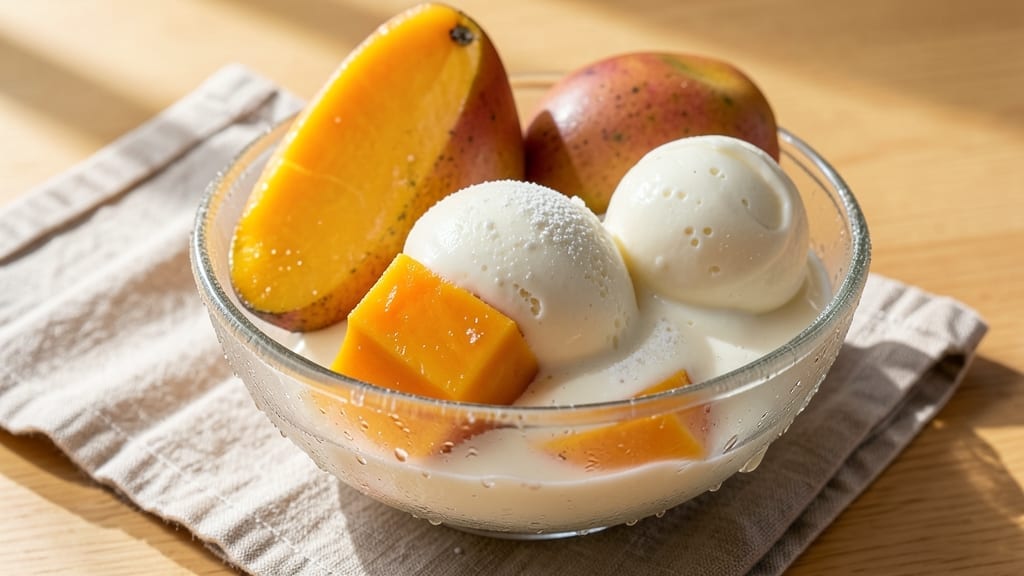
This 3-ingredient mango ice cream recipe transforms ripe mangoes into velvety, dairy-free perfection with just coconut milk and agar-agar—no ice cream maker required. The secret lies in blending fresh mango puree with full-fat coconut milk, then setting it with agar-agar for a creamy texture that rivals traditional ice cream.
I developed this after craving something light, refreshing, and completely plant-based that still delivered on that classic ice cream experience.
The beauty of this recipe is its simplicity: no added sugars, no artificial flavors, just the natural sweetness of ripe mangoes and the richness of coconut milk. Agar-agar, a plant-based thickener, creates that signature creamy consistency without the need for churning.
The process is straightforward—blend, freeze, and scoop—but the result is restaurant-quality dessert that feels indulgent yet guilt-free.
What you’ll end up with is a vibrant, tropical ice cream with a smooth, almost custard-like texture and bursts of mango flavor in every bite. The color alone is stunning—bright orange with flecks of mango pulp—making it as visually appealing as it is delicious.
Perfect for summer gatherings, post-dinner treats, or satisfying that sweet tooth without the heavy cream.
For an extra touch, garnish with toasted coconut flakes or fresh mint leaves before serving. This recipe scales effortlessly, so you can make a small batch for two or a large one for a crowd.
The best part? It’s ready in just 30 minutes of prep time, with 4 hours of freezing—minimal effort for maximum flavor. Let’s make this creamy delight!
Ingredients for 3 ingredient mango ice cream
Three ingredients. Zero guilt. Tropical flavor explosion in every bite.
| Ingredient | Amount | Notes |
|---|---|---|
| Ripe Mangoes 🥭 | 3 whole | Pitted, peeled, and frozen for 1 hour |
| Full-Fat Coconut Milk 🥥 | 1 can | 13.5 oz can, well-shaken |
| Agar-Agar Powder 🌿 | ½ tsp | Or 1 tsp agar flakes |
Mangoes are the star here—ripe ones (the kind that give slightly when squeezed) pack the most flavor. Trader Joe’s or local markets usually have the sweetest varieties. Freezing them first makes blending a breeze—just toss the peeled, pitted fruit on a tray for an hour before blending. The coconut milk? Full-fat only—it’s what gives that creamy, indulgent texture. Skip the light version, trust me. Agar-agar is the magic ingredient—it’s plant-based, sets beautifully, and doesn’t leave that chalky aftertaste like gelatin.
No ripe mangoes? Frozen mango chunks work perfectly—just thaw them first. Coconut milk shortage? Cashew cream (blend soaked cashews with water) is a great swap, though the flavor will be slightly different. Agar-agar hard to find? Kappa carrageenan can work in a pinch, but reduce to 1/4 tsp—it’s way more potent. The blend should be smooth, but if you get any pulp, don’t stress—it’ll just add texture to your ice cream. Garnish with toasted coconut flakes or fresh mint if you’re feeling fancy.
This keeps beautifully—1 week in the freezer if stored airtight. For best texture, let it sit at room temperature for 5 minutes before scooping. Portion into small containers for easy grab-and-go treats. The flavor actually improves after 24 hours as the mango sweetness melds with the coconut richness. Double the batch if you’re feeding a crowd—it disappears fast.
Why You’ll Love This Recipe
- Here’s what sold me: I can use up overripe mangoes that’d otherwise go bad, and the coconut milk stretches further than store-bought ice cream. Plus, it keeps for weeks in the freezer—so I make a big batch, freeze it, and grab a scoop whenever cravings hit. Smart, simple, and satisfying.
- No Blender Needed: I’ll be real—this recipe beats my old blender-based attempts every time. The agar-agar transforms blended mango and coconut milk into silky perfection without freezing or churning. Just blend, simmer, pour, and chill. That’s it.
- Tropical in a Bowl: The combo of ripe mango’s natural sweetness and full-fat coconut milk’s richness? Chef’s kiss. The agar-agar gives it that perfect creamy texture—no ice crystals, no gummy mess—just pure, velvety mango flavor that tastes like a vacation.
- Party-Ready in Minutes: Between us, this is my go-to for last-minute gatherings. It sets in the freezer while you handle everything else, and no one will guess it’s just three ingredients. Serve it in cups for kids, scoop it into bowls for adults—it’s the crowd-pleaser I always reach for.
Step-by-step instructions for 3-Ingredient mango ice cream
Here’s how to transform ripe mangoes into creamy, dreamy ice cream with just three ingredients.
Freeze the Mangoes for Texture
Cut the 3 whole ripe mangoes in half, remove the pits, and peel away the skin using a small knife or spoon. Slice the flesh into chunks and spread them evenly on a parchment-lined baking sheet. Place the tray in the freezer for 1 hour—this ensures the mangoes stay firm when blended and prevents a soupy texture.
I like to arrange the chunks in a single layer so they freeze quickly and uniformly. The goal is to have frozen mango pieces that can be easily pulverized in the food processor, not icy cubes that resist blending. After freezing, transfer the mango chunks to an airtight container and keep them frozen until ready to use—they’ll stay frozen for up to 2 weeks.
Blend the Frozen Mango into a Smooth Purée
In a food processor, combine the frozen mango chunks and pulse them for 30 seconds until they break down into small pieces. Then add the 1 can full-fat coconut milk (well-shaken) and continue blending for 1-2 minutes until completely smooth and free of any graininess.
The key here is patience—don’t rush the blending process. You’re looking for a texture similar to thick pudding, not a chunky sorbet. If the mixture seems too thick, let it sit at room temperature for 5 minutes to soften slightly before proceeding. This step is where the magic happens—the coconut milk’s richness combines with the mango’s natural sweetness to create a velvety base.
Cook the Mixture to Set the Texture
Transfer the mango purée to a medium saucepan and place it over medium heat. Stir in the 0.5 teaspoon agar-agar powder and bring the mixture to a gentle boil, whisking constantly to prevent lumps from forming. Once boiling, reduce the heat to low and let it simmer for 3-5 minutes, stirring frequently, until it thickens noticeably and coats the back of a spoon.
The agar-agar acts as a natural thickener and stabilizer, giving your ice cream that perfect creamy consistency without the need for added sugars or dairy. You’ll know it’s ready when the mixture holds its shape when you spoon a small amount onto a plate and it doesn’t immediately run back into the pan. Let the mixture cool completely to room temperature before proceeding—this step is crucial for achieving the best texture in your final product.
Chill and Freeze for Creamy Perfection
Pour the cooled mango mixture into a shallow, freezer-safe container with a lid. Smooth the top with a spatula to remove any bubbles, then cover and refrigerate for 1 hour to chill completely. This pre-chilling step helps the mixture freeze more evenly and prevents ice crystals from forming.
After chilling, transfer the container to the freezer and freeze for 6-8 hours, or until completely solid. For best results, I like to use a loaf pan or rectangular container—this makes it easier to scoop neat portions later. When it’s fully frozen, remove it from the freezer 10 minutes before serving to soften slightly, making it easier to scoop without losing its shape. The finished ice cream should have a creamy, almost custard-like texture with vibrant mango flavor and no icy chunks.
Serve and Enjoy Your Homemade Creation
Use a spoon or ice cream scoop to serve the mango ice cream directly from the container. The texture should be smooth and creamy, with a vibrant orange color that reflects the fresh mango flavor. For an extra touch, garnish with a sprinkle of toasted coconut flakes or a few fresh mango slices on top.
This ice cream keeps well in the freezer for up to 2 weeks, though I find it’s best enjoyed within the first few days when the flavors are at their peak. The natural sweetness of the mango shines through, making this a refreshing treat that’s perfect for hot days or as a special dessert. The absence of added sugars means you can enjoy it guilt-free while still satisfying your sweet tooth.
Pro Tips For Making 3 Ingredient Mango Ice Cream
- Blend Until Silky: Pulse your mango chunks first, then blend with coconut milk—this prevents grainy texture. I learned this the hard way after making a batch that tasted like mango sorbet instead of creamy ice cream.
- Strain the Mango: Run the blended mix through a fine-mesh sieve to remove fibers—trust me, it’s worth the extra 30 seconds. My first batch had tiny stringy bits that ruined the smoothness.
- Boil Agar-Agar Fast: Heat the coconut milk to a rolling boil before adding agar-agar, then whisk in the powder immediately. Stirring too long after adding it turns the mix gluey instead of setting properly.
- Chill Before Freezing: Let the mixture cool to room temperature first—about 20 minutes—then refrigerate for 1 hour. Skipping this makes the agar-agar set unevenly, leading to icy patches instead of a clean scoop.
Regional styles of 3 ingredient mango ice cream
Tropical Thai Twist
In Thailand, they take mango desserts to the next level by infusing them with aromatic spices. For a Thai-inspired version, blend in 1 teaspoon of pandan extract or 2 tablespoons of fresh pandan juice with the mango purée before cooking.
Add ½ teaspoon of palm sugar (or regular brown sugar) and a pinch of salt> to enhance the tropical flavors. Serve with toasted mung bean noodles> for a fun, crunchy texture that’s popular in street-side desserts. 🌿
Mexican Mango-Chile
For a spicy-sweet kick, stir ½ teaspoon of chili powder> and ¼ teaspoon of ground cinnamon> into the cooked mango mixture before freezing. Top with diced jalapeño> and a sprinkle of tajín> (chili-lime seasoning) when serving.
This version is a crowd-pleaser at summer cookouts and pairs perfectly with horchata> or Mexican hot chocolate>. The heat balances the sweetness beautifully. 🌶️
Japanese Mochi-Style
Transform your ice cream into a Japanese-inspired treat by blending in ¼ cup of mochi powder> (or 2 tablespoons of sweet red bean paste>) with the mango purée. After freezing, slice the ice cream into cubes and roll them in kinako (roasted soybean flour)> for a nutty, earthy finish.
Serve in small paper cones or on skewers for a fun, handheld dessert. This version is inspired by daifuku> mochi but with a tropical twist. ✨
Caribbean Rum Infusion
For a boozy, tropical treat, stir 1 tablespoon of dark rum> (like Appleton Estate>) into the warm mango mixture before chilling. Garnish with toasted coconut flakes> and a sprinkle of nutmeg> for a dessert that feels like a vacation in every bite.
This version is perfect for celebrating special occasions or enjoying with a glass of piña colada>. Just be sure to serve it to adults—rum adds a subtle warmth that pairs wonderfully with the mango’s sweetness. 🍹
Indian Mango Lassi
Give your ice cream a creamy, yogurt-like texture by blending in ½ cup of plain coconut yogurt> (or regular yogurt if not vegan) with the mango purée. Add ½ teaspoon of cardamom powder> and a pinch of saffron> for an Indian-inspired twist.
Serve in small bowls with a drizzle of rose syrup> or kheer (rice pudding)> on the side. This version is inspired by mango lassi>, a popular Indian dessert that’s both refreshing and indulgent. 🌺
Nutrition facts
Frequently asked questions
Can I make this recipe without agar-agar?
Yes! If you don’t have agar-agar, try 1 teaspoon of kappa carrageenan (reduce to 1/4 tsp—it’s stronger) or 2 tablespoons of chia seeds soaked in 3 tbsp water for 10 minutes before blending. For a dairy-free alternative, 1/2 cup coconut cream (chilled overnight) can add richness, though the texture will be softer. The key is ensuring your thickener works with plant-based ingredients.
Why did my mango ice cream turn icy?
Icy texture usually means air got trapped during freezing. To fix it next time, press plastic wrap directly on the surface before freezing, or use a loaf pan for even freezing. Also, avoid opening the container while freezing—temperature fluctuations create ice crystals. For existing icy ice cream, blend it briefly with 1 tbsp coconut milk to restore creaminess.
How do I know when the mangoes are ripe?
Look for mangoes that yield slightly when gently pressed near the stem. The skin should be smooth and vibrant (not dry or dull). For best flavor, choose Ataulfo or Tommy Atkins varieties—they’re naturally sweeter. If using frozen mangoes, thaw them first and drain excess liquid before blending. Ripe mangoes are the secret to naturally sweet, flavorful ice cream without added sugars!
Can I make this with other tropical fruits?
Try pineapple, papaya, or guava—just adjust the sweetness. For pineapple, add 1 tsp vanilla extract to balance acidity. Mango’s natural sweetness works perfectly with coconut milk, but guava may need 1/2 tsp maple syrup. The agar-agar method works for any pureed fruit—just ensure it’s fully ripe for best texture.
How do I serve this for a crowd?
Double the recipe and freeze in pint-sized containers for easy portioning. For a restaurant-style presentation, serve in waffle cones or small bowls with toppings like toasted coconut, lime zest, or crushed macadamia nuts. Keep extra containers at room temperature for 10 minutes before serving to prevent freezer burn. This makes a stunning dessert table centerpiece!

- 3lb Prime Rib Roast Recipe: Juicy Pink Center Guaranteed in 3 Hours - October 31, 2026
- 5 Spice Cake Recipe: Warmly Spiced Layers With Crunchy Top - October 31, 2026
- 1950’s Macaroni and Cheese Recipe: Nostalgic Creamy Cheese Sauce with Buttery Noodles - October 31, 2026