
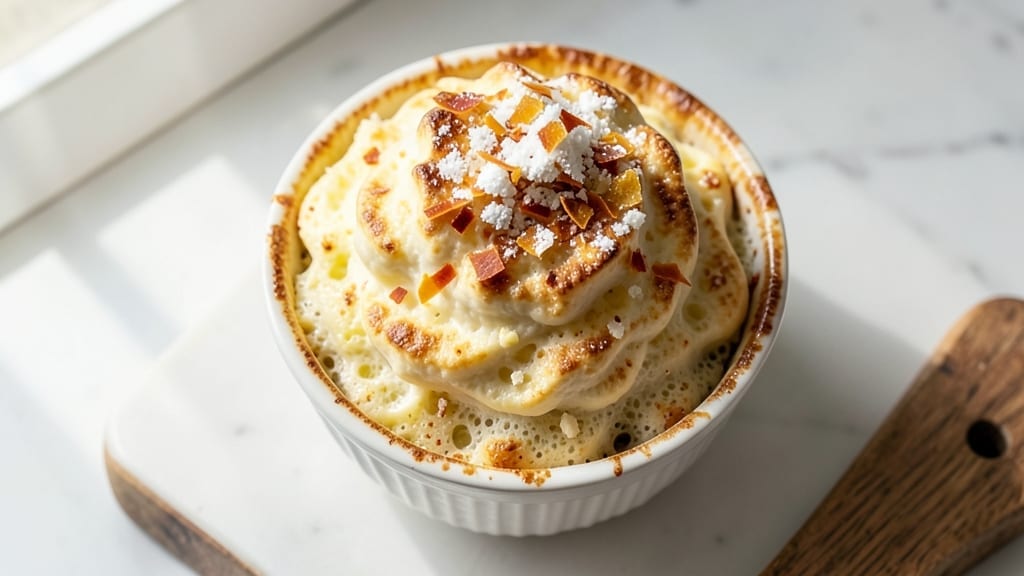
A 4-cheese egg souffle transforms simple eggs into a restaurant-worthy dish with light-as-air texture and gooey, melty centers that scream indulgence. The secret lies in precise technique—whisking egg whites to stiff peaks while folding in four distinct cheeses (Gruyère, sharp cheddar, Gouda, and Parmesan) for depth without heaviness.
I’ve perfected this recipe after years of trial and error, ensuring every souffle rises effortlessly and holds its shape until the last bite.
What makes this souffle special is the balanced cheese combination: Gruyère adds nutty richness, cheddar brings sharpness, Gouda contributes creaminess, and Parmesan delivers umami punch. The key to success?
A preheated oven at 350°F and a water bath to prevent cracking—no more sad, flat soufflés. Even beginners can master this with the right steps, and the result is a dish that feels luxurious without requiring advanced skills.
Imagine serving golden, cloud-like soufflés with melty cheese centers that ooze slightly when cut—each bite is a perfect harmony of texture and flavor. The aroma alone will have guests gathering at the table, and the visual appeal makes it ideal for brunch or dinner parties.
This recipe delivers restaurant-quality results in under an hour, with minimal active time.
For extra flair, garnish with fresh chives or a sprinkle of smoked paprika, but the real star is the cheese. The secret to keeping the soufflés light?
Folding the cheese gently into the egg mixture after the whites reach stiff peaks—any disruption risks deflating that precious airiness. Let’s create something truly special.
Ingredients for 4 cheese egg souffle
Eight essential ingredients transform ordinary eggs into restaurant-worthy soufflés with perfect airy texture and melty cheese centers.
| Ingredient | Amount | Notes |
|---|---|---|
| Large Eggs 🥚 | 8 whole | Room temperature for best volume |
| Gruyère Cheese 🧀 | ¾ cup | Freshly grated, aged 12+ months |
| Sharp White Cheddar Cheese 🧀 | ½ cup | Shredded, not pre-shredded |
| Aged Gouda Cheese 🧀 | ½ cup | Medium-aged, freshly grated |
| Parmesan Cheese 🧀 | ½ cup | Finely grated, Parmigiano-Reggiano |
| Unsalted Butter 🧈 | 2 tbsp | Melted for ramekins |
| Granulated Sugar 🍚 | 2 tbsp | Superfine preferred for dissolving |
| Kosher Salt 🧂 | ½ tsp | Diamond Crystal preferred |
| Fresh Chives 🌿 | 2 tbsp | Finely chopped for garnish |
| Smoked Paprika 🌶️ | ¼ tsp | For garnish, optional |
| Water 💧 | ½ cup | For water bath |
The cheese selection is non-negotiable for this recipe. Gruyère from Whole Foods or specialty cheese shops delivers that nutty depth, while sharp white cheddar should have visible crystals—Cabot or Wedge brands excel. For Gouda, seek aged 12-18 months from Dutch imports, and Parmesan must be Parmigiano-Reggiano—none of that pre-grated sawdust. I always buy cheese in blocks and grate it myself using a microplane for maximum surface area. The fresher the cheese, the better it melts without clumping. Store all cheeses wrapped in parchment paper inside zip-top bags to maintain moisture and flavor for up to 3 weeks.
No Gruyère? Comté or Emmental work in a pinch, though the flavor profile shifts. Pre-shredded cheese contains anti-caking agents that prevent proper melting—always grate your own. For the sugar, turbinado or powdered sugar can substitute, though superfine dissolves most cleanly. The smoked paprika is optional but adds that restaurant-quality finish. If you’re short on time, pre-grate all cheeses and store them in the fridge until ready to use. The eggs must be room temperature—cold eggs won’t whip properly. For a vegan version, replace the cheeses with nutritional yeast and vegan cheese blends, though texture will differ significantly.
Soufflés require immediate service—these must go straight from oven to table. Once baked, they’ll hold for about 10 minutes before deflating. For make-ahead prep, assemble the ramekins with butter and sugar up to 24 hours ahead and refrigerate. The egg whites should be whipped just before folding—they lose volume if left sitting. Leftover cheese can be stored in an airtight container for up to 1 week, while unused egg whites can be frozen for 3 months in a sealed container. Garnishes like chives and paprika should be added immediately before serving to preserve their vibrant colors.
Why You’ll Love This Recipe
- No Whisk Arm Fatigue: I swear by this one—just separate eggs, fold in grated cheeses, and pop it in the oven. No standing over a bowl for 10 minutes like some soufflés demand. The Gruyère melts into a silky blanket, and the sharp cheddar adds that je ne sais quoi without extra effort.
- Cheese Overload (In a Good Way): Between the nutty Gouda, the tangy cheddar, and that umami punch from Parmesan, every bite feels like a little flavor party. Honestly, I’ve made this for brunch, lunch, or even a fancy dinner—it’s that good. The texture? Light as air with a golden crust that cracks just enough to show off the gooey center.
- Weeknight Dinner to Brunch Hero: This isn’t just a side—it’s a full meal. Serve it with a simple salad for lunch, or pair it with roasted veggies for dinner. My kids even ask for it on school nights (yes, even on a Tuesday night). It reheats beautifully too, so it’s my secret weapon for busy mornings.
- Cheaper Than Takeout: A batch of this costs me about $8 for six servings—way less than ordering in. The cheeses stretch far, and eggs are always a budget win. Plus, leftovers? They disappear faster than I can say “second helping.” I’ll be real: it’s the kind of dish that makes me feel like I’m feeding a crowd without breaking the bank.
Step-by-step instructions for 4 cheese egg soufflé
Mastering this technique transforms simple eggs into airy, golden towers with molten cheese centers.
Separate Eggs and Prepare the Cheese Mixture
Begin by separating the 8 whole large eggs, placing yolks in one bowl and whites in a second, chilled bowl. I use a fine-mesh sieve for perfect separation—discard any stray yolks in the whites. This precision prevents deflation later.
In a separate bowl, combine the 0.75 cup Gruyère cheese, 0.5 cup sharp white cheddar cheese, 0.5 cup aged Gouda cheese, and 0.5 cup Parmesan cheese. Use a microplane for the Parmesan to achieve an ultra-fine texture that melts seamlessly. Add the 2 tbsp granulated sugar and 0.5 tsp kosher salt, then fold everything together with a rubber spatula until uniformly blended. The sugar helps stabilize the egg whites while balancing the cheese’s saltiness.
Whip Egg Whites to Stiff Peaks
Return to the chilled bowl of egg whites and whip them to stiff peaks using a stand mixer fitted with the whisk attachment. Start on low speed and gradually increase to high, whipping for 5-7 minutes until the whites hold their shape when the whisk is lifted. The bowl should feel cool to the touch—overheating causes collapse.
While whipping, I like to add the egg whites in three stages: first half, then a short rest, then the remaining whites. This gradual incorporation maintains volume. Reserve 1 tbsp of the stiff peaks for later use—they’ll help stabilize the soufflé when folding in the cheese mixture.
Fold in Yolks and Cheese Mixture
In a separate bowl, gently whisk the 8 egg yolks until they’re pale and slightly thickened. This step ensures they blend smoothly without deflating the whites. Add the cheese mixture and fold together with a spatula until fully combined. The goal is a smooth, velvety paste that won’t disrupt the whites’ structure.
Now, carefully fold the yolk-cheese mixture into the reserved stiff egg whites using a spoon-and-fold technique. Start by cutting through the center of the whites, then gently folding the bottom up and over. Repeat 8-10 times until just combined—stop when no streaks remain. The batter should be thick and glossy, holding its shape when lifted. Overmixing here is the most common mistake—it releases air and causes collapse.
Fill Ramekins and Prepare Water Bath
Preheat your oven to 350°F. Lightly grease four 4-ounce ramekins with the 2 tbsp melted unsalted butter, then dust with a pinch of flour or cheese to prevent sticking. Divide the soufflé batter evenly among the ramekins, filling each ¾ full. Tap the ramekins gently on the counter to release any air bubbles.
Place the filled ramekins in a deep baking dish and pour 0.5 cup water into the bottom. The water creates a steam bath that cooks the soufflés evenly without drying them out. The water should come midway up the sides of the ramekins—never submerge them completely. Bake for 15-18 minutes until the soufflés are golden brown and spring back when gently pressed.
Serve Immediately for Maximum Height
Remove the soufflés from the oven and serve immediately—they’ll begin deflating as they cool. I like to garnish each with a sprinkle of finely chopped fresh chives and a pinch of smoked paprika for color and depth. The centers should be creamy and molten, with a crisp exterior that contrasts beautifully with the airy interior.
For best results, serve straight from the ramekins. The soufflés will settle slightly as they cool, but their height and texture are at their peak when piping hot. If you must hold them, tent loosely with foil to preserve heat and structure. Each bite should deliver that perfect balance of light, airy egg and rich, melting cheese—the hallmark of a successful soufflé.
Pro Tips For Making 4 Cheese Egg Souffle
- Prep Cheese Like a Pro: Grate your Gruyère and aged Gouda yourself—store-bought pre-shredded cheese has anti-caking agents that make soufflés gummy. Use a fine grater (not a food processor) and pulse the sharp cheddar in short bursts to avoid turning it into cheese dust, which weakens structure.
- Whisk Eggs Until They’re Hot: Heat your egg whites and yolks separately in a double boiler until they reach 160°F (71°C)—this makes them whip faster and hold volume better. I learned this the hard way when my soufflés collapsed like sad pancakes because the eggs were too cold.
- Don’t Overfill the Molds: Fill your ramekins only halfway—soufflés need room to rise, and overpacking guarantees a dense, sad center. Tap the molds gently on the counter to settle the batter before baking, then smooth the tops with a wet finger for that restaurant-worthy finish.
- Bake Low and Slow: Preheat your oven to 325°F (163°C), not 350°F—high heat causes the outside to set before the inside is done, leading to cracks. Bake for 12 minutes, then open the oven door for 30 seconds to let steam escape before serving; this keeps the texture light, not rubbery.
Best sauces and condiments for 4 cheese egg souffle
Classic Hollandaise Sauce
This rich, buttery sauce is the perfect complement to your 4-cheese souffle, adding a luxurious finish that balances the dish’s airy texture.
I use a classic French hollandaise made with 2 egg yolks, 1 tbsp lemon juice, and ½ cup unsalted butter, melted and whisked together over a double boiler until thick and glossy.
The acidity from the lemon cuts through the richness of the cheese, while the butter adds a velvety smoothness that enhances every bite. 🍳
Creamy Gruyère Sauce
For a deeper cheese flavor, try a Gruyère-based sauce that mirrors the primary cheese in your souffle. Melt ½ cup Gruyère with 1 tbsp heavy cream and 1 tsp Dijon mustard over low heat, stirring until smooth.
Finish with a splash of white wine (about 1 tbsp) to deglaze the pan and add brightness. Drizzle this over the souffle just before serving to intensify the nutty, melty cheese experience.
Herbed White Wine Reduction
Elevate your souffle with a white wine reduction that adds acidity and complexity. Simmer ½ cup dry white wine (like Sauvignon Blanc) with 1 tbsp shallots, 1 sprig thyme, and 1 bay leaf until reduced by half.
Strain out the herbs, then whisk in 1 tbsp cold butter for a silky finish. The wine’s crispness contrasts beautifully with the creamy cheese, making each bite feel sophisticated.
Spicy Honey Drizzle
For a sweet-spicy kick, prepare a honey-chili drizzle by combining 2 tbsp honey with ½ tsp chili powder and 1 tsp apple cider vinegar. Warm the mixture gently until the honey melts, then drizzle over the souffle just before serving.
The heat from the chili powder awakens the palate, while the honey adds a subtle sweetness that rounds out the dish. This is my go-to for a modern twist on a classic.
Garlic Aioli
A garlic aioli adds a bold, savory contrast to the delicate souffle. Blend ½ cup mayonnaise with 1 minced garlic clove, 1 tsp lemon juice, and ½ tsp smoked paprika until smooth.
Spread a thin layer on the ramekin before baking, or serve it on the side for dipping. The garlic’s punch cuts through the richness, while the paprika echoes the garnish on top, tying the flavors together seamlessly.
Balsamic Glaze
For a tangy, umami-rich pairing, reduce ¼ cup balsamic vinegar in a small saucepan until syrupy (about 5-7 minutes). Let it cool slightly, then drizzle lightly over the souffle.
The balsamic’s depth enhances the cheese’s complexity, while its acidity keeps the palate fresh. This is a game-changer for those who love bold, balanced flavors. 💫
Nutrition facts
Frequently asked questions
Why do my egg soufflés collapse?
Collapse happens when air escapes from the egg whites! The most common causes are overmixing the batter, opening the oven door early, or not using stiff peaks. Always fold the cheese mixture gently into the whites, avoid overfilling ramekins, and bake at exactly 350°F—never higher. A water bath also helps maintain structure.
Can I make this recipe without a stand mixer?
Hand-whisk the egg whites in a chilled bowl for 7-10 minutes until stiff peaks form. Work in short bursts to prevent overheating, and use a balloon whisk for efficiency. The key is patience—don’t rush the whipping process, or the soufflés may not rise properly.
How do I substitute cheeses if I don’t have all four?
For a similar flavor profile, replace Gruyère with Comté or Emmental, and swap cheddar for Pecorino Romano if needed. Avoid pre-shredded cheese—it contains anti-caking agents that prevent proper melting. If you’re missing Gouda, use Monterey Jack for creaminess, but the texture will differ slightly.
Can I bake individual soufflés in advance?
No—soufflés must be baked and served immediately for maximum height! However, you can prep the ramekins with butter and sugar up to 24 hours ahead. Store the cheese mixture separately in the fridge, and whip the egg whites fresh just before folding. Assemble the batter right before baking to ensure perfect texture.
What’s the best way to reheat leftover souffle?
Unfortunately, soufflés don’t reheat well—they lose their airy texture. If you have leftovers, the best option is to reheat small pieces in a 350°F oven for 5-7 minutes until warm, but expect a denser result. For future attempts, bake only what you plan to serve immediately!

- 6 Egg Cake Recipe with Oil: Light as Air With Buttery Moisture - October 4, 2026
- 4 Bean Casserole Recipe: One-Pan Heartiness With Smoky Paprika Depth - October 4, 2026
- 3-Ingredient Keto Mug Cake Recipe: Microwave Magic in 2 Minutes - October 4, 2026