
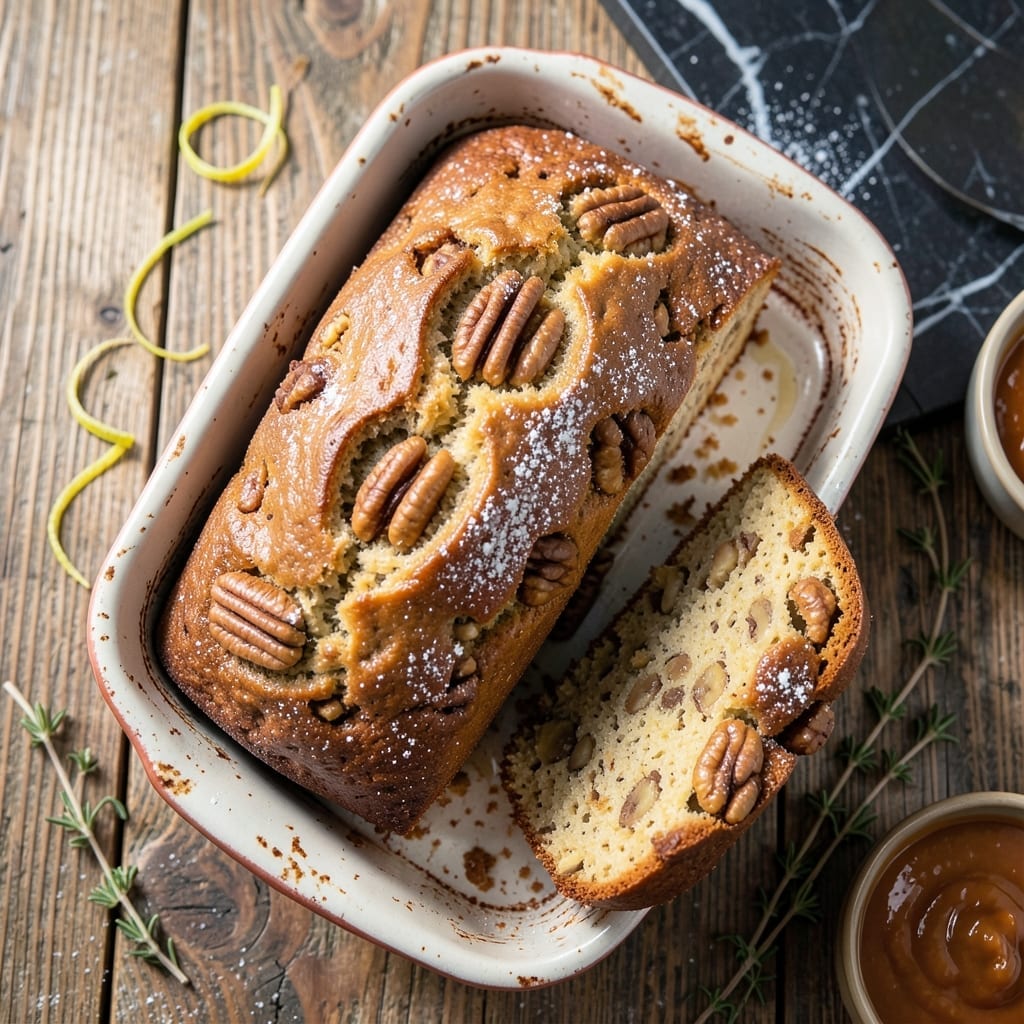
High-altitude baking requires precision, and this banana nut bread delivers a moist crumb with perfect texture every time.
Walnuts add satisfying crunch while the recipe’s adjustments ensure proper rise and structure at elevation. The result is a tender, flavorful loaf that stays moist for days.
Ingredients for Banana Nut Bread Recipe High Altitude
Precision ingredients ensure this loaf rises perfectly with a moist crumb and walnut crunch.
| Ingredient | Amount | Notes |
|---|---|---|
| All-Purpose Flour 🌾 | 2 cups | Sifted for high-altitude adjustment |
| Baking Soda 🧂 | 1 tsp | Increased for elevation balance |
| Salt 🧂 | ½ tsp | Fine sea salt preferred |
| Ground Cinnamon 🌿 | 1 tsp | Ceylon or cassia variety |
| Unsalted Butter 🧈 | ½ cup | Room temperature, softened |
| Granulated Sugar 🍚 | ¾ cup | Fine granulated for even distribution |
| Brown Sugar 🍯 | ¼ cup | Light or dark, packed |
| Large Eggs 🥚 | 2 whole | Room temperature for even mixing |
| Vanilla Extract 🌿 | 1 tsp | Pure vanilla for best flavor |
| Ripe Bananas 🍌 | 1 ½ cups | Mashed, about 3-4 medium bananas |
| Sour Cream 🥛 | ½ cup | Full-fat for moisture retention |
| Walnuts 🌰 | ¾ cup | Chopped, toasted for crunch |
The flour is critical for structure at elevation—King Arthur or Gold Medal are reliable choices. Room temperature butter and eggs ensure even mixing, which is essential for high-altitude consistency. Sour cream adds moisture without thinning the batter. For the best flavor, use bananas with plenty of brown speckles (the riper, the better). Walnuts should be fresh—Diamond of California brand is widely available and dependable.
No sour cream? Full-fat Greek yogurt works at a 1:1 ratio. Brown sugar can be swapped with coconut sugar, but expect a slightly deeper flavor. If you’re out of walnuts, pecans or hazelnuts make great substitutes—just toast them first to enhance their crunch. For a lighter texture, cake flour can replace up to half the all-purpose, but this may require additional adjustment for altitude.
Store this bread wrapped in foil at room temperature for up to 3 days, or refrigerate for 5 days. For longer storage, freeze slices for up to 3 months. Toast before serving to revive texture. Bananas can be frozen ahead—thaw and drain excess liquid before using.
Why You’ll Love This Recipe
- I’ll be real: leftovers taste even better the next morning.
- One-Bowl Wonder: I just dump everything in, mix, and go—no fancy tools, no fuss.
- Warm Cinnamon Hug: That cinnamon and butter combo makes every bite taste like home.
- Breakfast or Dessert: Honestly, it’s just as good toasted with coffee as it is with vanilla ice cream.
Step-by-Step Instructions for Banana Nut Bread High Altitude
Here is the method. Straightforward, tested, works every time.
Step 1: Cream Butter and Sugars for Optimal Texture
In a large mixing bowl, beat the 0.5 cup Unsalted Butter with the 0.75 cup Granulated Sugar and 0.25 cup Brown Sugar until light and fluffy. I use an electric mixer on medium speed for 3-4 minutes to ensure maximum air incorporation.
This step is crucial for high-altitude baking, as the extra air helps compensate for lower air pressure. The mixture should be pale in color and noticeably increased in volume. Stop occasionally to scrape down the sides of the bowl for even mixing.
Step 2: Incorporate Wet Ingredients Gradually
Add the 2 whole Large Eggs, one at a time, beating well after each addition. Then mix in the 1 tsp Vanilla Extract. I always use room temperature eggs for better emulsification with the butter mixture.
Next, add the 1.5 cups Ripe Bananas and 0.5 cup Sour Cream. Mix until just combined—the batter will look slightly lumpy, but that’s normal. The sour cream adds the moisture needed to prevent dryness at high altitude.
Step 3: Combine Dry Ingredients and Fold Gently
In a separate bowl, whisk together the 2 cups All-Purpose Flour, 1 tsp Baking Soda, 0.5 tsp Salt, and 1 tsp Ground Cinnamon. These quantities are specifically adjusted for high-altitude baking to ensure proper rise and structure.
Gradually add the dry ingredients to the wet mixture, folding gently with a silicone spatula until just combined. Overmixing will develop gluten and result in a dense loaf. The batter should be thick but pourable.
Step 4: Fold in Walnuts and Bake to Perfection
Gently fold in the 0.75 cup Walnuts until evenly distributed. Pour the batter into a greased 9×5-inch loaf pan, spreading it evenly with the spatula. The pan should be about two-thirds full to allow for proper rising.
Bake in a preheated 350°F oven for 55-65 minutes, or until a toothpick inserted into the center comes out clean or with a few moist crumbs. At high altitude, I start checking at the 50-minute mark, as baking times can vary.
Step 5: Cool Completely Before Slicing
Remove the pan from the oven and let it cool in the pan for 10 minutes. Then transfer the loaf to a wire rack to cool completely. This cooling period allows the crumb structure to set properly, preventing a gummy texture.
The bread is ready to slice when it’s warm to the touch but no longer hot. For the moistest result, wrap any leftovers tightly in plastic wrap or store in an airtight container at room temperature.
Pro Tips For Making Banana Nut Bread Recipe High Altitude
- Adjust the Leavening: At high altitude, reduce baking soda by 1/8 teaspoon and add an extra tablespoon of flour to prevent the bread from rising too quickly and collapsing. I learned this the hard way after my first few loaves sunk in the middle.
- Use Room-Temp Butter: Cream the unsalted butter until it’s truly soft—about 65-68°F—so it blends evenly with the sugars. Sounds obvious, but cold butter leaves lumps, and no one wants chunky banana bread.
- Skip Overmixing: Stir the wet and dry ingredients just until combined, even if the batter looks a little streaky. Overmixing develops gluten, and you’ll end up with dense, tough bread instead of tender.
- Add Extra Moisture: High altitude dries things out, so toss in an extra egg or 2 tablespoons of yogurt to keep the bread rich and moist. My grandmother swore by this, and her loaves were always perfect.
Pro Cooking Tips for banana nut bread recipe high altitude
💡 Master the Heat
High altitude baking requires adjustments to prevent dryness. Reduce your oven temperature by 15–25°F to allow the bread to bake evenly without over-browning. This slower bake ensures the center cooks through while maintaining moisture. Keep an eye on the edges—they brown faster at higher elevations!
🌡️ Adjust Your Leavening
At high altitudes, leavening agents like baking powder and soda work more aggressively. Decrease baking powder by 1/8–1/4 teaspoon and baking soda by a pinch to avoid a collapsed or overly porous crumb. This small tweak keeps your bread light yet sturdy.
✨ Hydration is Key
Dry mountain air can sap moisture from your bread. Add 1–2 tablespoons of extra liquid (milk, yogurt, or water) to the batter for a tender texture. For extra richness, swap some liquid for sour cream—it adds tang and keeps the loaf irresistibly moist.
🎯 Nail the Timing
High-altitude loaves often bake faster. Start checking for doneness 5–10 minutes early using a toothpick test. If the top browns too quickly, tent with foil to shield it while the center finishes. Patience pays off with a perfectly golden, crack-free crust!
Nutrition Facts

- 6 Egg Cake Recipe with Oil: Light as Air With Buttery Moisture - October 4, 2026
- 4 Bean Casserole Recipe: One-Pan Heartiness With Smoky Paprika Depth - October 4, 2026
- 3-Ingredient Keto Mug Cake Recipe: Microwave Magic in 2 Minutes - October 4, 2026