
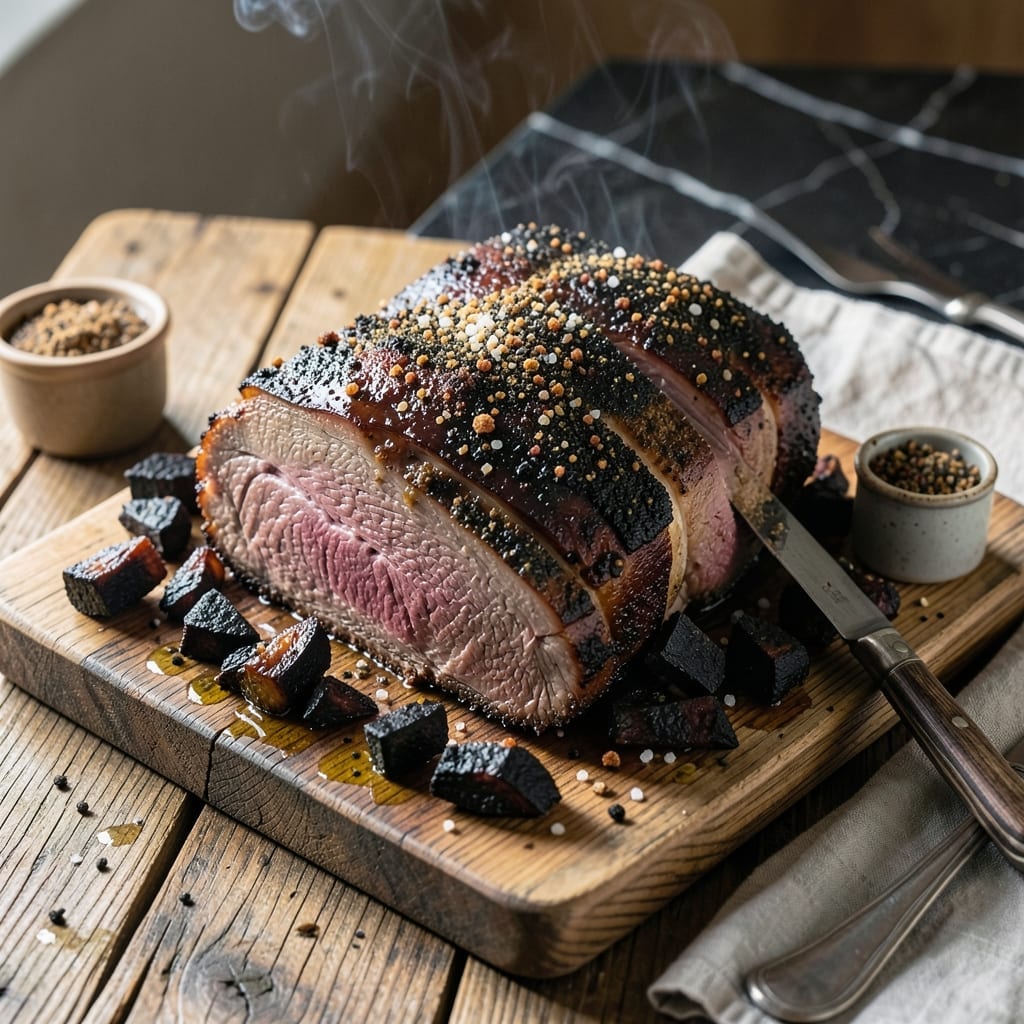
I’ve spent years perfecting this brisket method, and the secret is patience—low heat and slow smoking transform tough meat into tender, juicy perfection.
This isn’t a weekend project you can rush. The magic happens during those long hours in the smoker, where wood smoke works its alchemy on the beef.
What comes out is a brisket with a dark, flavorful bark on the outside and meat that falls apart at the slightest touch of your fork.
Whether you’re feeding a crowd or just want leftovers for days, this method delivers that competition-style texture every time.
Ingredients for Claude’s Brisket
Slow smoked perfection starts with quality beef and a bold dry rub.
| Ingredient | Amount | Notes |
|---|---|---|
| Beef Brisket 🥩 | 5 lb | Full packer cut preferred |
| Coarse Kosher Salt 🧂 | ¼ cup | Diamond Crystal preferred |
| Black Pepper 🌶️ | ¼ cup | Freshly ground coarse |
| Garlic Powder 🧄 | 2 tbsp | Not garlic salt |
| Onion Powder 🧅 | 2 tbsp | Fresh ground preferred |
| Paprika 🌶️ | 2 tbsp | Sweet or smoked variety |
| Brown Sugar 🍚 | ½ cup | Light or dark both work |
| Mustard Powder 🟡 | 1 tbsp | Dry powder, not prepared |
| Apple Cider Vinegar 🍏 | ½ cup | For spritzing during smoke |
| Hickory Wood Chunks 🪵 | 4 pieces | Or oak/pecan for milder smoke |
| Beef Broth 🥩 | 2 cups | Low sodium preferred |
| Butter 🧈 | ½ cup | Unsalted for wrapping |
| Yellow Mustard 🟡 | ¼ cup | Binder for bark formation |
The brisket is everything here. Full packer cuts (12-14 lbs whole) give you that perfect fat-to-meat ratio, but a flat cut works if that’s what your butcher carries. I get mine from Costco—consistent quality and good price. Look for heavy marbling (those white fat streaks) and a thick, even shape. The salt needs to be coarse kosher—table salt is too fine and can make the rub taste harsh.
No hickory? Oak or pecan wood gives a milder smoke that still works beautifully. Short on time for the full smoke? Oven at 275°F with liquid smoke gets you close (not quite the same, but edible). Brown sugar can be swapped for white sugar in a pinch, but it adds less depth. The apple cider vinegar in the spritz keeps the meat moist—don’t skip this part.
Raw brisket keeps in the fridge for 3-4 days (wrapped tightly), but it’s best smoked fresh. Leftovers freeze beautifully for up to 3 months—slice before freezing for easy portioning. The rub can be made a day ahead; just store it in an airtight container.
Why You’ll Love This Recipe
- Set It and Forget: I rub the brisket with salt, pepper, garlic, and onion powder, then let the oven do the work.
- Melt-in-Your-Mouth Good: That crust from the coarse salt and the deep, savory warmth of the garlic and onion—honestly, it’s ridiculous.
- Feeds a Hungry Group: I made this for a Sunday dinner with 10 people and everyone left happy.
- Leftovers for Days: One brisket turns into tacos, sandwiches, or chili—my freezer thanks me every time.
Step-by-Step Instructions for Smoked Brisket
Here’s my method for achieving that melt-in-your-mouth tenderness with a perfect bark every time.
Step 1: Trim and Season the Brisket
Start by trimming the fat cap on the 5 lb Beef Brisket down to about ¼ inch thickness. I use a sharp knife to remove any hard fat or silver skin, leaving just enough to protect the meat during the long smoke.
In a bowl, combine the 0.25 cup Coarse Kosher Salt, 0.25 cup Black Pepper, 2 tbsp Garlic Powder, 2 tbsp Onion Powder, 2 tbsp Paprika, 0.5 cup Brown Sugar, and 1 tbsp Mustard Powder. Rub this mixture generously over every surface of the brisket, pressing it in so it adheres well. Let it sit at room temperature for 1 hour while you prepare the smoker.
Step 2: Set Up the Smoker for Low and Slow
Preheat your smoker to 225°F using the 4 pieces Hickory Wood Chunks. I prefer hickory for its bold, smoky flavor, but oak or pecan work well for a milder profile. Place a water pan in the smoker to maintain moisture during the cook.
Once the smoker reaches temperature and you see clean, thin blue smoke, place the brisket fat-side up on the grates. The fat will render down and baste the meat as it cooks. Close the lid and let it smoke undisturbed for the first 4-5 hours.
Step 3: Spritz and Wrap Through the Stall
After the first few hours, the brisket will hit “the stall” (around 165°F internal temperature), where the temperature plateaus. This is normal. Every 1-2 hours, spritz the brisket with a mix of 0.5 cup Apple Cider Vinegar and 2 cups Beef Broth to keep it moist and add flavor.
Once the internal temperature reaches 165-170°F, wrap the brisket tightly in pink butcher paper (or foil in a pinch). Add 0.5 cup Butter and a drizzle of the 0.25 cup Yellow Mustard to the paper before wrapping—this helps create a beautiful, sticky bark. Return it to the smoker.
Step 4: Smoke to Probe-Tender Perfection
Continue smoking until the internal temperature reaches 200-205°F and a probe slides in like butter with no resistance. This usually takes 10-12 hours total, depending on your smoker and the size of the brisket.
Trust the probe test over the thermometer—tenderness is what matters most. If the brisket feels tough at 200°F, keep cooking. It’s done when the probe glides in effortlessly.
Step 5: Rest and Slice
Remove the brisket from the smoker and let it rest wrapped in the butcher paper for at least 1 hour (I prefer 2 hours in a cooler). This resting period allows the juices to redistribute, ensuring every slice is moist and flavorful.
Unwrap the brisket and slice against the grain into ¼-inch thick pieces. The grain direction changes between the flat and point, so adjust your slicing angle accordingly. Serve immediately while still warm.
Pro Tips For Making Claude’S Brisket
- Season Overnight: Rub that brisket with coarse kosher salt, black pepper, garlic powder, and onion powder the night before—this gives the spices time to penetrate deeply and the salt to work its magic on the meat’s texture.
- Low And Slow: After searing, drop the oven temp to 275°F and let it cook for at least 6 hours—rushing this with higher heat leaves you with tough, chewy meat instead of that fall-apart tenderness.
- Skip The Trim: I learned this the hard way—don’t trim off all the fat before cooking; that marbling is what keeps the brisket moist during the long cook, and you can always slice it off later if needed.
- Rest Under Foil: Once it’s done, tent the brisket loosely with foil and let it rest for a full 30 minutes—this keeps the juices inside where they belong instead of all over your cutting board.
Regional Styles of This claudes brisket
Texas-Style Classic
This is the gold standard—simple salt and pepper rub with a long 12-hour smoke at 225°F using post oak wood. The bark forms a dark, nearly black crust while the inside stays impossibly juicy. I learned this method from a pitmaster in Lockhart. 🔥
Kansas City Sweet
Here the rub includes more brown sugar and sometimes molasses for a sweeter profile. They often add a mop sauce during cooking and finish with a thick, sweet BBQ sauce. The result is stickier and more saucy than Texas brisket.
Central Texas Hybrid
This version blends techniques by using a heavy pepper rub like Texas but adds a vinegar-based mop. The smoke is still long and low, but the finish has a tangy kick. I love this style for sandwiches.
Carolina Vinegar Touch
In the Carolinas, they incorporate a vinegar and pepper sauce that’s either mopped on during cooking or served on the side. The smoke is often lighter, using hickory or pecan, allowing the vinegar tang to shine through.
Memphis Dry-Rub
Memphis brisket skips the sauce entirely, relying on a complex dry rub with paprika, garlic, and sometimes cayenne. The meat is typically sliced thinner and served with the rub as the star. It’s all about the bark here.
Competition Style
This is brisket taken to the next level with injected marinades, multi-stage cooking, and precise temperature control. The bark is often crunchier, and the meat is probed for perfect tenderness. Judges look for a clean bite with no stringiness.
Nutrition Facts
Frequently Asked Questions
What’s the ideal smoker temperature?
Maintain a steady 225°F throughout the cook for best results. This low and slow approach ensures the connective tissue breaks down properly.
How do I know when it’s done?
The brisket is ready when it reaches 200-205°F internally and a probe slides in like butter. Don’t rush it—tenderness is key.
Can I use a different wood?
While hickory is classic, oak or pecan work well for milder smoke. Avoid soft woods like pine.
What if it stalls early?
This is normal. When the internal temp hits 165°F, wrap in butcher paper with butter to push through the stall.

- 6 Egg Cake Recipe with Oil: Light as Air With Buttery Moisture - October 4, 2026
- 4 Bean Casserole Recipe: One-Pan Heartiness With Smoky Paprika Depth - October 4, 2026
- 3-Ingredient Keto Mug Cake Recipe: Microwave Magic in 2 Minutes - October 4, 2026