
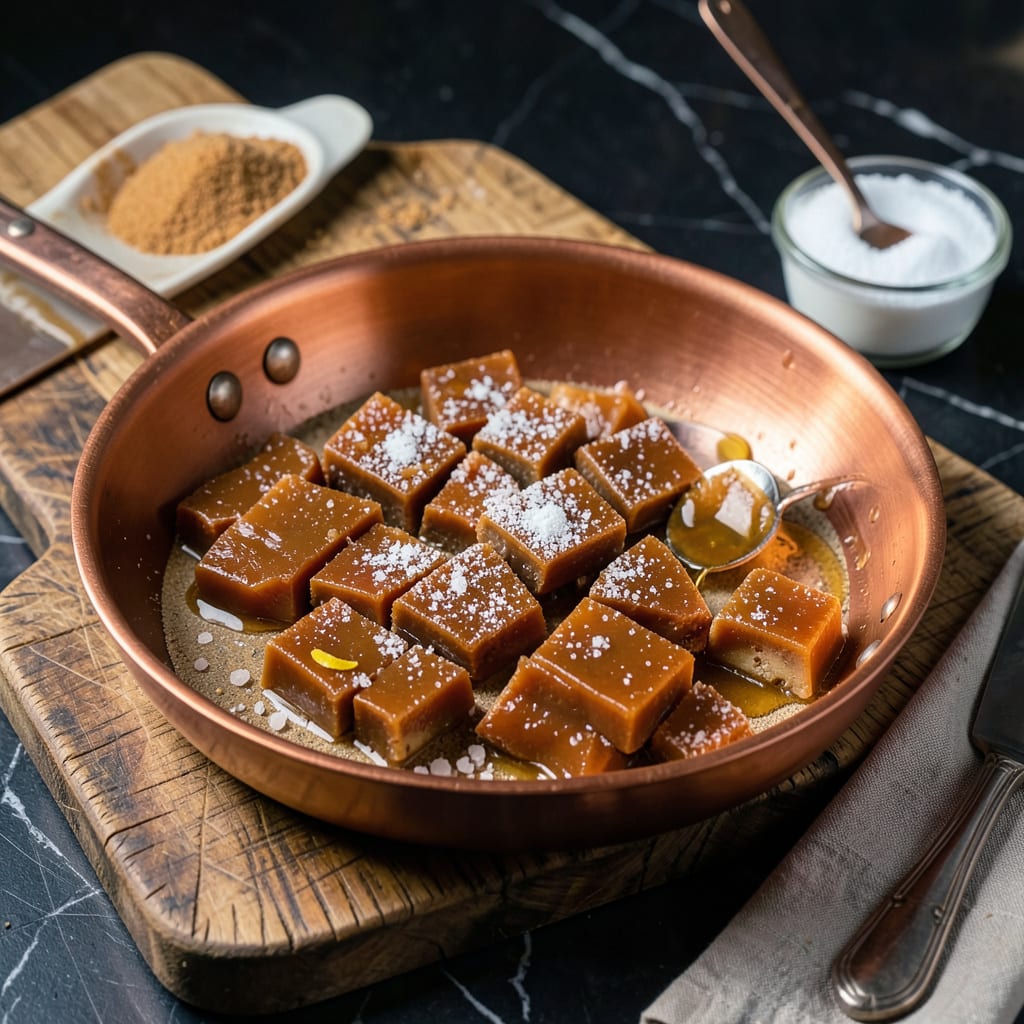
Creating perfect almond toffee at home requires precision, but the results are worth every minute. This recipe delivers the signature buttery crunch and nutty richness that made Enstrom toffee famous, with a foolproof method for achieving that ideal golden-brown snap.
The secret lies in carefully monitoring the sugar mixture to reach the exact hard-crack stage at 300°F, then quickly incorporating toasted almonds before the toffee sets. When coated in smooth chocolate and finished with an extra sprinkle of nuts, this homemade version rivals any gourmet confection. Every bite offers the satisfying contrast of crisp toffee, creamy chocolate, and toasted almonds.
Ingredients for Enstrom Toffee
Precision matters with these nine ingredients to achieve Enstrom’s signature buttery crunch and nutty depth in every batch.
| Ingredient | Amount | Notes |
|---|---|---|
| Unsalted Butter 🧈 | 1 ½ cups | European-style preferred for richness |
| Granulated White Sugar 🍚 | 1 ½ cups | Fine grain for even dissolution |
| Light Brown Sugar 🍚 | ½ cup | Packed for moisture content |
| Water 💧 | ¼ cup | Filtered for purity |
| Light Corn Syrup 🧃 | ¼ cup | Prevents sugar crystallization |
| Diamond Crystal Kosher Salt 🧂 | ½ tsp | Precise measurement critical |
| Vanilla Extract 🌿 | 1 tsp | Pure extract for depth |
| Toasted Almonds 🌰 | 1 ½ cups | Chopped medium-fine for texture |
| Semi-Sweet Chocolate Chips 🍫 | 2 cups | High-quality 60% cacao minimum |
| Finely Chopped Almonds 🌰 | ½ cup | For final garnish |
The butter quality is non-negotiable for authentic Enstrom texture. European-style butter (like Plugrá or Kerrygold) delivers the requisite fat content (82-86%) for that melt-in-your-mouth quality. Granulated sugar must be pure cane—Domino or C&H brands ensure consistent crystallization. For the corn syrup, Karo Light is the professional standard, though organic alternatives work if processed identically. Toast almonds in a 300°F oven for 12-15 minutes until fragrant and golden—this prevents softening when mixed with hot toffee.
Substitutions require careful consideration to maintain structural integrity. Honey or agave cannot replace corn syrup—they introduce excess moisture and alter the hard-crack stage. For chocolate, Guittard or Ghirardelli semi-sweet chips provide the ideal melt point; avoid compound chocolate. If almond allergies are a concern, toasted pecans or hazelnuts may substitute at a 1:1 ratio, though flavor profiles will differ. Vanilla bean paste (1:1 ratio) can replace extract for visible speckles, but maintain the precise 1 tsp measurement to avoid flavor dominance.
Store uncoated toffee in an airtight container with parchment between layers to prevent sticking. Optimal conditions are 60-65°F with minimal humidity—avoid refrigeration as it accelerates sugar bloom. Chocolate-coated pieces maintain quality for 2 weeks at room temperature or 3 months frozen in vacuum-sealed bags. Always bring chilled toffee to room temperature before serving to preserve the signature snap. Use a candy thermometer calibrated within the past year for temperature accuracy.
Why You’ll Love This Recipe
- I’ll be real: when a recipe starts with butter, two kinds of sugar, and nothing fussy, I’m already sold. The corn syrup keeps it smooth without any weird aftertaste—just pure, crackly, buttery toffee every single time.
- Five-Ingredient Magic: I’ll be real: when a recipe starts with butter, two kinds of sugar, and nothing fussy, I’m already sold. The corn syrup keeps it smooth without any weird aftertaste—just pure, crackly, buttery toffee every single time.
- That First Crunch: Honestly, the moment you bite through the crispy top layer into the melt-in-your-mouth center? It’s why I make double batches. The brown sugar adds this deep caramel note that white sugar alone just can’t hit.
- Gift-Worthy in 30: I’ve wrapped this in cellophane bags with ribbon for teachers, neighbors, and last-minute hostess gifts. It looks like you slaved over it (but we know better). Pro tip: Sprinkle flaky salt on top before it sets—people will ask for the recipe.
Step-by-Step Instructions for Buttery Almond Toffee
Precision and patience yield the ideal balance of buttery richness, caramelized crunch, and chocolate-almond harmony.
Step 1: Prepare the Sugar Mixture and Cook to Soft Crack Stage
In a heavy-bottomed 3-quart saucepan, combine the 1.5 cups granulated white sugar, 0.5 cup light brown sugar, 0.25 cup water, 0.25 cup light corn syrup, and 0.5 tsp Diamond Crystal kosher salt. Stir gently with a silicone spatula just until the ingredients are moistened—avoid stirring once heating begins to prevent sugar crystallization.
Clip a candy thermometer to the side of the pan, ensuring the tip doesn’t touch the bottom. Cook over medium heat until the mixture reaches 235°F, about 8-10 minutes. At this stage, you’ll notice the edges beginning to bubble vigorously and the syrup taking on a pale golden hue. Resist the urge to stir; instead, gently swirl the pan if needed to ensure even heating.
Step 2: Incorporate Butter and Reach Hard Crack Stage
Once the syrup reaches 235°F, gradually add the 1.5 cups unsalted butter in four additions, allowing each portion to melt completely before adding the next. This gradual incorporation prevents the mixture from separating. The temperature will drop significantly with each butter addition—this is normal and expected.
Continue cooking over medium heat, monitoring the thermometer closely. The mixture will progress through color stages: golden at 250°F, amber at 275°F, and finally a rich caramel at 300°F. At 290°F, begin testing for doneness by dropping a small amount into ice water—it should form brittle threads when 300°F is achieved. The entire process from butter addition to hard crack stage takes approximately 15-20 minutes.
Step 3: Add Vanilla and Almonds for Final Texture
Immediately remove the pan from heat when the mixture reaches 300°F. Stir in the 1 tsp vanilla extract—the mixture will bubble vigorously due to the temperature difference. Quickly but carefully fold in the 1.5 cups toasted almonds, ensuring even distribution throughout the molten toffee. The almonds will begin to sizzle slightly as they absorb the residual heat.
Pour the mixture onto a 12×17-inch parchment-lined baking sheet, using an offset spatula to spread it into an even layer approximately ¼-inch thick. Work swiftly as the toffee begins to set within 2-3 minutes. For precise thickness, lift the parchment slightly to check the underside—it should be uniformly golden-brown without dark spots.
Step 4: Apply Chocolate Layer and Final Garnish
Allow the toffee to cool for 5 minutes until the surface is firm but still warm to the touch. Immediately sprinkle the 2 cups semi-sweet chocolate chips evenly over the surface. Let them sit undisturbed for 2 minutes to soften, then use an offset spatula to spread the melted chocolate into a smooth, even layer. The residual heat from the toffee will melt the chocolate perfectly without requiring additional tempering.
While the chocolate is still glossy, sprinkle the 0.5 cup finely chopped almonds evenly over the top, pressing gently to ensure adhesion. Let the toffee cool completely at room temperature for 1 hour, then refrigerate for 30 minutes to fully set the chocolate. The finished toffee should have a glossy chocolate top, a golden caramel center, and audible crunch when broken.
Step 5: Break and Store for Optimal Freshness
Once fully set, transfer the toffee (still on parchment) to a cutting board. Use a chef’s knife to score the toffee into 1-inch squares, then break along the scored lines by hand for rustic edges. The ideal break will have clean fractures through the toffee layer with minimal chocolate separation.
Store the toffee in an airtight container between layers of parchment paper at room temperature for up to 2 weeks, or refrigerate for up to 1 month. For longer storage, freeze in a single layer before transferring to containers—this preserves the signature crunch and prevents the chocolate from blooming. Serve at room temperature for the best texture contrast between the crisp toffee and smooth chocolate.
Troubleshooting Perfect Results
Toffee Won’t Set
If your toffee remains sticky or soft after cooling, it likely didn’t reach the proper temperature. Always use a calibrated candy thermometer and cook until 300°F is achieved—this is the hard-crack stage where sugar forms brittle threads. I once rushed this step and ended up with caramel instead of toffee! 🌡️
Butter Separates
When butter separates from the sugar mixture, it’s usually added too quickly or at the wrong temperature. Add the 1.5 cups butter in small batches, letting each fully melt before adding more. If separation occurs, remove from heat and whisk vigorously to re-emulsify before continuing to cook.
Grainy Texture
Graininess results from sugar crystallization, often caused by stirring after heating begins or using a dirty pan. Wipe down the saucepan sides with a damp pastry brush to dissolve stray sugar crystals. I always use a silicone spatula for initial stirring to minimize this risk.
Chocolate Won’t Stick
If chocolate peels away when breaking, the toffee was too cool when you applied it. Spread the 2 cups chocolate chips immediately after pouring the toffee while it’s still warm. The residual heat creates a perfect bond. A quick 30-second oven warm can help if it cools too fast.
Burnt Flavor
Burnt taste means the mixture exceeded 300°F. Cook over medium heat and stir only when necessary. The color should progress from golden to amber to caramel—never black. I recommend using a heavy-bottomed saucepan for even heat distribution to prevent hot spots.
Almonds Sink
When almonds sink to the bottom, they were added too early or the mixture wasn’t hot enough. Fold in the 1.5 cups toasted almonds right at 300°F and pour immediately. The toffee should be thick enough to suspend them evenly throughout the mixture. 💡
Nutrition Facts

- 6 Egg Cake Recipe with Oil: Light as Air With Buttery Moisture - October 4, 2026
- 4 Bean Casserole Recipe: One-Pan Heartiness With Smoky Paprika Depth - October 4, 2026
- 3-Ingredient Keto Mug Cake Recipe: Microwave Magic in 2 Minutes - October 4, 2026