
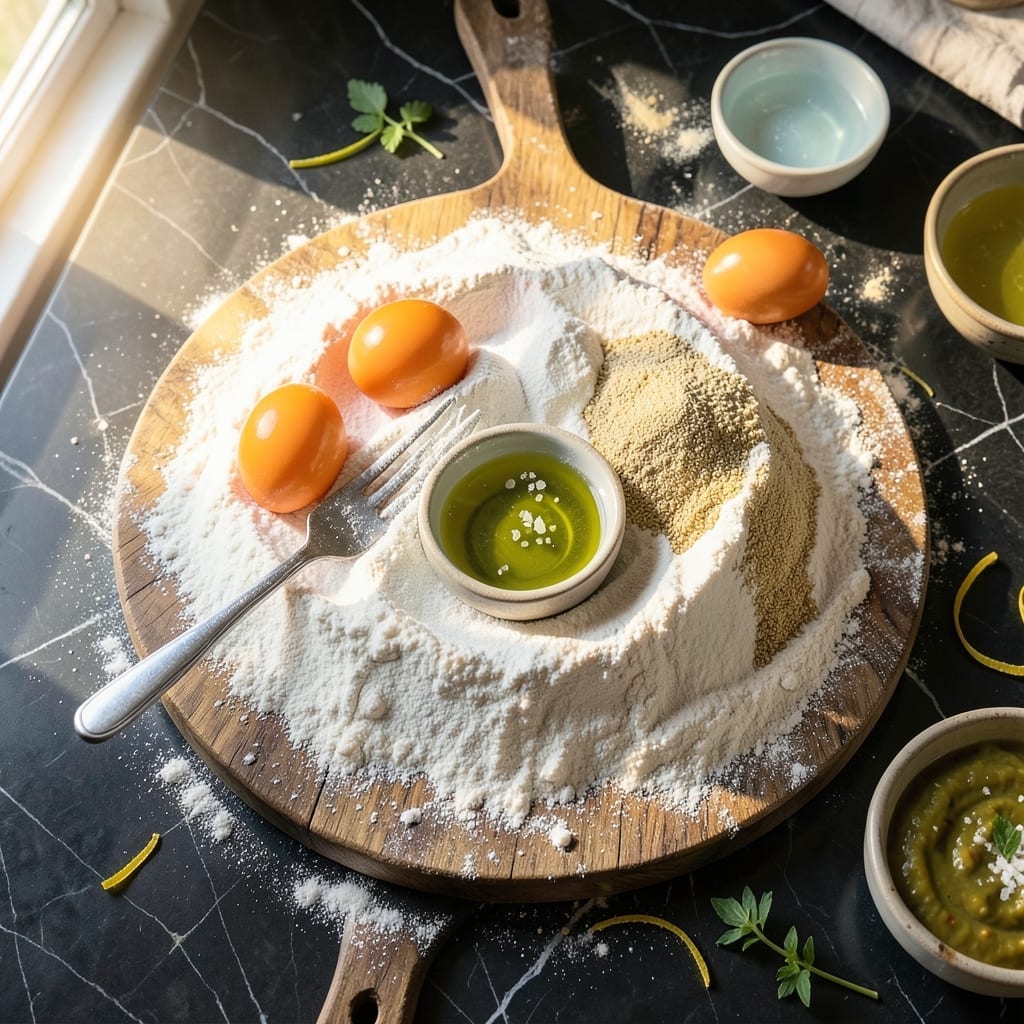
There’s a transformative joy in crafting pasta from scratch, and 00 flour is the secret to achieving that signature Italian silkiness. This method honors tradition while making the process approachable for any home cook.
With just a few simple ingredients and a little patience, you’ll create noodles that are tender yet firm, with a delicate texture that store-bought versions can’t match. The key lies in proper kneading and resting to develop the gluten.
The result is fresh pasta that cooks in 2-3 minutes and absorbs sauces beautifully. Its smooth, velvety bite makes every dish feel like a restaurant-quality experience.
Once you taste the difference, you’ll understand why this homemade approach is worth the effort. The process becomes as rewarding as the final dish.
Ingredients for Fresh Pasta Recipe 00 Flour
Just six ingredients separate you from restaurant-quality fresh pasta at home.
| Ingredient | Amount | Notes |
|---|---|---|
| 00 Flour 🌾 | 3 cups | Italian-style, finely milled |
| Semolina Flour 🌾 | ½ cup | For texture and bite |
| Large Eggs 🥚 | 4 whole | Room temperature preferred |
| Extra-Virgin Olive Oil 🫒 | 1 tbsp | For dough elasticity |
| Sea Salt 🧂 | 1 tsp | Fine grain for even distribution |
| Water 💧 | 1 tbsp | As needed for consistency |
The 00 flour is non-negotiable here—Antimo Caputo is the gold standard (find it at Eataly or specialty Italian markets). Semolina adds that authentic bite, but if you can’t find it, bread flour works in a pinch. Always check the mill date on flour—freshness matters more than you think. Room temperature eggs incorporate better, so pull them out an hour before starting.
No 00 flour? All-purpose flour plus cornstarch (2 tbsp per cup) mimics the texture. Out of semolina? Skip it—just use all 00 flour. The olive oil can be any high-quality extra-virgin, but avoid strongly flavored oils. For vegan pasta, replace eggs with 1/4 cup lukewarm water per egg—the dough will be slightly more delicate.
Fresh pasta cooks fast—like, 2-3 minutes fast. Store uncooked dough wrapped tightly in plastic for 24 hours in the fridge, or freeze for 1 month. Dust with extra 00 flour before freezing to prevent sticking. Always let dough come to room temp before rolling.
Why You’ll Love This Recipe
- No-Knead Magic: I just mix the 00 flour, eggs, and oil—no fancy equipment, no sore arms.
- Silky Texture: The 00 flour makes it so tender, and the semolina adds just the right bite.
- Freezer Friendly: I double the batch and freeze half for those nights I need pasta in 5 minutes.
- Pantry Staples: Between us, I always have these ingredients on hand—no last-minute grocery runs.
Step-by-Step Instructions for Fresh Pasta with 00 Flour
Here’s the method I use for silky, restaurant-quality noodles at home every time.
Step 1: Create the Well and Combine Wet Ingredients
On a clean work surface or in a large mixing bowl, mound the 3 cups 00 Flour and 0.5 cup Semolina Flour together. Use your fingers to create a deep well in the center—this is your mixing bowl. The well should be wide enough to hold all the wet ingredients without spilling over.
Crack the 4 whole Large Eggs directly into the well. Add the 1 tbsp Extra-Virgin Olive Oil, 1 tsp Sea Salt, and 1 tbsp Water. I always use room temperature eggs here—they incorporate more evenly into the flour and create a smoother dough.
Step 2: Gradually Incorporate the Flours
Using a fork, gently beat the wet ingredients together in the well. Start incorporating the flour from the inner rim of the well, gradually working your way outward. The mixture will transform from a liquid to a shaggy, cohesive dough as you pull in more flour.
Here’s the thing—you might not need all the flour, or you might need a touch more water. The dough should come together into a rough ball that’s slightly tacky but not sticky. If it feels too dry, add water 1 teaspoon at a time. If it’s too wet, sprinkle in a bit more flour. This tactile feedback is why making pasta by hand is so satisfying.
Step 3: Knead Until Silky Smooth
Once the dough comes together, it’s time to knead. Push, fold, and turn the dough for 8-10 minutes using the heels of your hands. You’ll feel it change from rough and lumpy to incredibly smooth and elastic—this is the gluten developing, which gives your pasta its perfect texture.
If the dough sticks to your hands or the surface, dust lightly with 00 Flour. Don’t add too much, though, or your pasta will be tough. You want the dough to be firm but pliable. When you press your finger into the dough and it springs back slowly, you’re ready for the next step.
Step 4: Rest the Dough
Shape the dough into a ball, wrap it tightly in plastic wrap, and let it rest at room temperature for 30 minutes. This resting period allows the gluten to relax, making the dough infinitely easier to roll out later. It also gives the flour time to fully hydrate.
I know it’s hard to wait when you’re this close to fresh pasta, but don’t skip this step. You’ll notice a dramatic difference in how the dough handles after resting. The color will also deepen slightly as the flour absorbs the liquid.
Step 5: Roll and Cut the Pasta
Divide the rested dough into 4 equal portions (since you’re making 4 servings). Working with one portion at a time (keep the others covered), flatten it with your hands and run it through a pasta machine on the widest setting. Fold the sheet in thirds like a letter and repeat 2-3 times.
Gradually decrease the setting and roll the dough through once at each thickness, without folding, until you reach your desired thickness. For most shapes, I stop at the second-to-last setting. Cut the sheets into your preferred shape—tagliatelle, fettuccine, or pappardelle all work beautifully with this dough. Cook immediately or dust with flour and refrigerate for up to 24 hours.
Pro Tips For Making Fresh Pasta Recipe 00 Flour
- Knead Longer: I learned this the hard way—work the dough for at least 8-10 minutes until it’s silky smooth, not just combined. The gluten develops fully, and you’ll avoid tough, chewy pasta.
- Use Room-Temp Eggs: Sounds weird, but it works: take your eggs out 30 minutes before mixing. Cold eggs make the dough seize up, and you’ll fight it the whole time.
- Skip the Extra Flour: Resist the urge to dust your work surface heavily—too much extra 00 flour makes the pasta dry and brittle. A light dusting is all you need.
- Rest the Dough: After kneading, wrap it in plastic and let it sit for at least 30 minutes. My grandmother swore by this, and she was right: it relaxes the gluten so the pasta rolls out thin without springing back.
Regional Styles of This Recipe
Emilia-Romagna Classic
In Bologna, they use only 00 flour and eggs—no semolina, no water. The ratio is 100g flour per egg, kneaded for 15-20 minutes until satin-smooth. This creates sfoglia, the ultra-thin sheets used for tortellini and lasagna. I learned this from a nonna in Parma who swore by her hand-cranked Imperia machine. 🗺️
Roman Tradition
Roman cooks often add 1 tbsp olive oil per 100g flour for extra elasticity, perfect for tonnarelli—square-spaghetti that holds sauce beautifully. They rest the dough 1 hour before rolling, claiming it develops more flavor. Try this with a simple cacio e pepe for authentic results.
Southern Italian Style
In Puglia, semolina is king. They use 50/50 00 flour and semolina for a chewier bite, ideal for orecchiette and cavatelli. The dough is firmer, rolled thicker, and often shaped by hand. I love how this version stands up to hearty ragù sauces.
Venetian Approach
Venetian pasta often includes 1 egg yolk per 100g flour plus 1 whole egg, creating a richer, more golden dough. This is perfect for bigoli, the thick, rustic noodles traditionally served with duck ragù. The extra yolks give it a luxurious texture. ✨
Tuscan Variation
Tuscans sometimes add 1 tsp white wine per 100g flour for a subtle acidity that pairs with wild game sauces. The dough is rolled slightly thicker for pappardelle, the wide ribbons that cradle rich stews beautifully.
Nutrition Facts
Frequently Asked Questions
Why use 00 flour instead of all-purpose?
00 flour is finely milled with a lower protein content, creating a silkier texture. All-purpose works but yields slightly chewier noodles. The difference is most noticeable in delicate shapes like tagliatelle.
Can I make this without a pasta machine?
Roll the dough as thin as possible with a rolling pin, about 1-2mm. It takes more effort, but the results are just as delicious. A wine bottle works in a pinch.
How do I know when the dough is properly kneaded?
It’s ready when smooth, elastic, and springs back slowly when pressed. If it tears easily, keep kneading for 2-3 more minutes. Under-kneaded dough cracks when rolling.
What’s the best way to store fresh pasta?
Dust uncooked noodles with flour, place in a single layer, and refrigerate for 24 hours or freeze for 1 month. For cooked pasta, toss with oil and refrigerate for 3-4 days.

- 6 Egg Cake Recipe with Oil: Light as Air With Buttery Moisture - October 4, 2026
- 4 Bean Casserole Recipe: One-Pan Heartiness With Smoky Paprika Depth - October 4, 2026
- 3-Ingredient Keto Mug Cake Recipe: Microwave Magic in 2 Minutes - October 4, 2026