
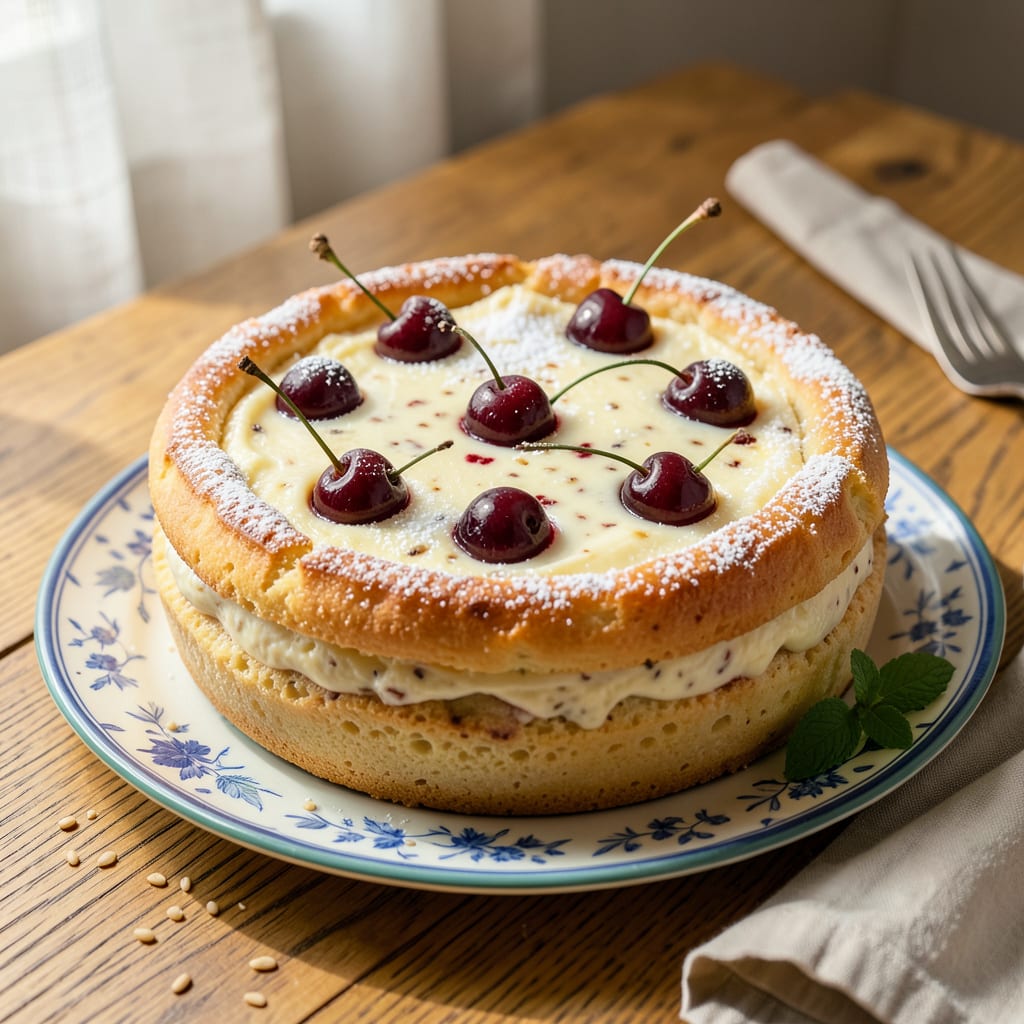
There’s something deeply comforting about a traditional German custard kuchen, where tender dough cradles a velvety custard filling that’s been perfected through generations. This recipe captures the essence of what German grandmothers have been baking for decades—a simple yet extraordinary coffee cake that transforms basic ingredients into something truly special.
The secret lies in the balance between the buttery dough and the creamy custard layer, which achieves its signature texture through precise egg tempering and gentle baking. What emerges from the oven is a golden cake with a delicate crumb and a custard so smooth it practically melts on your tongue—perfect with afternoon coffee or as a simple dessert.
Ingredients for German Custard Kuchen
This traditional German custard kuchen relies on simple yet precise ingredients to achieve its signature velvety texture and delicate crumb.
| Ingredient | Amount | Notes |
|---|---|---|
| All-purpose flour 🌾 | 3 ½ cups | Sifted for lighter texture |
| Granulated sugar 🍚 | ¾ cup | Divided for dough and custard |
| Active dry yeast 🍞 | 2 ¼ tsp | One standard packet |
| Whole milk 🥛 | ¾ cup | Warm to 110°F (43°C) |
| Unsalted butter 🧈 | ¾ cup | Softened, plus extra for greasing |
| Large eggs 🥚 | 3 whole | Divided: 1 for dough, 2 for custard |
| Vanilla extract 🌱 | 1 tsp | Pure extract recommended |
| Salt 🧂 | ¾ tsp | Fine sea salt preferred |
| Sour cream 🥛 | ½ cup | Full-fat for richness |
| Heavy cream 🥛 | 1 cup | Cold, for custard layer |
| Lemon zest 🍋 | 1 tsp | Freshly grated preferred |
| Powdered sugar 🍬 | ½ cup | For dusting finished kuchen |
[recipeingredientscaler]
The foundation of this kuchen lies in the quality of dairy products. Optimal results require full-fat sour cream and heavy cream—avoid low-fat substitutions as they compromise the custard’s signature creaminess. European-style butter (like Plugrá or Kerrygold) with higher fat content yields superior dough texture. For the milk, whole milk is non-negotiable; the fat content is essential for proper yeast activation and custard setting. When selecting flour, unbleached all-purpose from brands like King Arthur provides consistent protein content for the ideal tender crumb structure that German grandmothers perfected over generations.
Substitutions must be approached with caution to maintain authenticity. While Greek yogurt can replace sour cream in a pinch, the resulting custard may be slightly less rich. For those avoiding dairy, coconut cream (chilled overnight) can mimic heavy cream’s texture, though flavor profiles will differ. The vanilla extract should be pure Madagascar bourbon vanilla—imitation vanilla lacks the depth required for this traditional recipe. In emergencies, vanilla bean paste (1:1 ratio) offers comparable quality. The lemon zest, while seemingly minor, provides essential brightness; orange zest may substitute but alters the classic flavor profile slightly.
Storage considerations are paramount for both ingredients and finished product. Keep all dairy components refrigerated until use, particularly the heavy cream which separates when warm. The assembled kuchen maintains optimal texture for 2 days at room temperature (covered) or 5 days refrigerated. For longer storage, freeze uncut portions wrapped tightly in plastic for up to 3 months. Always bring refrigerated kuchen to room temperature before serving—this restores the custard’s signature velvety mouthfeel. Powdered sugar should be added just before serving to prevent absorption into the custard layer.
Why You’ll Love This Recipe
- No Yeast Stress: Honestly, the yeast gets handled in 5 minutes flat—just bloom it in warm milk while you measure the flour. No finicky proofing or waiting hours; the dough rises while you make the custard filling.
- That Custard Magic: Here’s what sold me—the warm, buttery crust with that barely-set vanilla custard center. It’s like if a donut and crème brûlée had a delicious German lovechild.
- Breakfast or Dessert? Yes.: I’ve served this at 8 AM with coffee and at 8 PM with whipped cream. The same pan goes from weekday breakfast to Sunday dessert without breaking a sweat.
- Leftovers? Still Gold: Between us, it tastes even better the next day—cold, straight from the fridge, or warmed for 10 seconds. And with basic pantry staples, it’s cheaper than a bakery run.
Step-by-Step Instructions for German Custard Kuchen
This traditional method ensures a tender base and velvety custard layer with professional results.
Step 1: Prepare the Yeast Dough Base
In a stand mixer fitted with the dough hook, combine the 3.5 cups all-purpose flour, 0.75 tsp salt, and 2.25 tsp active dry yeast. Warm the 0.75 cup whole milk to 110°F (43°C)—this temperature activates the yeast without killing it. The milk should feel warm to the touch but not hot.
Add the warmed milk, 1 large egg, 0.25 cup granulated sugar, and 0.75 cup softened unsalted butter to the dry ingredients. Mix on low speed until combined, then increase to medium and knead for 5-7 minutes until the dough becomes smooth and elastic. It should pull away from the sides of the bowl cleanly when ready.
Transfer the dough to a lightly greased bowl, cover with plastic wrap, and let rise in a warm place for 1-1.5 hours or until doubled in volume. The dough should spring back slowly when gently pressed with a finger, indicating proper proofing.
Step 2: Create the Custard Filling
While the dough rises, prepare the custard layer. In a medium bowl, whisk together the remaining 2 large eggs, 0.5 cup granulated sugar, 0.5 cup sour cream, 1 cup heavy cream, 1 tsp vanilla extract, and 1 tsp lemon zest. The mixture should be smooth with no sugar granules remaining.
For optimal texture, ensure all custard ingredients are at room temperature before combining. The lemon zest adds brightness that balances the richness of the custard. Strain the mixture through a fine-mesh sieve to remove any potential lumps from the eggs or zest, creating a perfectly smooth filling.
Step 3: Assemble and Proof the Kuchen
Once doubled, punch down the dough and transfer it to a greased 9×13-inch baking pan. Press the dough evenly into the pan, building up the edges slightly to contain the custard. Use floured fingers to prevent sticking as you shape the base.
Pour the prepared custard mixture evenly over the dough base. Gently tilt the pan to distribute the custard completely. Let the assembled kuchen rest uncovered at room temperature for 20-30 minutes while you preheat the oven to 350°F. This brief rest allows the custard to settle and the dough to begin its final rise.
Step 4: Bake to Golden Perfection
Bake the kuchen in the preheated 350°F oven for 35-40 minutes. The finished kuchen should have a golden brown crust around the edges and a slightly jiggly center when gently shaken. The custard will continue to set as it cools, so don’t overbake waiting for complete firmness.
A properly baked kuchen will have a custard layer that’s set but still creamy, not rubbery. The edges should pull away slightly from the pan sides. If the top begins to brown too quickly, tent loosely with aluminum foil for the remaining baking time to prevent over-browning.
Step 5: Cool and Finish
Remove the kuchen from the oven and let it cool in the pan on a wire rack for 1 hour. This cooling period allows the custard to fully set and the flavors to meld. Attempting to cut the kuchen while still warm will result in a runny custard layer and compromised presentation.
Once completely cooled, dust the top evenly with the 0.5 cup powdered sugar using a fine-mesh sieve. For clean slices, use a sharp chef’s knife dipped in hot water and wiped dry between cuts. Serve at room temperature for the ideal texture contrast between the tender base and creamy custard layer.
Pro Cooking Tips for Perfect Results
Yeast Activation Secrets
Getting the yeast just right makes all the difference in your kuchen’s texture. I always use an instant-read thermometer to check my milk is exactly 110°F—any hotter kills the yeast, while cooler temperatures slow activation. Let the yeast bloom for 5-10 minutes until foamy before mixing; this guarantees your dough will rise properly. 🌡️
Dough Kneading Technique
The key to tender kuchen is kneading until the dough passes the “windowpane test.” After 5-7 minutes of mixing, stretch a small piece—it should be thin enough to see light through without tearing. This develops the gluten perfectly. I use my KitchenAid stand mixer with the dough hook for consistent results.
Custard Temperature Control
Room temperature ingredients are non-negotiable for smooth custard. I take my eggs and dairy out 1 hour before mixing. When combining, whisk gently to avoid incorporating air bubbles that could cause the custard to puff unevenly during baking. Straining through a fine-mesh sieve removes any potential lumps from zest or eggs.
Perfect Proofing Environment
Create a warm proofing spot by placing the dough bowl on your stove with the oven light on. The ideal temperature is 75-80°F. I cover mine with a damp towel to prevent skin formation while allowing expansion. The dough should double in 1-1.5 hours—any longer means your environment is too cool.
Baking Doneness Test
The custard should jiggle slightly in the center when done—like gelatin—but not be liquid. I check at 30 minutes by gently shaking the pan. The edges will pull away slightly and turn golden brown. If the top browns too fast, tent with foil for the last 10 minutes of baking.
Cooling for Clean Slices
Patience is everything with kuchen. I let mine cool completely—about 1 hour—before dusting with powdered sugar. This prevents the custard from running when cut. For perfect slices, run your knife under hot water and wipe dry between each cut. The contrast between the warm knife and cool kuchen creates clean edges. ✨
Nutrition Facts
Frequently Asked Questions
Can I make this ahead of time?
The kuchen actually tastes better the next day. Bake it completely, let it cool, then store covered at room temperature for up to 2 days. For longer storage, refrigerate for up to 5 days—just bring to room temperature before serving.
Why did my custard layer sink in the middle?
This usually happens from underbaking or opening the oven too soon. The custard should jiggle slightly but not be liquid when done. Check at 30 minutes—if the center still looks wet, give it 5-10 more minutes. Avoid peeking during the first 25 minutes of baking.
What’s the best way to serve this?
Traditionally, it’s dusted with powdered sugar and served with coffee. For special occasions, add fresh berries or a dollop of whipped cream. Cut into squares when completely cool for clean slices—warm custard will stick to the knife.
Can I use instant yeast instead of active dry?
Yes, but reduce the amount by 25% (use 1.75 tsp instead of 2.25 tsp). Instant yeast doesn’t need proofing—mix it directly with dry ingredients. The dough may rise slightly faster, so watch it closely during the 1-hour rise.

- 6 Egg Cake Recipe with Oil: Light as Air With Buttery Moisture - October 4, 2026
- 4 Bean Casserole Recipe: One-Pan Heartiness With Smoky Paprika Depth - October 4, 2026
- 3-Ingredient Keto Mug Cake Recipe: Microwave Magic in 2 Minutes - October 4, 2026