
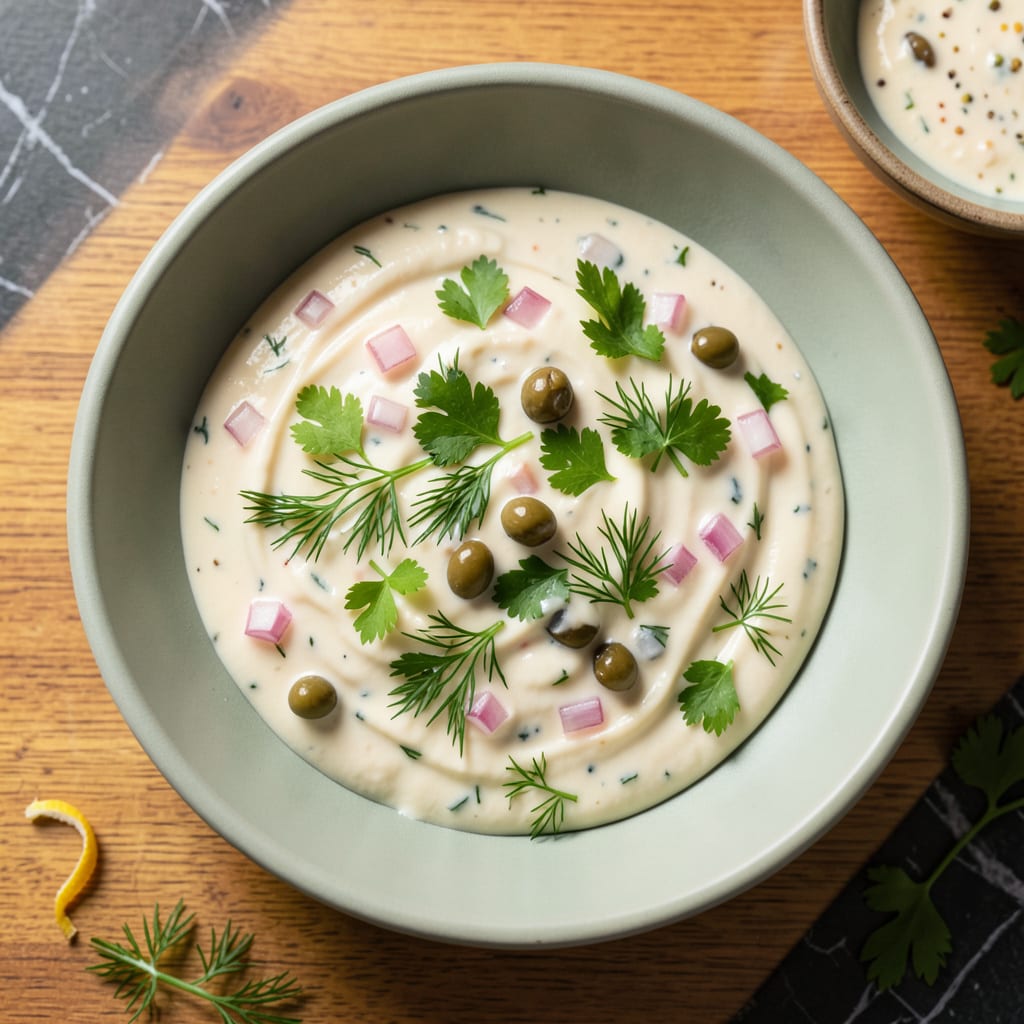
This tartar sauce delivers the perfect balance of creamy richness and tangy brightness that elevates any seafood dish. Developed with precision, it combines finely chopped capers and cornichons with fresh herbs for that signature briny, herby complexity. The technique matters as much as the ingredients here.
What sets this version apart is the careful emulsification and creamy texture that clings beautifully to fried fish or crab cakes. Unlike store-bought versions, this sauce develops deeper flavor after resting for an hour in the refrigerator. Use it as a dip, spread, or finishing touch for restaurant-quality results at home.
Ingredients for Gordon Ramsay Tartar Sauce
These precisely measured ingredients create the signature creamy, tangy balance that defines this restaurant-quality tartar sauce.
| Ingredient | Amount | Notes |
|---|---|---|
| Mayonnaise 🥫 | 1 ½ cups | High-quality, full-fat preferred |
| Cornichons 🥒 | ¼ cup | Finely chopped, drained well |
| Capers 🌿 | 2 tbsp | Non-pareil variety, drained and chopped |
| Shallot 🧅 | 2 tbsp | Finely minced, about 1 small shallot |
| Fresh Dill 🌿 | 1 tbsp | Finely chopped, stems removed |
| Fresh Flat-Leaf Parsley 🍃 | 1 tbsp | Finely chopped, leaves only |
| Dijon Mustard 🧂 | 1 tbsp | Smooth, high-quality brand |
| Fresh Lemon Juice 🍋 | 1 ½ tbsp | Newly squeezed for brightness |
| Worcestershire Sauce 💧 | ½ tsp | Anchovy-based for umami depth |
| Kosher Salt 🧂 | ½ tsp | Diamond Crystal preferred |
| Freshly Ground Black Pepper 🌶️ | ¼ tsp | Coarsely ground for texture |
The mayonnaise serves as the foundation—Hellmann’s Real Mayonnaise or Duke’s deliver optimal creaminess and stability. Cornichons and capers must be non-pareil variety for their delicate texture; avoid larger, salt-packed capers. Fresh herbs are non-negotiable: flat-leaf parsley and dill provide the necessary brightness. For shallots, select firm bulbs with dry skins—Whole Foods or specialty grocers typically stock superior quality. The Dijon mustard should be smooth and potent; Maille is the professional standard.
Substitutions require careful consideration to maintain balance. Dill pickles can replace cornichons at a 1:1 ratio, though their flavor profile differs slightly. If capers are unavailable, finely chopped green olives offer a comparable briny note. For the Worcestershire sauce, anchovy paste diluted with water (1:1 ratio) provides similar umami depth. Lemon juice may be substituted with white wine vinegar at half the quantity, though the brightness will be less pronounced. Avoid pre-ground black pepper—its volatile oils dissipate quickly.
This sauce benefits from 1 hour of refrigeration before serving to allow flavors to meld. Store in an airtight container for up to 5 days—the acidity preserves freshness. For optimal texture, avoid freezing, as emulsification may break. Prepare components separately if making ahead: chop herbs and aromatics, then combine with mayonnaise just before serving. Always use a clean spoon to prevent contamination and maintain the 7-day maximum shelf life.
Why You’ll Love This Recipe
- No Food Processor Needed: I’ve made this three times now with just a knife and a bowl. The most “work” is finely chopping the cornichons and shallot—honestly, it’s kind of therapeutic. No fancy gadgets, no extra dishes to wash.
- That Tangy, Briny Punch: Here’s what sold me—the capers and cornichons cut through the richness of the mayo like a splash of cold lemonade on a hot day. The fresh dill? It’s the herby finish that makes you go back for “just one more bite” of whatever you’re dipping.
- Fish Fry’s Best Friend: I slather this on crispy fish tacos, dollop it beside beer-battered cod, even stir a spoonful into tuna salad when I’m bored of the usual. Between us, it’s the reason my Friday night fish-and-chips feels like a restaurant meal (yes, even on a Tuesday night).
- Stays Good for Days: Unlike homemade aioli that turns sketchy overnight, this keeps in the fridge for up to 5 days—no separation, no weird aftertaste. I make a double batch on Sunday and suddenly, weekday lunches (sandwiches, wraps, even sad desk salads) feel intentional. No waste, no last-minute panic.
Step-by-Step Instructions for Tartar Sauce
Master the technique for achieving perfectly balanced tartar sauce with professional results every time.
Step 1: Prepare the Aromatic Base
Begin by finely mincing the 2 tbsp Shallot until it reaches a uniform, confetti-like consistency. Transfer to a medium mixing bowl. This forms the aromatic foundation that will carry through the entire sauce.
Add the 0.25 cup Cornichons (finely chopped and well-drained) and 2 tbsp Capers (drained and chopped) to the bowl. The cornichons provide essential acidity while the capers contribute briny complexity. Stir these ingredients together to distribute evenly.
Step 2: Incorporate Fresh Herbs and Acid
Finely chop the 1 tbsp Fresh Dill and 1 tbsp Fresh Flat-Leaf Parsley, removing all stems. Add these to the bowl along with the 1.5 tbsp Fresh Lemon Juice and 0.5 tsp Worcestershire Sauce. The fresh herbs should be added immediately after chopping to preserve their volatile oils.
The lemon juice brightens the sauce while the Worcestershire adds umami depth. Stir these wet ingredients into the cornichon mixture until fully combined. The mixture should appear vibrant with visible herb flecks throughout.
Step 3: Create the Creamy Emulsion
Add the 1.5 cups Mayonnaise to the bowl in three stages. After each addition, fold gently with a silicone spatula using a J-shaped motion to maintain air incorporation. This gradual addition prevents the sauce from breaking or becoming too thin.
Once fully incorporated, add the 1 tbsp Dijon Mustard, 0.5 tsp Kosher Salt, and 0.25 tsp Freshly Ground Black Pepper. The mustard acts as an emulsifier while the salt enhances all flavors. Fold until completely homogeneous with no visible streaks.
Step 4: Balance and Adjust Seasoning
Taste the sauce and evaluate the balance of creamy, tangy, and briny elements. The texture should coat the back of a spoon while maintaining visible texture from the chopped ingredients. If needed, adjust with additional lemon juice for acidity or mayonnaise for creaminess.
Let the sauce rest for 10 minutes at room temperature to allow flavors to meld. This resting period is crucial for the shallots to mellow and the herbs to infuse fully. The final consistency should be thick enough to cling to seafood but still spoonable.
Step 5: Serve at Optimal Temperature
Transfer the tartar sauce to a serving bowl and chill for 30 minutes before serving. The brief chilling period allows the flavors to harmonize while maintaining the ideal creamy texture. Serve slightly cool but not ice cold to preserve the full flavor profile.
For best results, use within 24 hours of preparation when the herbs are at their freshest. The sauce should appear pale with visible specks of green herbs, cornichons, and capers throughout, offering both visual appeal and textural contrast.
Troubleshooting Great gordon ramsay tartar sauce
Sauce Too Thin
If your tartar sauce feels runny, the likely culprit is excess moisture from the cornichons or capers. Always pat them dry with paper towels after chopping. For immediate fixes, fold in an additional ¼ cup mayonnaise to restore body. I’ve found that Hellmann’s works best for thickening due to its higher fat content. 💡
Overpowering Brine Flavor
When capers or cornichons dominate, balance is key. Start by adding 1 tsp honey or ½ tsp sugar to counteract saltiness. If the issue persists, dilute with 2 tbsp plain Greek yogurt—it maintains creaminess while softening the brine. Always taste as you adjust to avoid overshooting the fix.
Herbs Turn Brown
Fresh dill and parsley can oxidize quickly, turning unappetizing. To prevent this, add herbs just before serving or store sauce in an airtight container with plastic wrap pressed directly on the surface. For make-ahead batches, mix herbs into individual portions only as needed. ❄️
Sauce Separates
Emulsion breakdown often happens when ingredients aren’t fully incorporated. Re-whisk vigorously with a fork or small whisk in a circular motion. If separation persists, add ½ tsp Dijon mustard—its emulsifying properties will rebind the mixture. Avoid blenders, as they can over-process the texture.
Lacks Brightness
Flat-tasting sauce usually needs acid. Start with an extra ½ tbsp lemon juice, then taste. For complexity, add ¼ tsp white wine vinegar. I prefer freshly squeezed lemon for its vibrant, clean acidity. Remember that flavors develop after 30 minutes of chilling, so reassess before final adjustments.
Grainy Texture
Uneven chopping creates an unpleasant mouthfeel. For rescue, pulse the sauce 2-3 times in a food processor—just enough to smooth without puréeing. Alternatively, press through a fine-mesh sieve to remove larger bits. Prevention is easier: use a sharp chef’s knife and rock-chopping motion for uniform pieces. ✨
Nutrition Facts
Frequently Asked Questions
Can I use store-bought mayo for this recipe?
While homemade mayo offers superior texture, Hellmann’s Real Mayonnaise or Duke’s work perfectly here. The key is choosing full-fat versions for that signature creamy base. Avoid low-fat alternatives—they’ll compromise the rich mouthfeel.
How far in advance can I make this sauce?
For best flavor, prepare it up to 24 hours ahead. The herbs stay vibrant and the shallots mellow beautifully. Store in an airtight container with plastic wrap pressed directly on the surface to prevent browning. Beyond 2 days, the freshness noticeably declines.
What’s the best way to chop the capers and cornichons?
Use a sharp chef’s knife and the rock-chopping technique for uniform pieces. Finely mince until no piece exceeds 1/8 inch—this ensures perfect texture distribution. For extra precision, pulse briefly in a mini food processor, but don’t over-process into a paste.
Can I substitute the shallots with regular onion?
While possible, shallots offer a more delicate, sweet sharpness that’s ideal here. If substituting, use 1 tbsp finely minced red onion and soak in ice water for 10 minutes to mellow the bite. Drain well before adding to prevent watering down the sauce.
Why does my sauce taste flat after mixing?
This usually means it needs more acid or salt. Start with an extra ½ tbsp lemon juice, then taste. If still dull, add a pinch of kosher salt—it enhances all flavors. Remember that flavors bloom after 30 minutes chilling, so reassess before final adjustments.

- 6 Egg Cake Recipe with Oil: Light as Air With Buttery Moisture - October 4, 2026
- 4 Bean Casserole Recipe: One-Pan Heartiness With Smoky Paprika Depth - October 4, 2026
- 3-Ingredient Keto Mug Cake Recipe: Microwave Magic in 2 Minutes - October 4, 2026