
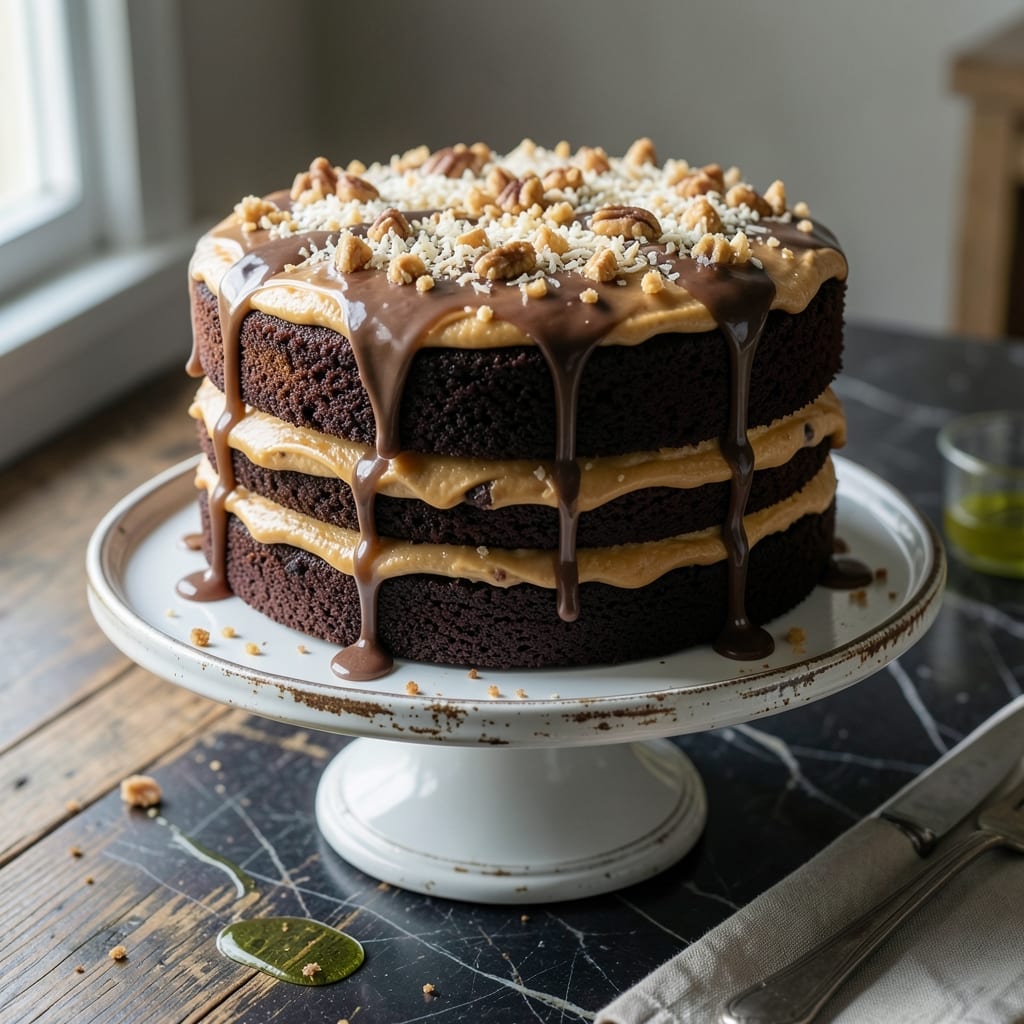
This vintage 1957 recipe brings authentic German chocolate cake to your kitchen with its signature pecan-coconut frosting.
The original version delivers rich, moist layers and a caramelized topping that defined an era of baking excellence.
Ingredients for Original German Chocolate Cake Recipe 1957
Authentic vintage ingredients deliver that 1957 German chocolate cake magic with pecan-coconut frosting.
| Ingredient | Amount | Notes |
|---|---|---|
| German Sweet Chocolate 🍫 | 4 oz | Baking bar, chopped |
| All-Purpose Flour 🌾 | 2 cups | Sifted before measuring |
| Granulated Sugar 🍚 | 2 cups | Fine white sugar |
| Light Brown Sugar 🟤 | 1 cup | Packed firmly |
| Unsalted Butter 🧈 | 1 cup | Room temperature, 2 sticks |
| Large Eggs 🥚 | 4 whole | Separated, room temperature |
| Vanilla Extract 🌿 | 2 tsp | Pure extract preferred |
| Baking Soda 🧂 | 1 tsp | Fresh for best rise |
| Salt 🧂 | ½ tsp | Fine sea salt |
| Buttermilk 🥛 | 1 cup | Full-fat for richness |
| Pecans 🌰 | 2 cups | Chopped, toasted for frosting |
| Shredded Coconut 🥥 | 1 ½ cups | Sweetened or unsweetened |
| Evaporated Milk 🥛 | 1 can | 12 oz can, undiluted |
| Light Brown Sugar 🟤 | 1 ½ cups | Packed firmly, for frosting |
| Unsalted Butter 🧈 | ½ cup | 1 stick, for frosting |
| Vanilla Extract 🌿 | 1 tsp | Pure extract, for frosting |
The chocolate must be Baker’s German Sweet Chocolate—it’s the signature ingredient that defines the flavor. Whole Foods or King Arthur Baking online carry it if your local store doesn’t. The buttermilk needs to be full-fat for the right texture, and don’t skip toasting the pecans (worth the extra minute). For the flour, Gold Medal or Pillsbury all-purpose works perfectly—no need for cake flour here.
No German chocolate? Semi-sweet chocolate plus 1 tbsp sugar gets you close but misses the caramel notes. Buttermilk substitute: whole milk with 1 tbsp vinegar. Out of pecans? Walnuts work at a one-to-one ratio. The evaporated milk is non-negotiable for the frosting’s signature caramelized texture—don’t swap it for regular milk. Brown sugar can be light or dark, but light keeps the frosting color true to the era.
Store the chocolate and pecans in cool, dark places—they keep for 6-12 months. The buttermilk lasts 1 week in the fridge once opened. Once baked, the cake stays moist for 4-5 days at room temperature in an airtight container, or freeze layers unfrosted for up to 3 months.
Why You’ll Love This Recipe
- One Bowl Wonder: I just dump the dry ingredients in one bowl, melt the chocolate and butter in a saucepan, and mix—no fancy equipment.
- Rich Chocolate Kick: The German sweet chocolate gives it that deep, slightly nutty flavor that regular cocoa can’t match.
- Crowd Pleaser: I’ve served this at birthdays, potlucks, and even a last-minute dinner party—always disappears fast.
- Keeps Like a Champ: Honestly, it tastes even better the next day, and the leftovers stay moist for up to a week.
Step-by-Step Instructions for Original German Chocolate Cake
This vintage method delivers the authentic three-layer cake with signature pecan-coconut frosting.
Step 1: Prepare the Chocolate Cake Base
Preheat your oven to 350°F and grease three 9-inch round cake pans, then line the bottoms with parchment paper. This prevents sticking and ensures clean removal after baking.
Melt the 4 oz German Sweet Chocolate with the 1 cup Unsalted Butter in a heatproof bowl over simmering water, stirring until smooth. Remove from heat and let cool slightly. In a separate bowl, whisk together the 2 cups All-Purpose Flour, 1 tsp Baking Soda, and 0.5 tsp Salt to aerate the dry ingredients.
In a large mixing bowl, beat the 2 cups Granulated Sugar with the 1 cup Light Brown Sugar and melted chocolate mixture. Add the 4 whole Large Eggs one at a time, then stir in the 2 tsp Vanilla Extract. Alternate adding the dry ingredients and 1 cup Buttermilk, beginning and ending with flour. Mix until just combined—overmixing develops gluten and creates a dense cake.
Step 2: Bake the Cake Layers
Divide the batter evenly among the prepared pans. Bake for 25-30 minutes, or until a toothpick inserted into the center comes out clean. Rotate the pans halfway through for even baking.
You’ll know the layers are done when they pull slightly away from the sides of the pans and the tops spring back when lightly pressed. Avoid opening the oven door too early, as this can cause the cakes to sink in the middle.
Cool the layers in their pans for 10 minutes, then transfer them to wire racks to cool completely. This cooling step is crucial—applying frosting to warm layers will cause it to melt and slide off.
Step 3: Make the Pecan-Coconut Frosting
In a large saucepan, combine the 1 can Evaporated Milk, 1.5 cups Light Brown Sugar, 0.5 cup Unsalted Butter, and 4 whole Large Eggs (yolks only). Cook over medium heat, stirring constantly, until the mixture thickens to a pudding-like consistency, about 10-12 minutes.
Remove from heat and stir in the 1 tsp Vanilla Extract, 2 cups Pecans, and 1.5 cups Shredded Coconut. The mixture will thicken further as it cools. Let it cool to room temperature, stirring occasionally to prevent a skin from forming on top.
Step 4: Assemble the Layered Cake
Place one cake layer on a serving plate and spread a generous portion of frosting evenly over the top. Repeat with the second layer, then place the final layer on top. Spread the remaining frosting over the top and sides of the cake, creating the signature rustic, textured appearance.
The frosting will set slightly as it cools, making the cake easier to slice. For best results, let the assembled cake rest for 1 hour before serving to allow the flavors to meld together.
Pro Tips For Making Original German Chocolate Cake Recipe 1957
- Melt Chocolate Slowly: Use a double boiler or microwave in 20-second bursts, stirring between each—German Sweet Chocolate scorches easily and turns grainy if rushed.
- Room Temp Butter: Let your unsalted butter sit out for at least an hour before creaming; cold butter won’t incorporate properly with the sugars, leaving your cake dense.
- Don’t Overmix Batter: After adding flour, mix just until combined—I learned this the hard way after my first few cakes turned out tough and chewy.
- Toast the Pecans: Spread the pecans for the frosting on a baking sheet at 350°F for 8-10 minutes before chopping; it deepens their flavor and keeps them crisp in the filling.
Wine and Beer Pairings for These Flavors
Beer Pairings
The rich, chocolatey depth of the original German chocolate cake recipe 1957 pairs beautifully with dark, malty beers. A stout or porter like Guinness or Samuel Smith’s Oatmeal Stout complements the cake’s cocoa notes with its roasted, coffee-like flavors. For a lighter contrast, a brown ale such as Newcastle offers caramel and nutty undertones that harmonize with the pecan-coconut frosting.
Wine Pairings
A bold Cabernet Sauvignon or Port enhances the cake’s intensity, with dark fruit and chocolate notes mirroring its flavors. For a sweeter match, a Tawny Port like Graham’s 10-Year adds layers of caramel and dried fruit that pair wonderfully with the frosting’s richness. A Zinfandel also works, offering jammy berry notes that cut through the sweetness.
Non-Alcoholic Options
For a non-alcoholic pairing, try a cold brew coffee with a splash of cream to echo the cake’s depth. A sparkling chocolate soda or cream soda can also be a fun, bubbly contrast to the dense, fudgy texture. These options keep the focus on the vintage dessert’s indulgent flavors without overpowering them.
Nutrition Facts

- 6 Egg Cake Recipe with Oil: Light as Air With Buttery Moisture - October 4, 2026
- 4 Bean Casserole Recipe: One-Pan Heartiness With Smoky Paprika Depth - October 4, 2026
- 3-Ingredient Keto Mug Cake Recipe: Microwave Magic in 2 Minutes - October 4, 2026