
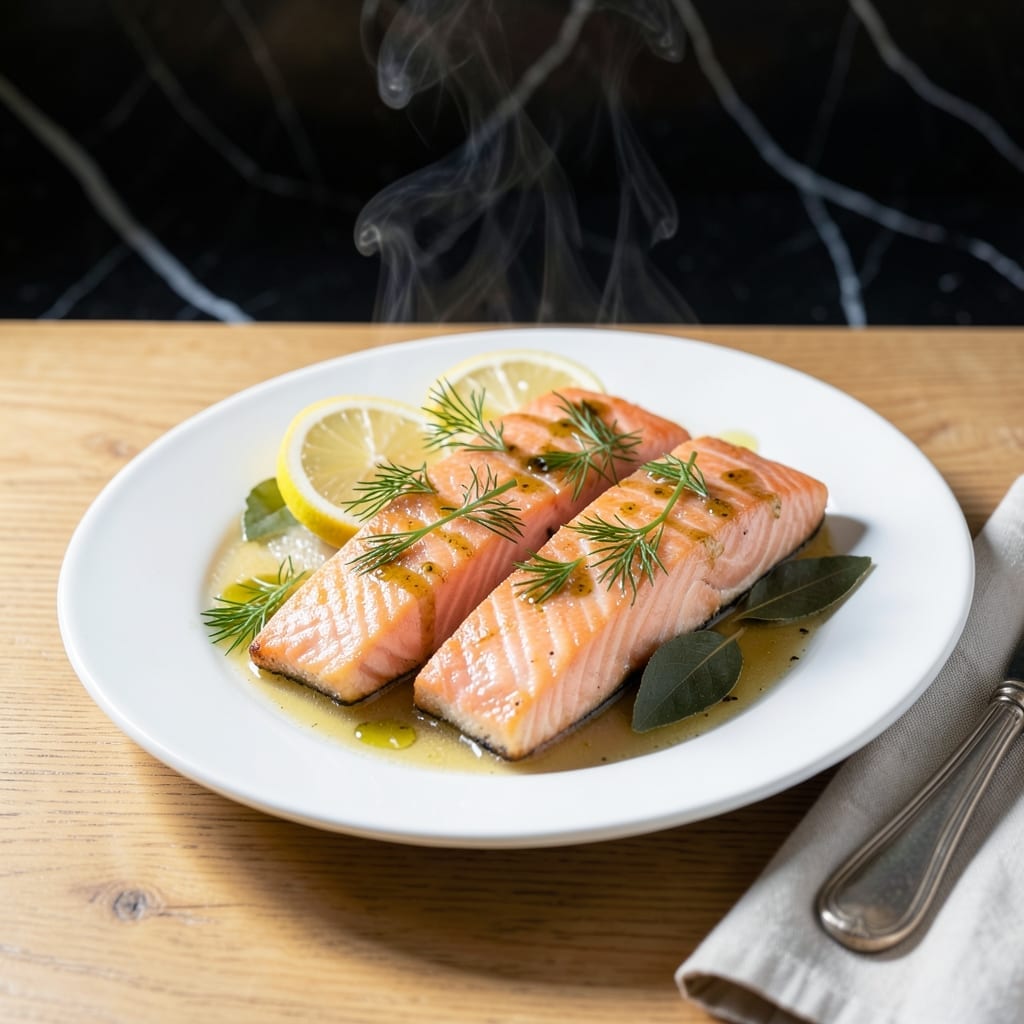
There’s a reason Jamie Oliver’s approach to poached salmon is so revered—it preserves the fish’s natural tenderness while infusing it with subtle flavor. This method relies on gentle heat and a flavorful liquid to create silky, perfectly cooked salmon every time.
The technique is simple but precise: simmer the salmon in a court bouillon or lightly seasoned water, ensuring the temperature stays just below boiling. This keeps the fish moist and prevents it from drying out, resulting in a delicate, flaky texture.
What sets this apart is the attention to detail—fresh herbs, a splash of white wine, and aromatic vegetables elevate the poaching liquid. The salmon absorbs these flavors without overpowering its natural taste.
Serve it warm or chilled, paired with a light sauce or fresh greens. This dish proves that sometimes, the simplest methods yield the most impressive results.
Ingredients for Poached Salmon Recipe Jamie Oliver
Fresh salmon and aromatic herbs create this elegant poached dish with minimal effort.
| Ingredient | Amount | Notes |
|---|---|---|
| Salmon Fillets 🐟 | 1 ½ lb | Skin-on or skinless, center-cut preferred |
| Dry White Wine 🍷 | 2 cups | Sauvignon Blanc or Pinot Grigio recommended |
| Water 💧 | 4 cups | Filtered for best flavor |
| Fresh Lemon Slices 🍋 | 4 slices | Thinly sliced, seeds removed |
| Bay Leaves 🍃 | 2 whole | Dried, whole leaves |
| Fresh Dill Sprigs 🌿 | 4 sprigs | Or 2 tbsp chopped fresh dill |
| Fresh Parsley Sprigs 🌿 | 4 sprigs | Flat-leaf variety preferred |
| Black Peppercorns 🌶️ | 1 tsp | Whole, lightly crushed |
| Kosher Salt 🧂 | 1 tbsp | Diamond Crystal preferred |
| Shallot 🧅 | 1 whole | Thinly sliced |
| Carrot 🥕 | 1 whole | Cut into thick rounds |
| Celery Stalk 🌿 | 1 whole | Cut into 2-inch pieces |
| Fresh Lemon Juice 🍋 | 2 tbsp | For finishing |
| Extra-Virgin Olive Oil 🫒 | 2 tbsp | For drizzling |
The salmon quality is paramount. Wild-caught sockeye or coho offer the best flavor and texture. Whole Foods or Costco typically carry excellent fresh options. Look for fillets with vibrant color and no fishy odor. For the court bouillon, a dry white wine with crisp acidity like Sauvignon Blanc enhances the poaching liquid beautifully.
No white wine? Substitute with additional water and 1 tbsp of white wine vinegar. Fresh herbs can be swapped—fennel fronds or tarragon work well. If using dried herbs, reduce to one-third the amount. The shallot can be replaced with a small onion, though the flavor profile will be slightly different.
Poached salmon keeps well in the fridge for 2-3 days. Store it in its poaching liquid to maintain moisture. Best served warm or at room temperature. The poaching liquid can be strained and reduced for a light sauce (3-4 days refrigerated).
Why You’ll Love This Recipe
- One-Pan Elegance: I love that this comes together in a single saucepan—just salmon, wine, lemon, and bay leaves simmering away while I set the table.
- Bright, Clean Flavor: The wine and lemon slices infuse the salmon with a delicate, citrusy taste that feels fancy without being overpowering.
- Dinner Party Ready: Honestly, it’s my go-to for impressing guests with minimal effort—looks beautiful and tastes like I slaved for hours.
- Budget-Friendly Luxe: A few affordable fillets and pantry staples turn into a restaurant-worthy meal, and leftovers make killer salads the next day.
Step-by-Step Instructions for Poached Salmon
Here’s the method. Straightforward, tested, works every time.
Step 1: Prepare the Poaching Liquid
In a large, deep skillet or wide pot, combine the 4 cups Water, 2 cups Dry White Wine, 1 tbsp Kosher Salt, and 1 tsp Black Peppercorns. Add the sliced Shallot, Carrot, and Celery Stalk along with the 2 whole Bay Leaves, 4 sprigs Fresh Dill Sprigs, and 4 sprigs Fresh Parsley Sprigs.
Bring to a gentle simmer over medium heat—you want small bubbles, not a rolling boil. This ensures the liquid infuses with flavor without becoming too aggressive. Simmer for 10 minutes to allow the aromatics to fully develop their essence in the broth.
Step 2: Add the Salmon and Poach Gently
Lower the 1.5 lb Salmon Fillets into the simmering liquid, ensuring they are fully submerged. If needed, add a bit more water to cover. The liquid should just barely shimmer—you’ll see tiny bubbles breaking the surface, but it should never reach a boil.
Poach the salmon for 8-10 minutes depending on thickness. You’ll know it’s done when the flesh turns from translucent to opaque and flakes easily with a fork. Avoid stirring or disturbing the fillets—this keeps them intact and prevents sticking.
Step 3: Finish with Lemon and Rest
Using a slotted spatula, carefully transfer the salmon to a serving platter. Add the 4 slices Fresh Lemon Slices to the poaching liquid and let them steep for 1 minute to infuse extra brightness. Remove the lemon slices and arrange them over the salmon.
Drizzle the fillets with the 2 tbsp Fresh Lemon Juice and the 2 tbsp Extra-Virgin Olive Oil. Let the salmon rest for 5 minutes before serving—this allows the flavors to meld and the fish to finish cooking gently from residual heat.
Step 4: Serve with Poaching Liquid
Ladle some of the warm poaching liquid over the salmon just before serving. The liquid should be fragrant with herbs and vegetables, adding depth to the dish. Discard the spent aromatics from the liquid if desired, or leave them as a rustic touch.
Serve immediately, with extra lemon slices on the side. The salmon should be tender, silky, and infused with the delicate flavors of wine, herbs, and citrus. Each bite should be moist, with a subtle complexity from the poaching broth.
Pro Tips For Making Poached Salmon Recipe Jamie Oliver
- Simmer, Don’t Boil: Keep the heat low enough that the liquid barely trembles—any harder and the salmon will toughen. I learned this the hard way after my first few fillets turned rubbery.
- Pat Fillets Dry: Quickly pat the salmon dry with a paper towel before poaching to help it absorb the wine and lemon flavors better. Sounds minor, but it actually changes the outcome.
- Skip the Overcrowding: Poach the fillets in a single layer with space between them, or they’ll steam unevenly. After burning three batches, I finally figured out this was the culprit.
- Use Cold Liquid: Start the salmon in cold wine and water, then bring it up to a simmer—this guarantees even cooking and prevents the outside from overcooking before the inside’s done.
Creative Variations of This Recipe
Mediterranean Twist
Swap the white wine for 2 cups vegetable broth and add ½ cup Kalamata olives, 1 tbsp capers, and 3 garlic cloves. The briny, savory notes pair beautifully with the salmon’s richness. Finish with a sprinkle of crumbled feta for a Greek-inspired dish. 🌿
Asian-Inspired Flavor
Replace the wine with 2 cups water and ¼ cup soy sauce. Add 1-inch ginger slices, 2 star anise pods, and 1 stalk lemongrass. The aromatic poaching liquid infuses the salmon with warm, umami depth. Serve with steamed jasmine rice.
Citrus and Herb
Boost the citrus by adding 1 naval orange slice and 1 lime slice to the poaching liquid. Use fresh thyme and rosemary instead of dill and parsley. The bright, herbal notes make this version feel fresh and vibrant.
Creamy Dill Sauce
After poaching, reduce the liquid by half, then whisk in ½ cup crème fraîche and 1 tbsp Dijon mustard. This silky sauce adds a tangy richness that complements the salmon beautifully. Spoon it over the fillets just before serving.
Spiced Chai Poach
For a warm, aromatic twist, add 1 cinnamon stick, 3 cardamom pods, and 5 whole cloves to the liquid. The spices create a subtly sweet, fragrant base that pairs surprisingly well with the salmon’s delicate flavor. 💡
Lemon-Garlic Butter
After poaching, melt 4 tbsp butter with 2 minced garlic cloves and 1 tbsp lemon zest. Drizzle this over the salmon for a luxurious finish. The butter adds richness while keeping the dish light and flavorful.
Nutrition Facts
Frequently Asked Questions
What temperature should the poaching liquid be?
Keep it at a gentle simmer around 160-180°F. Tiny bubbles should barely break the surface—never boiling. This prevents overcooking and keeps the salmon tender.
Can I use frozen salmon for poaching?
Yes, but thaw it completely in the fridge first. Poaching partially frozen fish can result in uneven cooking. Pat it dry before adding to the liquid for best results.
How do I know when the salmon is done?
The flesh should turn opaque and flake easily with a fork. For 1.5-inch fillets, this takes about 8-10 minutes. Avoid overcooking by checking early.
What can I use instead of white wine?
Substitute with 2 cups water plus 1 tbsp vinegar or vegetable broth. The acidity mimics wine’s brightness, though the flavor profile will be milder.

- 6 Egg Cake Recipe with Oil: Light as Air With Buttery Moisture - October 4, 2026
- 4 Bean Casserole Recipe: One-Pan Heartiness With Smoky Paprika Depth - October 4, 2026
- 3-Ingredient Keto Mug Cake Recipe: Microwave Magic in 2 Minutes - October 4, 2026