
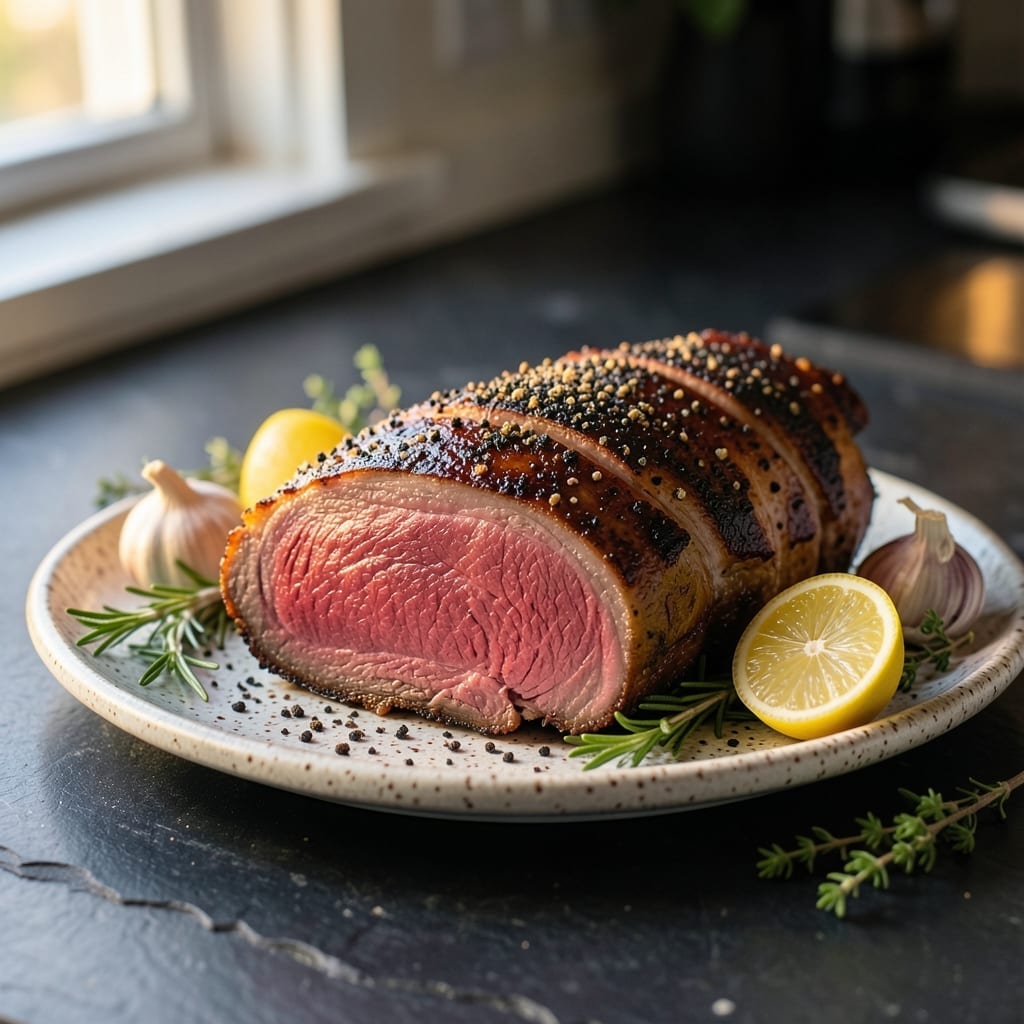
This bone-in prime rib is the ultimate holiday centerpiece, delivering restaurant-quality results with a simple herb crust.
Achieve perfectly tender, juicy meat with a golden crust by following this proven method for a show-stopping main dish.
Ingredients for Prime Rib Roast Recipe Bone In
Sixteen ingredients create this restaurant-quality bone-in prime rib with herb crust.
| Ingredient | Amount | Notes |
|---|---|---|
| Bone-In Prime Rib Roast 🥩 | 5 lb | Well-marbled, first cut preferred |
| Kosher Salt 🧂 | 2 tbsp | Diamond Crystal preferred for even seasoning |
| Freshly Ground Black Pepper 🌶️ | 1 tbsp | Coarse grind for crust |
| Fresh Rosemary 🌿 | 3 sprigs | Stems removed, finely chopped |
| Fresh Thyme 🍃 | 3 sprigs | Leaves stripped from stems |
| Fresh Garlic Cloves 🧄 | 6 cloves | Minced to fine paste consistency |
| Dijon Mustard 🟡 | 2 tbsp | Whole grain or smooth variety |
| Extra-Virgin Olive Oil 🫒 | 2 tbsp | High-quality, cold-pressed |
| Dry Red Wine 🍷 | 1 cup | Bold variety like Cabernet Sauvignon |
| Unsalted Butter 🧈 | 4 tbsp | Softened to room temperature |
| Beef Stock 🥘 | 2 cups | Low-sodium preferred for reduction |
| All-Purpose Flour 🌾 | 1 tbsp | For thickening pan juices |
The prime rib is non-negotiable here—bone-in first cut delivers superior flavor and presentation. Source from a reputable butcher like Whole Foods or a local specialty shop, requesting a well-marbled roast with the fat cap intact. Diamond Crystal kosher salt is essential for proper seasoning penetration. For the herbs, fresh rosemary and thyme are mandatory (dried won’t achieve the same aromatic impact). Always check the sell-by date on beef stock—freshness matters for the reduction.
No red wine? Substitute with additional beef stock plus 1 tbsp balsamic vinegar for acidity. Fresh herbs unavailable? Use half the amount of dried, but the flavor profile will be less vibrant. Garlic can be substituted with 2 tsp garlic powder (though fresh is superior). For a gluten-free version, cornstarch replaces flour in the pan sauce. Butter can be swapped with ghee for a richer, clarified flavor.
Prime rib is best cooked immediately after purchase, but can be refrigerated for 2-3 days if necessary. Store herbs wrapped in damp paper towels in a sealed container for 5-7 days. The roast can be carved and reheated gently in beef stock to maintain moisture, though it’s ideal served fresh from the oven.
Why You’ll Love This Recipe
- Set and Forget: I season it with salt, pepper, rosemary, and thyme, pop it in the oven, and let the bone-in prime rib do all the work.
- Rich Herb Crust: That combo of fresh rosemary and thyme with the natural beef juices? Ridiculously good.
- Holiday Showstopper: Between us, this is my go-to for Christmas dinner—impresses every single time.
- Next-Day Magic: Honestly, the leftovers make the best sandwiches I’ve ever had.
Step-by-Step Instructions for Bone-In Prime Rib Roast
Master the technique for a showstopping roast with a perfect herb crust and rich pan sauce.
Step 1: Prepare the Herb Paste and Season the Roast
Remove the bone-in prime rib roast from the refrigerator 2 hours before cooking to bring it to room temperature. This ensures even cooking throughout the thick cut. Pat it completely dry with paper towels—moisture prevents proper browning.
In a small bowl, combine the 2 tbsp Dijon mustard, 2 tbsp extra-virgin olive oil, chopped 3 sprigs fresh rosemary, stripped leaves from 3 sprigs fresh thyme, and minced 6 cloves fresh garlic cloves into a thick paste. Rub this mixture evenly over the entire surface of the roast, pressing it into the meat. Season generously with the 2 tbsp kosher salt and 1 tbsp freshly ground black pepper. Let the seasoned roast sit uncovered while the oven preheats.
Step 2: Sear and Begin Roasting
Preheat your oven to 450°F. Place the roast bone-side down in a roasting pan with the fat cap facing up. This high-heat sear creates a flavorful crust. Roast at 450°F for 20 minutes to develop a deep brown exterior.
After searing, reduce the oven temperature to 325°F. Insert a meat thermometer into the thickest part of the roast, avoiding the bone. Continue roasting, basting occasionally with the pan drippings. This step ensures the herb paste forms a golden crust while the interior cooks slowly to your desired doneness.
Step 3: Roast to Desired Internal Temperature
Roast at 325°F until the internal temperature reaches 120-125°F for medium-rare (approximately 1.5 to 2 hours for a 5 lb roast). The exact time varies based on your oven and the roast’s shape, so rely on the thermometer rather than timing alone.
For medium, aim for 130-135°F. Remember that the temperature will rise an additional 5-10°F during resting. The roast is ready when the meat pulls away slightly from the bones and the thermometer registers your target temperature.
Step 4: Rest and Prepare the Pan Sauce
Transfer the roast to a cutting board, tent loosely with foil, and let it rest for 20-30 minutes. This critical step allows the juices to redistribute, ensuring moist, flavorful slices. Do not skip this resting period—it makes a significant difference in texture and moisture.
While the roast rests, place the roasting pan on the stovetop over medium heat. Add the 1 cup dry red wine and deglaze the pan, scraping up all the browned bits. Simmer for 2-3 minutes until reduced by half. Add the 2 cups beef stock and bring to a simmer.
Step 5: Finish the Sauce and Serve
In a small bowl, mix the 1 tbsp all-purpose flour with 2 tbsp of the 4 tbsp unsalted butter to form a beurre manié. Whisk this mixture into the simmering pan juices and cook for 3-4 minutes until the sauce thickens enough to coat the back of a spoon.
Remove from heat and whisk in the remaining 2 tbsp unsalted butter until fully incorporated. Strain the sauce through a fine-mesh sieve for a smooth consistency. Carve the roast between the bones into thick slices and serve with the rich, herb-infused pan sauce.
Pro Tips For Making Prime Rib Roast Recipe Bone In
- Rest the Roast: After pulling it from the oven, let the prime rib rest for at least 20-30 minutes under loose foil. I learned this the hard way—the juices redistribute, and slicing too soon leaves you with a dry, sad dinner.
- Salt Overnight: Rub the roast with kosher salt 12-24 hours before cooking. Sounds weird, but it works: the salt penetrates deep, and the crust turns out impossibly crisp.
- Skip Cold Meat: Take the roast out of the fridge 2-3 hours before cooking to bring it to room temperature. After burning the edges on my first few attempts, I finally figured out this prevents uneven cooking.
- Herb Paste: Crush the rosemary and thyme with a little olive oil into a paste before rubbing it on. My grandmother swore by this, and she was right: the flavors stick better and infuse every bite.
Essential Equipment for This Recipe
Must-Have Tools 🔪
A sharp carving knife (like the Wüsthof Classic) is non-negotiable for slicing through the bone-in prime rib cleanly. A roasting pan with a rack (such as the All-Clad Stainless Steel Roaster) ensures even heat circulation for perfect browning.
Don’t skip a meat thermometer—the Thermoworks Smoke is a chef favorite for precision. Tongs and a basting spoon help manage juices and flipping with ease.
Nice-to-Have Upgrades 🍳
A stand mixer (like the KitchenAid Artisan) speeds up herb crust prep. For even cooking, a reverse sear setup with a pellet grill (e.g., Traeger Pro Series) adds smoky depth.
A fat separator (such as the OXO Good Grips) makes gravy silky smooth. A wireless probe thermometer lets you monitor temps without opening the oven.
Budget Alternatives ✨
Swap pricier knives for a victorinox fibrox—affordable and razor-sharp. Use a disposable aluminum pan with a DIY rack (crumpled foil works!).
For temp checks, an instant-read thermometer (like the Taylor Precision) is a wallet-friendly pick. Baste with a heatproof silicone brush instead of a spoon.
Nutrition Facts

- 6 Egg Cake Recipe with Oil: Light as Air With Buttery Moisture - October 4, 2026
- 4 Bean Casserole Recipe: One-Pan Heartiness With Smoky Paprika Depth - October 4, 2026
- 3-Ingredient Keto Mug Cake Recipe: Microwave Magic in 2 Minutes - October 4, 2026