
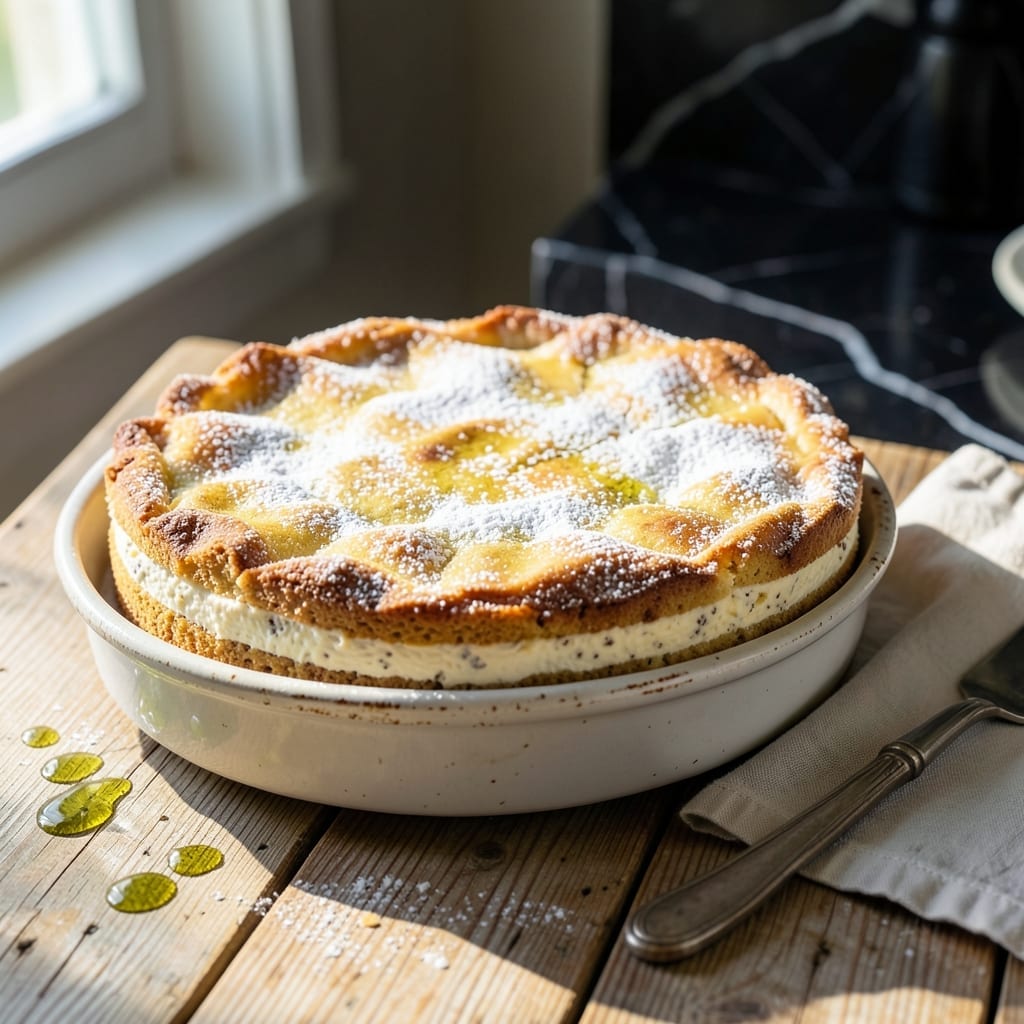
This chess cake delivers a perfect balance of creamy filling and a buttery, flaky crust that melts in your mouth. The layers come together beautifully with every bite.
I’ve refined this recipe to ensure the filling sets just right—smooth and slightly gooey without being runny. The crust stays crisp and golden, providing the perfect contrast to the rich, custard-like center.
With simple ingredients and straightforward steps, this dessert bakes up in under an hour. It’s ideal for gatherings or a special treat at home.
Serve it warm or chilled, and watch it disappear. Here’s how to make it happen.
Ingredients for Recipe for Chess Cake
Simple pantry staples create this rich, layered dessert with ease.
| Ingredient | Amount | Notes |
|---|---|---|
| All-Purpose Flour 🌾 | 2 cups | Plus extra for dusting |
| Granulated Sugar 🍚 | 1 ½ cups | Divided for crust and filling |
| Unsalted Butter 🧈 | 1 cup | Cold, cubed for crust |
| Yellow Cornmeal 🌽 | 2 tbsp | Fine grind for texture |
| Salt 🧂 | ½ tsp | Divided for crust and filling |
| Cream Cheese 🧀 | 16 oz | Full-fat, softened to room temperature |
| Large Eggs 🥚 | 3 whole | Room temperature for smooth filling |
| Vanilla Extract 🌿 | 2 tsp | Pure extract for best flavor |
| Ice Water 💧 | 3 tbsp | For crust dough binding |
| Powdered Sugar 🍚 | ½ cup | For dusting finished cake |
The butter must be cold for the crust—Land O’Lakes or Plugrá work well. Use a food processor for even mixing, but a pastry cutter or fork works too (worth the extra minute). Cream cheese quality matters; Philadelphia brand gives the smoothest texture. Don’t substitute low-fat here—it won’t set properly.
No cornmeal? Fine semolina works as a swap. For a gluten-free crust, use a 1:1 GF flour blend (King Arthur’s is reliable). Eggs can’t be skipped, but in a pinch, extra cream cheese at a 1:1 ratio keeps the filling stable. Vanilla extract is non-negotiable—imitation vanilla lacks depth.
Assembled cake keeps 5 days in the fridge. Freeze for up to 3 months (thaw overnight). Dust with powdered sugar just before serving—adds that bakery finish. Always cool completely before slicing for clean layers.
Why You’ll Love This Recipe
- I’ll be real: it tastes even better the next day, and a 9×13 pan means leftovers for the whole week.
- One Bowl Magic: I mix everything in a single bowl—flour, sugar, butter, cornmeal—no fancy tools, just a spoon and 5 minutes.
- Buttery Cornmeal Crunch: That yellow cornmeal gives it this subtle crunch with the butter that’s just ridiculous in the best way.
- Potluck MVP: Honestly, it’s my go-to for church suppers, kids’ birthdays, or just because Tuesday needs a win.
Step-by-Step Instructions for Chess Cake
Follow this tested method for perfect layers and a buttery crust that holds together beautifully.
Step 1: Prepare the Shortbread Crust
In a food processor, pulse the 2 cups All-Purpose Flour, 2 tbsp Yellow Cornmeal, 0.5 tsp Salt, and 1 cup Unsalted Butter (cold and cubed) until the mixture resembles coarse crumbs. The butter should be pea-sized—this ensures a flaky texture rather than dense.
With the processor running, drizzle in the 3 tbsp Ice Water 1 tablespoon at a time until the dough just comes together. It should hold when pressed but not be sticky. Overworking the dough develops gluten, which toughens the crust.
Step 2: Press, Chill, and Pre-Bake the Crust
Press the dough evenly into a 9×13-inch baking pan, ensuring it covers the bottom completely and climbs slightly up the sides. Use the bottom of a measuring cup to create an even layer—this prevents uneven baking and cracking.
Chill the crust in the refrigerator for 30 minutes to firm up the butter. Then, preheat the oven to 350°F and bake the crust for 15-18 minutes until the edges are just starting to turn light golden brown. Remove it from the oven and let it cool slightly while you prepare the filling.
Step 3: Make the Cream Cheese Filling
In a large bowl, beat the 16 oz Cream Cheese (softened to room temperature) until smooth and creamy, about 2 minutes. Add the 1.5 cups Granulated Sugar and beat for another 2 minutes until fully incorporated and slightly fluffy.
Add the 3 whole Large Eggs one at a time, mixing well after each addition. Stir in the 2 tsp Vanilla Extract. The filling should be smooth and pourable—if it looks lumpy, the cream cheese wasn’t soft enough, so let it sit at room temperature for another 10-15 minutes before retrying.
Step 4: Bake the Cake to Gooey Perfection
Pour the filling over the pre-baked crust, spreading it evenly with a spatula. Return the pan to the 350°F oven and bake for 40-45 minutes until the edges are set but the center still has a slight jiggle when gently shaken.
Avoid overbaking—the center will continue to set as it cools. You want that signature gooey layer beneath a firm top. If the top begins to brown too quickly, loosely tent the pan with foil during the last 10-15 minutes of baking.
Step 5: Cool, Dust, and Serve
Allow the cake to cool completely in the pan on a wire rack, about 2 hours. This cooling time is crucial—it lets the layers set properly and makes the cake easier to slice cleanly. Resist the urge to rush this step; warm cake will be too soft to cut neatly.
Once fully cooled, dust the top evenly with the 0.5 cup Powdered Sugar. Slice into squares and serve at room temperature. The contrast of the crisp, buttery crust and the rich, creamy filling is what makes this dish unforgettable.
Pro Tips For Making Recipe For Chess Cake
- Room Temp Butter: Pull your unsalted butter out at least 1 hour before mixing—cold butter leaves lumps and warm butter flattens the texture. I learned this the hard way after three dense cakes.
- Toast the Cornmeal: Lightly brown the yellow cornmeal in a dry pan for 2-3 minutes before adding it to the batter. Sounds weird, but it actually changes the outcome, giving the cake a deeper, nuttier flavor.
- Skip Overmixing: Mix the batter just until the flour disappears—overworking it develops gluten, and your chess cake will end up tough instead of tender.
- Measure Flour Right: Spoon your all-purpose flour into the measuring cup and level it off, or use a scale for 120g per cup. Scooping directly from the bag packs it down and adds 20-30% more, which ruins the texture.
Common Mistakes When Making Great recipe for chess cake
Overworking the Crust
When making the shortbread base, pulse just until pea-sized crumbs form. Overmixing develops gluten, which creates a tough, dense crust instead of the flaky, buttery texture you want. I stop my food processor the moment the butter is evenly distributed. 💡
Skipping the Chill
Don’t rush the 30-minute chill for the pressed crust. This step firms up the butter so it doesn’t melt too quickly in the oven, which would cause the crust to spread unevenly. I’ve ruined batches by skipping this—lesson learned the hard way.
Cold Cream Cheese
Your 16 oz cream cheese must be fully softened to room temperature. Cold cream cheese creates lumps in the filling that won’t smooth out, no matter how long you beat it. I set mine out 2 hours before starting or microwave in 10-second bursts if I’m in a hurry.
Overbaking the Filling
The center should jiggle slightly when you take it out. Overbaking turns the filling dense and dry. If the top browns too fast, tent with foil at the 30-minute mark. The carryover heat will finish the setting as it cools.
Slicing Too Soon
Let the cake cool completely—about 2 hours—before slicing. Cutting warm cake causes the filling to ooze out and the layers to separate. I know it’s tempting, but patience here makes all the difference.
Incorrect Pan Size
Use a 9×13-inch pan for even baking. A smaller pan makes the crust too thick, while a larger one spreads the filling too thin. I line mine with parchment for easy removal and clean slices.
Nutrition Facts
Frequently Asked Questions
Can I use a different pan size?
Stick to a 9×13-inch pan for even baking. A smaller pan makes the crust too thick, while a larger one spreads the filling too thin, affecting texture and cook time.
Why does my filling turn out lumpy?
Lumps usually mean the 16 oz cream cheese wasn’t fully softened. Let it sit at room temperature for 2 hours before mixing, or use 10-second microwave bursts to soften it quickly.
How do I store leftovers?
Keep in an airtight container in the fridge for up to 5 days. For longer storage, freeze for 3 months and thaw overnight before serving.
Can I make this gluten-free?
Yes! Swap the all-purpose flour for a 1:1 gluten-free blend. The texture will be slightly different but still delicious.

- 6 Egg Cake Recipe with Oil: Light as Air With Buttery Moisture - October 4, 2026
- 4 Bean Casserole Recipe: One-Pan Heartiness With Smoky Paprika Depth - October 4, 2026
- 3-Ingredient Keto Mug Cake Recipe: Microwave Magic in 2 Minutes - October 4, 2026