
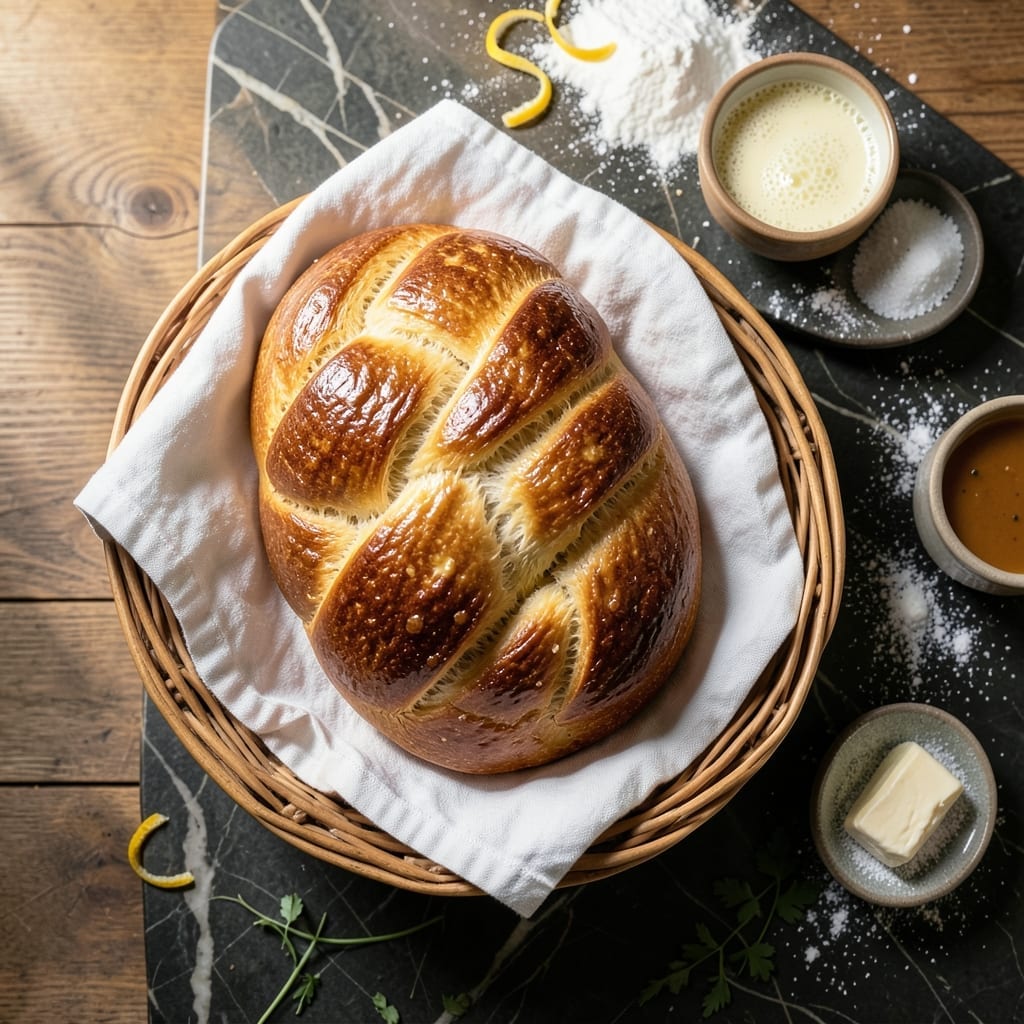
This traditional Greek Easter bread brings generations of baking wisdom to your kitchen table.
With its sweet, lightly spiced dough and distinctive braided shape, this creation delivers restaurant-quality results that honor authentic techniques.
Ingredients for Recipe for Tsoureki Bread
Traditional ingredients bring this sweet, spiced braided bread to life right in your kitchen.
| Ingredient | Amount | Notes |
|---|---|---|
| All-Purpose Flour 🌾 | 4 cups | Plus extra for dusting |
| Granulated Sugar 🍚 | ¾ cup | Divided for dough and glaze |
| Whole Milk 🥛 | 1 cup | Warm, about 110°F |
| Unsalted Butter 🧈 | ½ cup | Melted and cooled |
| Large Eggs 🥚 | 3 whole | Room temperature, divided |
| Active Dry Yeast 🍞 | 2 ¼ tsp | One packet, proofed |
| Ground Mahlep 🌿 | 1 tsp | Traditional Greek spice |
| Ground Cinnamon 🌶️ | ½ tsp | For warm spice flavor |
| Orange Zest 🍊 | 1 tbsp | From 1 large orange |
| Vanilla Extract 💧 | 1 tsp | Pure for best flavor |
| Salt 🧂 | 1 tsp | Fine sea salt preferred |
| Red Dyed Eggs 🥚 | 3 whole | For braid decoration |
| Sesame Seeds 🌿 | 2 tbsp | For topping the braid |
The mahlep is key here—Greek markets or online spice shops like Penzeys usually carry it. If you can’t find it, don’t skip the orange zest (that bright citrus note balances the sweetness perfectly). For the milk and butter, whole milk and high-quality butter give you the richest dough. I always use Plugrá butter for baking—it’s got that perfect 82% fat content for flaky layers.
No mahlep? Cardamom at half the amount gets you close. Short on orange zest? Lemon zest works too. For the eggs, if you’re worried about the red dye, natural alternatives like beet juice or paprika can tint them (though the color won’t be as vibrant). The flour can be bread flour if you want a slightly chewier texture—just don’t go over 4 cups total.
This bread tastes best the day it’s made but keeps well wrapped at room temp for 3-4 days. Leftovers? Toast slices and slather with honey. The dough can be made ahead—refrigerate overnight, then shape and bake the next morning. Freezes beautifully for up to 1 month.
Why You’ll Love This Recipe
- Mix & Forget: I love that I can toss the flour, milk, and eggs into the stand mixer and let the dough hook do all the work.
- Buttery Sweetness: The butter and sugar give it that rich, slightly sweet flavor that makes it impossible to resist warm from the oven.
- Holiday Star: It’s my go-to for Easter brunch, but honestly, I bake it just because it makes the house smell incredible.
- Stays Fresh: Leftovers? No problem—it stays soft for days, and toasted with jam, it’s even better the next morning.
Step-by-Step Instructions for Tsoureki Bread
Here’s my tested method for achieving that signature fluffy texture and golden braid.
Step 1: Activate the Yeast and Mix the Dough
Begin by proofing the 2.25 tsp active dry yeast in the warm 1 cup whole milk with a pinch of the 0.75 cup granulated sugar. Let it sit for 5-10 minutes until foamy—that’s your sign the yeast is active and ready to work its magic.
In a large bowl, combine the 4 cups all-purpose flour, remaining granulated sugar, 1 tsp salt, 1 tsp ground mahlep, and 0.5 tsp ground cinnamon. Make a well in the center and add the proofed yeast mixture, 0.5 cup melted unsalted butter, 2 large eggs (save one for egg wash), 1 tbsp orange zest, and 1 tsp vanilla extract.
Step 2: Knead Until Smooth and Elastic
Mix the dough with a wooden spoon until it comes together, then turn it out onto a lightly floured surface. Knead for 8-10 minutes by hand, or use a stand mixer with a dough hook for 5-7 minutes on medium speed. You’re aiming for a soft, slightly sticky dough that springs back when poked.
This is where the texture is made—don’t rush it. The dough should pull away from the sides of the bowl and feel smooth to the touch. If it’s too sticky, add a sprinkle more all-purpose flour, but go easy; you want it slightly tacky.
Step 3: First Rise Until Doubled in Size
Place the dough in a greased bowl, cover it with a clean kitchen towel, and let it rise in a warm, draft-free spot for 1.5-2 hours, or until it’s doubled in volume. I like to turn my oven on to its lowest setting, then turn it off and place the bowl inside—creates the perfect environment.
Poke the dough with your finger; if the indentation stays, it’s ready. This first rise develops the flavor and structure, so don’t skip it. The dough should look puffy and jiggle slightly when you move the bowl.
Step 4: Shape, Braid, and Add the Red Eggs
Punch down the risen dough and divide it into 3 equal portions. Roll each into a 24-inch long rope, tapering the ends slightly. Lay the ropes parallel to each other and pinch the tops together. Braid the dough, crossing the outer ropes over the center one alternately.
Gently press the 3 whole red dyed eggs into the braids where the strands cross, spacing them evenly. This is the signature look of tsoureki, so take your time. Tuck the ends under and pinch to seal.
Step 5: Second Rise, Egg Wash, and Bake
Place the braided loaf on a parchment-lined baking sheet. Cover loosely and let it rise again for 45-60 minutes until puffy. Preheat your oven to 350°F during the last 15 minutes of rising.
Beat the remaining 1 large egg and brush it generously over the loaf. Sprinkle with the 2 tbsp sesame seeds, pressing them lightly so they adhere. Bake for 25-30 minutes until the loaf is deep golden brown and sounds hollow when tapped.
If it’s browning too quickly, tent with foil. The internal temperature should reach 190°F. Let it cool on a wire rack for 20 minutes before slicing—this keeps the texture soft and prevents the loaf from crumbling.
Pro Tips For Making Recipe For Tsoureki Bread
- Warm the Milk: Heat the whole milk to about 110°F before mixing—too hot kills the yeast, too cold slows activation. I learned this the hard way after a loaf that refused to rise.
- Soften Butter Properly: Let the unsalted butter sit at room temperature for 45-60 minutes until pliable but not greasy. Sounds obvious, but cold butter tears the dough instead of incorporating smoothly.
- Test Dough Elasticity: Knead until the dough passes the windowpane test—stretch a small piece thin enough to see light through it without tearing. Skip this and your tsoureki will be dense.
- Brush with Syrup: After baking, brush the loaf with a simple syrup (equal parts sugar and water, heated) for that classic glossy finish. My grandmother swore by this, and she was right.
Pro Cooking Tips for This Recipe
💡 Master the Dough Consistency
Achieving the right dough texture is key for tsoureki bread. Aim for a soft, slightly sticky dough that pulls away from the bowl. If it’s too dry, add a tablespoon of warm milk; if too wet, sprinkle in a bit more flour. Knead for 8-10 minutes until smooth and elastic.
🌡️ Perfect the Proofing
Let the dough rise in a warm, draft-free spot until doubled in size, usually 1-2 hours. For best results, place it in an oven with the light on or near a warm window. Overproofing can make the bread dense, so keep an eye on it!
✨ Braid Like a Pro
For a flawless braid, divide the dough into three equal strands and roll them into long ropes. Tuck the ends under neatly and gently stretch the strands if they shrink. Brush with egg wash before baking for a golden, glossy finish.
🎯 Bake to Perfection
Bake at 350°F (175°C) for 25-30 minutes, or until the loaf sounds hollow when tapped. Tent with foil halfway if it browns too quickly. Let it cool completely before slicing to preserve moisture and texture.
Nutrition Facts

- 6 Egg Cake Recipe with Oil: Light as Air With Buttery Moisture - October 4, 2026
- 4 Bean Casserole Recipe: One-Pan Heartiness With Smoky Paprika Depth - October 4, 2026
- 3-Ingredient Keto Mug Cake Recipe: Microwave Magic in 2 Minutes - October 4, 2026