
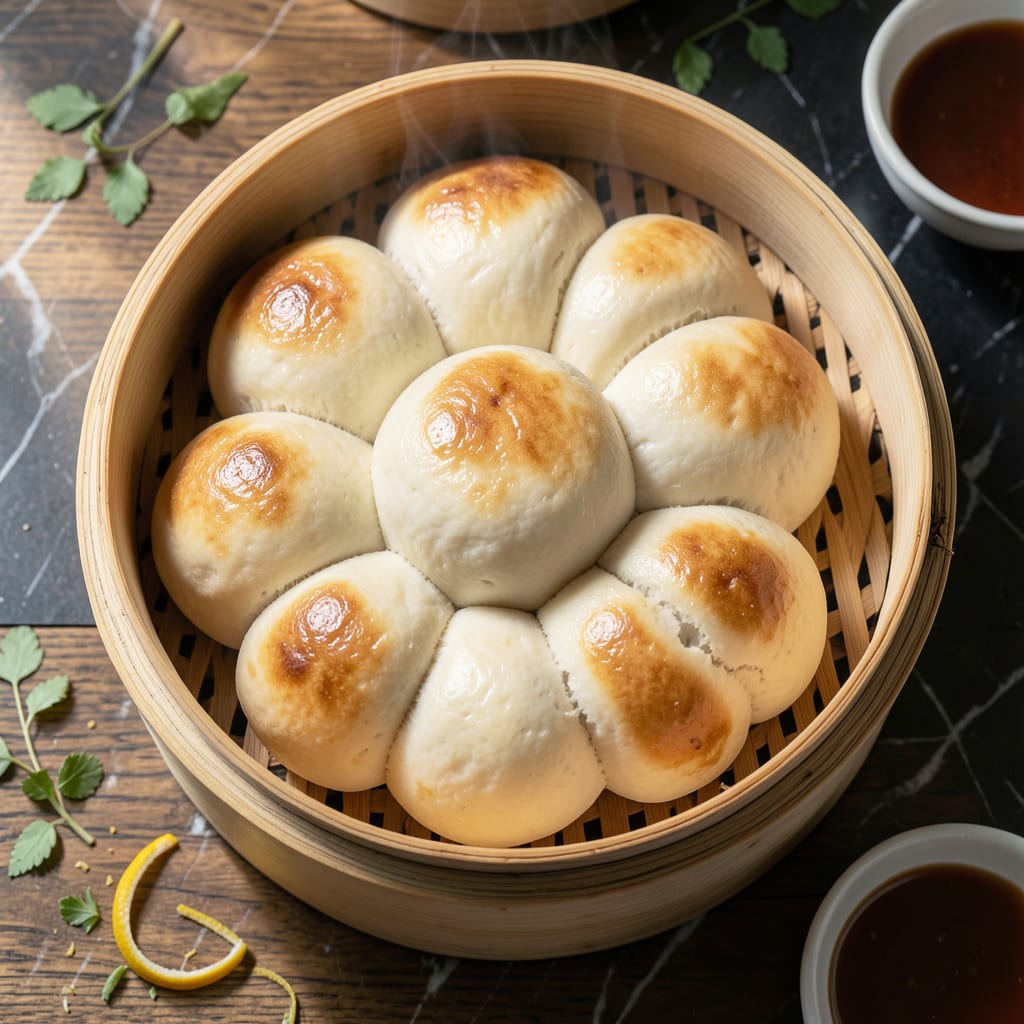
There’s a special satisfaction in pulling soft, cloud-like bread from your steamer basket. This method delivers a pillowy texture that’s light yet substantial, with a delicate chew that melts in your mouth.
No oven required—just simple ingredients and a steamer create bread that’s fresh, warm, and uniquely tender. The process transforms basic dough into something extraordinary with minimal effort.
Ingredients for Recipe Steamed Bread
Simple pantry staples transform into cloud-like bread with minimal effort and maximum reward.
| Ingredient | Amount | Notes |
|---|---|---|
| All-Purpose Flour 🌾 | 4 cups | Sifted for lighter texture |
| Active Dry Yeast 🍞 | 1 tsp | Proofed in warm water first |
| Granulated Sugar 🍚 | 1 tbsp | Feeds the yeast for rise |
| Warm Water 💧 | 1 ¼ cups | 110°F for yeast activation |
| Salt 🧂 | 1 tsp | Fine sea salt preferred |
| Neutral Oil 🫒 | 1 tbsp | Vegetable or canola oil |
| Baking Powder 🧂 | 1 tsp | Enhances lift in steam |
| Cornstarch 🌾 | 2 tbsp | Softens crumb texture |
| Large Egg 🥚 | 1 whole | Room temperature for even mixing |
| Whole Milk 🥛 | ½ cup | Warmed slightly for dough |
The flour quality matters here. King Arthur or Pillsbury all-purpose gives consistent results—avoid cake flour as it lacks the protein structure needed. Yeast must be fresh and active; test it in the warm water with sugar before committing. A standing mixer with dough hook makes this effortless, but a sturdy wooden spoon and elbow grease work too. The water temperature is critical: too hot kills yeast, too cold slows activation.
No all-purpose flour? Bread flour works at a 1:1 ratio but yields a slightly chewier crumb. Out of yeast? Baking powder alone (increase to 1.5 tsp) creates a quick bread version—less pillowy but still tender. Milk can be swapped for warm water, though the richness is lost. For a vegan version, replace the egg with 1 tbsp flaxseed meal + 3 tbsp water.
Steamed bread is best consumed fresh but keeps surprisingly well. Store in an airtight container at room temperature for up to 2 days. Reheat by steaming again for 2-3 minutes to restore that just-made softness. Dough can be prepared a day ahead—refrigerate overnight for a slower rise, then steam as usual.
Why You’ll Love This Recipe
- No-Knead Magic: I just mix flour, yeast, sugar, and warm water—no fancy techniques, no sore arms.
- Soft Cloud Bites: The steam makes these so fluffy and slightly sweet, with that perfect pull-apart texture.
- Breakfast to Snack: Honestly, it works as a morning treat with jam or as a side with dinner.
- Penny-Wise Puffs: A bag of flour and yeast makes a dozen for less than a coffee shop muffin.
Step-by-Step Instructions for Steamed Bread
Master these techniques to achieve the signature soft, fluffy texture that defines this dish.
Step 1: Activate the Yeast and Prepare the Dough Base
In a small bowl, combine the 1 tsp Active Dry Yeast, 1 tbsp Granulated Sugar, and 1.25 cups Warm Water at 110°F. Let sit for 5-7 minutes until the mixture becomes foamy—this confirms the yeast is active and ready to leaven your dough.
In a large mixing bowl, whisk together the 4 cups All-Purpose Flour, 1 tsp Salt, 1 tsp Baking Powder, and 2 tbsp Cornstarch. The cornstarch is key here; it softens the protein structure for that cloud-like crumb. Make a well in the center for the wet ingredients.
Step 2: Combine Wet and Dry Ingredients
Pour the activated yeast mixture into the well of your dry ingredients. Add the 1 whole Large Egg (room temperature ensures even distribution), 0.5 cup Whole Milk (warmed slightly to harmonize with the yeast), and 1 tbsp Neutral Oil. Use a wooden spoon or dough whisk to combine until a shaggy dough forms.
The dough will be slightly sticky but should pull away from the sides of the bowl. If it feels too dry, add 1-2 teaspoons of additional warm water; if too wet, sprinkle in 1-2 teaspoons of flour. Avoid over-flouring at this stage, as it can make the final bread dense.
Step 3: Knead to Develop Gluten Structure
Turn the dough onto a lightly floured surface and knead for 8-10 minutes by hand, or 6-8 minutes in a stand mixer fitted with a dough hook. You’re aiming for a smooth, elastic dough that springs back slowly when poked. The gluten development here is crucial—it provides the framework for the steam to expand the bread.
Lightly oil a clean bowl, place the dough inside, and cover with a damp kitchen towel. Let it rise in a warm, draft-free place for 1-1.5 hours, or until doubled in volume. The ideal rise environment is 80-85°F—I often use a turned-off oven with the light on to create this.
Step 4: Shape and Final Proof
Once risen, gently punch down the dough to release excess air. Divide it into 4 equal portions (for individual buns) or leave whole for a loaf. Shape each portion into a smooth ball or log, then place them on parchment paper squares to prevent sticking during steaming.
Cover the shaped dough with the damp towel again and let it proof for 30-45 minutes. You’ll know it’s ready when the dough looks puffy and a gentle press leaves a slow-to-rebound indentation. This final rise ensures maximum lift during steaming.
Step 5: Steam to Perfection
Bring 2-3 inches of water to a rolling boil in a large pot fitted with a steamer basket or bamboo steamer. Line the steamer with parchment paper (poke holes for steam circulation). Carefully place the proofed dough inside, leaving 1-2 inches of space between pieces for expansion.
Cover tightly and steam over medium-high heat for 15-20 minutes for individual buns or 25-30 minutes for a loaf. Do not lift the lid during the first 10 minutes—this causes temperature drops and deflates the rising bread. The bread is done when it’s shiny and springy to the touch, with no raw dough scent. Remove from the steamer and cool on a wire rack for 5 minutes before serving.
Pro Tips For Making Recipe Steamed Bread
- Test the Yeast: Always bloom your active dry yeast in warm water with a pinch of sugar first—I learned this the hard way after wasting flour on dough that never rose.
- Knead Thoroughly: Work the dough for at least 8-10 minutes until smooth; under-kneading gives you dense steamed bread with poor texture.
- Skip Cold Water: Warm water between 105-110°F activates yeast properly; cold water stalls fermentation, and too hot kills it entirely.
- Rest Before Steaming: Let the shaped dough proof for 30-45 minutes until puffy—this step ensures light, airy bread instead of a heavy, compact result.
Health Benefits of This Recipe
Low-Fat Goodness
This dish offers a low-fat alternative to traditional breads, with most of the fat coming from the 1 tbsp Neutral Oil and 1 whole Large Egg. Each serving contains less than 3g of fat, making it heart-healthy without sacrificing that soft, pillowy texture you love. 💪
Complex Carbohydrates
The 4 cups All-Purpose Flour provides complex carbohydrates for sustained energy release. Unlike refined breads, the steaming process preserves more nutrients in the flour, giving you longer-lasting fuel to power through your day.
Protein Boost
With 1 whole Large Egg and 0.5 cup Whole Milk in the recipe, you get a decent protein boost—about 8-10g per serving. This helps with muscle repair and keeps you feeling full longer than typical white bread.
Easy Digestion
Steamed bread is naturally easier to digest than oven-baked varieties because the steaming process breaks down some of the starches. The 2 tbsp Cornstarch also creates a gentler texture on your stomach, perfect for sensitive digestive systems.
Rich in B Vitamins
The combination of All-Purpose Flour and Whole Milk provides a good dose of B vitamins, particularly B1 and B6. These are essential for metabolism and nervous system health. The yeast activation process even enhances some of these nutrients. 🥛
Hydration Support
The steaming process infuses the bread with moisture, and the 1.25 cups Warm Water in the dough helps with daily hydration. While not a replacement for drinking water, every bit contributes to your overall fluid intake.
Nutrition Facts
Frequently Asked Questions
Why does my steamed bread turn out dense?
Over-kneading or insufficient rising time are the main causes. Knead just until smooth (8-10 minutes by hand) and let it rise until doubled (1-1.5 hours). Also ensure your yeast is fresh and water is at 110°F.
Can I make this without yeast?
Yes! Use 1.5 tsp baking powder instead for a quick version. The texture will be less pillowy but still soft. Add 1 tsp vinegar to react with the baking powder for better lift.
How do I know when it’s done steaming?
The bread should look shiny and spring back when touched. For buns, steam 15-20 minutes; for a loaf, 25-30 minutes. Avoid lifting the lid early to prevent collapsing.

- 6 Egg Cake Recipe with Oil: Light as Air With Buttery Moisture - October 4, 2026
- 4 Bean Casserole Recipe: One-Pan Heartiness With Smoky Paprika Depth - October 4, 2026
- 3-Ingredient Keto Mug Cake Recipe: Microwave Magic in 2 Minutes - October 4, 2026