
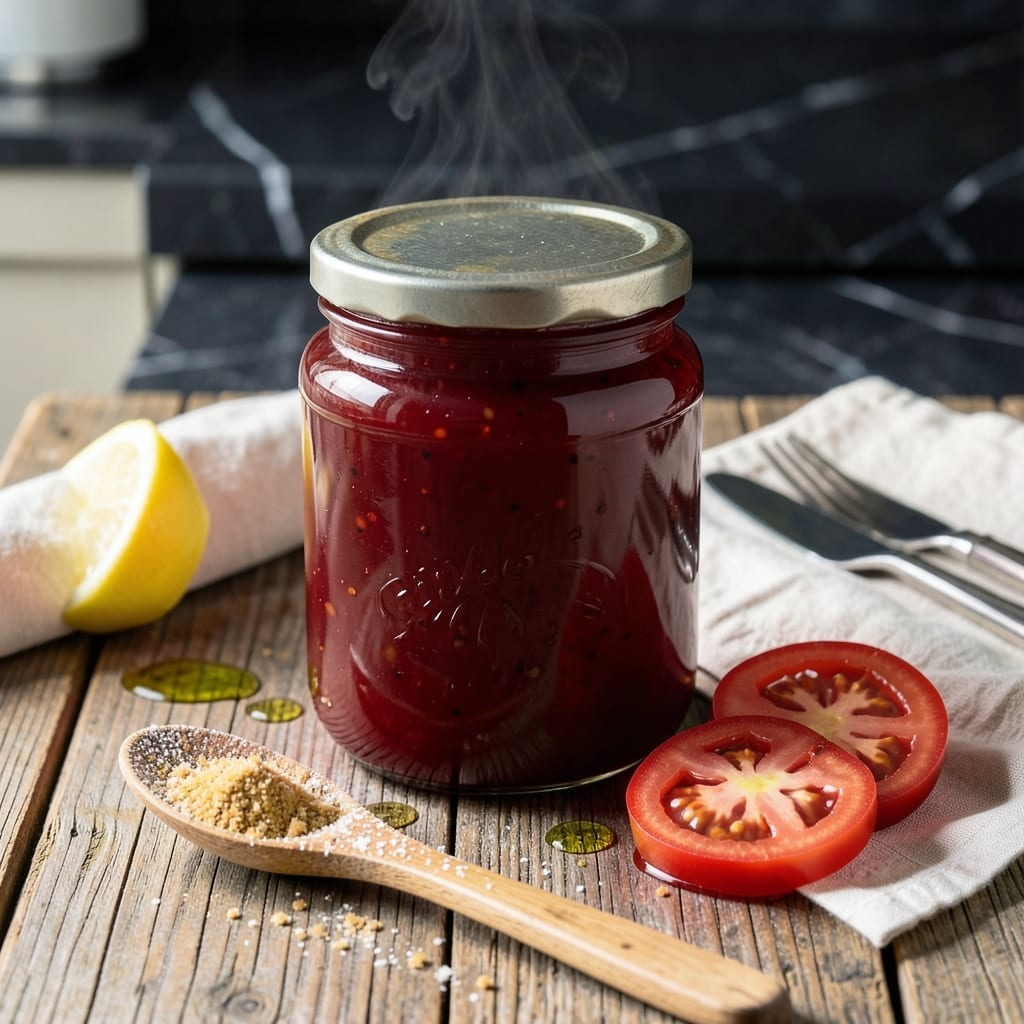
This tomato jelly is a game-changer for your pantry, turning garden tomatoes into a bright, glossy spread that’s perfect on toast or paired with cheese.
With just a few ingredients and pectin, you’ll create a preserve that’s tangy, sweet, and impossible to resist. It’s a simple way to capture summer flavor year-round.
Ingredients for Tomato Jelly Recipe Pectin
Transform garden tomatoes into a vibrant, glossy preserve with these simple pantry staples and pectin.
| Ingredient | Amount | Notes |
|---|---|---|
| Fresh Tomatoes 🍅 | 4 cups | Peeled, chopped, about 2 lbs |
| Granulated Sugar 🍚 | 3 cups | White sugar preferred for clarity |
| Powdered Pectin 🧂 | 1 ¾ oz | 1 package, for proper gelling |
| Apple Cider Vinegar 🍏 | ¼ cup | For brightness and tang |
| Lemon Juice 🍋 | 2 tbsp | Freshly squeezed preferred |
| Salt 🧂 | ½ tsp | Fine sea salt for balance |
| Black Pepper 🌶️ | ¼ tsp | Freshly ground for depth |
| Fresh Basil Leaves 🌿 | ¼ cup | Loosely packed, optional garnish |
The tomatoes are everything here—use vine-ripened or heirloom varieties for the best flavor. Farmers markets in late summer have the sweetest, most fragrant ones. If you’re using store-bought, roma tomatoes work well (the meaty ones with less water). Avoid those sad, pale winter tomatoes—they’ll give you a lackluster jelly. Pectin comes in powder or liquid; this recipe uses powdered pectin (like Ball or Sure-Jell).
No fresh tomatoes? Canned crushed tomatoes (about 28 oz) can work in a pinch—just drain them well. Want more tang? Swap apple cider vinegar for red wine vinegar. Short on sugar? Don’t reduce it by more than a quarter or the jelly won’t set. The basil is optional but adds a fresh note—skip if you don’t have it (or use a pinch of dried).
Jelly jars must be sterilized before filling. Once sealed, unopened jars keep in a cool, dark place for up to 1 year. After opening, store in the fridge for 3 weeks. The flavor deepens over time—wait a week before digging in for the best taste.
Why You’ll Love This Recipe
- One Pot Wonder: I love that I just toss the tomatoes, sugar, pectin, vinegar, and lemon juice into a single pot and let it work its magic.
- Sweet-Tart Magic: The combo of ripe tomatoes with that zing from the vinegar and lemon juice hits this perfect balance—bright and just sweet enough.
- Spreads Like a Dream: Honestly, it’s as good on toast as it is glazing chicken or pairing with cheese on a charcuterie board.
- Budget-Friendly Jar: A batch costs pennies compared to store-bought, and I end up with jars to gift or stash in the pantry for months.
Step-by-Step Instructions for Tomato Jelly
This method ensures a perfectly set, vibrant jelly with minimal fuss and maximum flavor.
Step 1: Prepare and Cook the Tomato Mixture
Combine the 4 cups Fresh Tomatoes with the 0.25 cup Apple Cider Vinegar, 2 tbsp Lemon Juice, 0.5 tsp Salt, and 0.25 tsp Black Pepper in a large, heavy-bottomed pot. I use a potato masher to break down the tomatoes slightly—this helps release their juices for a smoother jelly.
Bring the mixture to a full rolling boil over high heat, stirring occasionally to prevent sticking. Once boiling, reduce the heat to medium-high and let it simmer for 10-12 minutes until the tomatoes soften and break down further. You’ll notice the mixture thicken slightly as the liquid reduces.
Step 2: Incorporate Pectin for Proper Gelling
While the tomato mixture simmers, measure out the 1.75 oz Powdered Pectin. I like to mix it with ¼ cup of the 3 cups Granulated Sugar first—this prevents clumping when added to the hot liquid. Stir this pectin-sugar blend into the tomato mixture and return it to a full boil.
Boil hard for 1 minute, stirring constantly. This is critical for activating the pectin and ensuring your jelly sets properly. Watch for the mixture to thicken slightly—it should coat the back of a spoon with a syrupy consistency.
Step 3: Add Remaining Sugar and Finalize
Add the remaining 2¾ cups Granulated Sugar (since you already used ¼ cup with the pectin) to the pot. Stir well to dissolve completely, then bring the mixture back to a full rolling boil. Boil for another 4-5 minutes, stirring frequently to prevent scorching.
At this stage, the jelly should thicken noticeably. To test for doneness, place a small spoonful on a chilled plate. If it wrinkles slightly when pushed with a finger, it’s ready. Remove the pot from heat and skim off any foam that’s risen to the surface with a metal spoon.
Step 4: Jar and Seal the Jelly
Ladle the hot jelly into sterilized jars, leaving ¼-inch headspace. Wipe the rims clean with a damp cloth to ensure a proper seal. If canning for long-term storage, process the jars in a water bath for 10 minutes. For immediate use, simply let the jars cool to room temperature.
As the jelly cools, it will set completely. You’ll know it’s perfect when it holds its shape but still has a glossy, spreadable texture. Stir in the 0.25 cup Fresh Basil Leaves as an optional garnish just before jarring for a pop of color and fresh herbal notes.
Pro Tips For Making Tomato Jelly Recipe Pectin
- Boil Vigorous and Fast: Once you add the pectin-sugar mix, bring it to a full rolling boil that can’t be stirred down—this is non-negotiable for proper gel formation. I learned this the hard way after ending up with tomato syrup instead of jelly.
- Strain the Tomatoes: After blanching and peeling, strain the tomato pulp through a fine-mesh sieve to remove seeds and excess liquid—about 10 minutes of pressing guarantees a smoother jelly.
- Measure Acid Precisely: Use exactly 1 tablespoon of lemon juice and 1 tablespoon of apple cider vinegar per batch—too much acid can prevent setting, and too little leaves the jelly bland. Sounds weird, but it works.
- Skim Before Jar: Right before ladling into jars, skim off any foam with a metal spoon—it looks cleaner and prevents mold growth during storage. I skip this when I’m lazy, but the jelly keeps better when I don’t.
Essential Equipment for Perfect Results
Must-Have Tools
To make your tomato jelly recipe with pectin a success, a few key tools are non-negotiable. A large, heavy-bottomed pot (like a stainless steel All-Clad or enameled cast iron Le Creuset) ensures even heat distribution, preventing scorching. A candy or deep-fry thermometer is critical for hitting the perfect gel point (220°F). Don’t forget a fine-mesh strainer to remove seeds and skins for a smooth, glossy finish!
Nice-to-Have
For extra convenience, a jelly bag or cheesecloth helps strain the tomato juice effortlessly. A ladle with a pour spout (like the OXO Good Grips version) makes filling jars mess-free. If you’re canning, a water bath canner and jar lifter ensure safe, long-term storage. These tools streamline the process and elevate your results. 🎯
Budget Alternatives
No fancy gear? No problem! Use a regular pot (just stir frequently) and a meat thermometer in place of a candy thermometer. A clean kitchen towel can substitute for cheesecloth, and a mason jar funnel helps with pouring. With a little creativity, you can still achieve delicious tomato jelly without breaking the bank. ✨
Nutrition Facts

- 6 Egg Cake Recipe with Oil: Light as Air With Buttery Moisture - October 4, 2026
- 4 Bean Casserole Recipe: One-Pan Heartiness With Smoky Paprika Depth - October 4, 2026
- 3-Ingredient Keto Mug Cake Recipe: Microwave Magic in 2 Minutes - October 4, 2026