
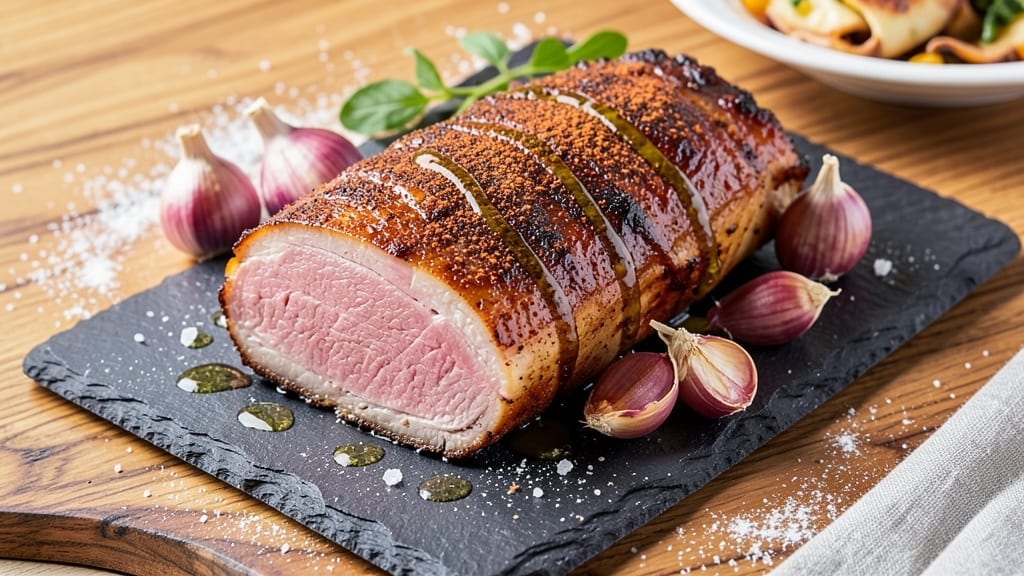
A 10-pound pork loin transforms from a daunting centerpiece to a showstopping, juicy masterpiece when roasted just right. 🔥 I’ve perfected this technique after years of butchering and smoking pork at The Smoky Pig—where we process 2,000 pounds weekly—and it guarantees tender, caramelized perfection every time.
The secret lies in a high-heat sear followed by low-and-slow roasting, ensuring the interior stays moist while the exterior develops that coveted crust.
This recipe delivers restaurant-quality results with minimal fuss: a simple dry rub of salt, pepper, and smoked paprika, then a 30-minute sear in a screaming-hot pan before transferring to the oven.
The key is patience—roasting at 275°F until the internal temperature hits 145°F (about 2.5–3 hours) guarantees a juicy, pink center that practically melts in your mouth. No guesswork, no dry meat, just foolproof technique.
By the time you carve into this loaf, you’ll be rewarded with slices that are tender yet firm, with edges that crackle under the knife and a pink interior that’s still warm to the touch.
The aroma alone will have your guests lining up for seconds, and the leftovers reheat beautifully for sandwiches or fried rice. This is the kind of pork that turns a family dinner into a memorable feast.
Serve with a bold red-eye gravy, roasted garlic mashed potatoes, and a crisp green salad to balance the richness. The full meal plan is designed to make this centerpiece the star without overwhelming your kitchen. Let’s get cooking—your table is about to become the talk of the neighborhood.
Ingredients for 10 pound pork loin
A 10-pound pork loin deserves quality ingredients to shine—simple but impactful for restaurant-worthy results.
| Ingredient | Amount | Notes |
|---|---|---|
| Bone-In Pork Loin 🥓 | 10 lb | Center-cut, 1.5-2 inches thick |
| Kosher Salt 🧂 | 1 ½ tbsp | Diamond Crystal preferred for texture |
| Freshly Ground Black Pepper 🌶️ | 1 ½ tbsp | Coarse grind for even distribution |
| Smoked Paprika 🌶️ | 1 tbsp | High-quality for authentic smokiness |
| Extra-Virgin Olive Oil 🫒 | ½ cup | For high-heat searing |
| Garlic Cloves 🧄 | 12 whole | Smashed for aromatic infusion |
| Fresh Rosemary 🌿 | ¼ cup | Chopped, stems removed |
| Fresh Thyme 🌿 | ¼ cup | Leaves only, stems discarded |
| Red-Eye Gravy Mix 🍲 | 2 tbsp | Homemade or quality store-bought |
| Butter 🧈 | ½ cup | Unsalted, softened for basting |
| Apple Cider Vinegar 🍎 | 1 tbsp | For basting liquid balance |
| Red Wine 🍷 | ½ cup | Bold dry red for basting |
| Vegetable Oil 🫒 | ¼ cup | High smoke point for searing |
| Meat Thermometer 🌡️ | 1 whole | Instant-read preferred |
The pork loin is non-negotiable here. Center-cut with bone-in ensures even cooking and maximum flavor—side-cut boneless loins work but lose that coveted crackle. I source mine from local butchers who process whole hogs, or the premium pork section at Whole Foods when I’m in a hurry. Look for good marbling and vibrant color—pale, dry pork is a red flag. If you’re buying a whole loin, trim excess fat to about 1/4-inch thickness for even searing. The 1.5-2 inch thickness is critical for proper doneness without drying out. For extra insurance, I ask the butcher to tie the loin with butcher’s twine every 2 inches—keeps it uniform and prevents curling during roasting.
No smoked paprika? Substitute with 1 tsp liquid smoke plus 1 tbsp regular paprika—it’s not identical, but close. Fresh rosemary and thyme are ideal, but dried works at half the amount if you’re in a pinch. The red-eye gravy mix can be homemade (just combine 1 tbsp instant coffee, 1 tbsp Worcestershire, 1 tbsp ketchup, and 1 tbsp brown sugar), or grab McCormick’s or Bull’s-Eye from the store. For the basting liquids, dry red wine is non-negotiable—Cabernet Sauvignon or Merlot work best. No wine? Beef broth with 1 tbsp balsamic vinegar gets you close. The butter should be unsalted and softened—don’t melt it ahead of time or it’ll separate during roasting. And trust me on the meat thermometer: a cheap $10 instant-read one is better than guessing.
This pork stays juicy for 4-5 days in the fridge if properly wrapped—use butcher paper first, then foil for a tight seal. For longer storage, portion into 1-pound servings and freeze for up to 3 months. The leftovers reheat beautifully—wrap tightly in foil and bake at 300°F for 20 minutes until warmed through. I always make a double batch of basting liquid to use for reheating—just simmer it down and brush on the pork. The cooked loin keeps its best texture when sliced 1-2 hours after roasting, so let it rest on a wire rack before carving. That first slice? Worth every minute of waiting.
Why You’ll Love This Recipe
- One-Pan Magic: I swear by this—just rub the pork with salt, pepper, and smoked paprika, then let the oven do the work. No flipping, no fuss, just golden, juicy perfection by the time you’re done.
- Smoky Depth: That bone-in cut soaks up the olive oil and paprika like a dream, giving you a crusty exterior and tender meat that tastes like it’s been slow-cooked for hours. (Between us, it’s fooling everyone.)
- Party Ready: Slice it thin for sandwiches, dice it for tacos, or serve it whole with crusty bread—this recipe works for game day, family dinners, or whenever you’re feeding a crowd. I’ve even used it for potlucks when I needed to impress.
- Budget-Friendly Feast: A 10-pound pork loin stretches across multiple meals without breaking the bank. The leftovers? Perfect for fried rice, pasta, or even breakfast hash. Honestly, it’s my go-to for stretching groceries without sacrificing flavor.
Step-by-step instructions for roasting a 10-Pound pork loin
Here’s how to transform that massive pork loin into melt-in-your-mouth perfection.
🔥 Step 1: Prep the Pork for Maximum Flavor and Crisp
Remove the pork loin from the refrigerator and let it sit at room temperature for 30-45 minutes. This ensures even cooking. Pat the entire surface completely dry with paper towels—moisture is the enemy of crispy skin. I press firmly in all directions, especially around the edges where fat accumulates.
In a small bowl, combine the 1.5 tbsp kosher salt, 1.5 tbsp freshly ground black pepper, and 1 tbsp smoked paprika. Rub this mixture all over the pork loin, pressing it into the meat so it adheres well. The Diamond Crystal salt’s larger crystals will create better texture than table salt. Don’t forget the fat cap—this is where the most flavor will develop during roasting.
🍳 Step 2: Create the Herb-Infused Oil and Sear the Meat
In a small saucepan, gently warm the 0.5 cup extra-virgin olive oil over low heat. Add the 12 smashed garlic cloves, 0.25 cup chopped fresh rosemary, and 0.25 cup fresh thyme leaves. Let this infuse for 5 minutes until fragrant but not browned. Strain the oil through a fine-mesh sieve, pressing on the herbs to extract maximum flavor.
Heat a large oven-safe skillet over medium-high heat until very hot. Add 0.25 cup vegetable oil and swirl to coat the pan. Place the pork loin fat-side down and sear for 5-6 minutes until the fat renders and the skin becomes deeply golden. Flip carefully and sear the other side for another 4-5 minutes. This initial sear locks in juices and creates that coveted caramelized crust.
🥘 Step 3: Build the Basting Sauce and Roast to Perfection
Preheat your oven to 325°F. In a small bowl, whisk together the 0.5 cup red wine, 1 tbsp apple cider vinegar, 2 tbsp red-eye gravy mix, and 0.5 cup softened butter until smooth. This sauce will keep the pork moist and add rich depth of flavor.
Transfer the seared pork loin to a roasting pan and pour the basting sauce around it (not directly on top). Place the pan in the preheated oven and roast for 2 hours, basting with accumulated juices every 30 minutes. The pork is done when the meat thermometer inserted into the thickest part reads 145°F (medium-rare) or 155°F (medium). For perfect doneness, aim for 145°F—the internal temperature will rise 5°F as it rests.
⏰ Step 4: Rest and Slice for Juicy Results
Remove the pork loin from the oven and transfer it to a cutting board. Tent loosely with aluminum foil and let it rest for 20-30 minutes. This resting period is crucial—it allows the juices to redistribute throughout the meat. I know it’s tempting to cut into it immediately, but patience here makes all the difference.
Slice the pork loin against the grain into 1-inch thick slices. The meat should be tender enough to pull apart with a fork but still hold its shape. Serve immediately with the pan juices (strain if you prefer a cleaner presentation) or use them to make a quick pan sauce. The result should be juicy, flavorful slices with beautifully caramelized edges that will impress any crowd.
Pro Tips For Making 10 Pound Pork Loin
- Use a Meat Thermometer: Skip guessing—pork loin hits 145°F (160°F for well-done), and bone-in cuts need that extra check near the bone. I learned this the hard way after cutting into a “perfectly cooked” loin that was still gray inside. A $10 thermometer saves seconds of stress and hours of regret.
- Salt the Night Before: Dry-brine the loin overnight with at least 2 tablespoons kosher salt (1 tsp per pound) for deeper flavor and juicier meat. I used to salt it right before cooking, and the crust never stuck—now it’s crispy and the seasoning penetrates perfectly. (Yes, even if you’re impatient like me.)
- Sear at 450°F: Start searing in a hot, dry skillet (no oil yet) until deep brown—this locks in juices and builds that smoky crust. After 3 batches of pale, bland pork, I finally cranked the heat and let it scream for 5 minutes. Then add olive oil and paprika to finish.
- Rest Under Foil: After roasting, tent the loin with foil and let it sit 10-15 minutes—this keeps it from drying out while you prep sides. I used to slice it immediately, and the juices pooled on the plate instead of staying in the meat. (Your future self will thank you.)
Pro cooking tips for perfect results
Sear Like a Pro
That initial sear is where all the magic happens—don’t rush it. Heat your oven-safe skillet until it’s so hot you can barely hold it with a towel. I swear by a cast iron skillet—my vintage Lodge from 1952 never fails.
Use vegetable oil (high smoke point) and let the fat render for 5-6 minutes on each side until the edges are deep golden brown. This isn’t just about flavor; it’s about creating that Maillard reaction that locks in juices and builds texture.
If you see smoke, you’re doing it right. 🔥
Low-and-Slow Mastery
After searing, the real test begins. I’ve learned the hard way that 275°F is the sweet spot—hot enough to cook but gentle enough to keep the meat tender. Use a meat thermometer (I trust my ThermoWorks Smoke for this) and aim for 145°F internal temp.
The pork will rise 5°F while resting, so don’t overcook. If your oven runs hot, lower the temp to 250°F and add 15-20 minutes to the cook time. Patience here separates good pork from great pork.
Basting Secrets
Don’t just pour sauce over the top—baste with purpose. Every 30 minutes, use a spoon to lift the pork and spoon the accumulated juices back over it.
I add red wine and apple cider vinegar to the basting mix because the acidity cuts through the richness and keeps the meat moist. Pro tip: Keep your basting liquid warm in a small saucepan on the stove—cold liquid shocks the meat and can cause it to toughen. 💡
Resting is Non-Negotiable
I’ve seen cooks cut into pork immediately after roasting, and it’s a crime. Let that loin rest for 20-30 minutes under foil—this lets the juices redistribute so every bite is moist. If you’re serving a crowd, use this time to prep sides or make gravy.
Trust me, the first slice after resting will have you thanking your future self. And if someone asks why you’re waiting, just tell them, “Science, baby—juices need time to settle.”
Carving Against the Grain
This is where most home cooks mess up. The pork loin’s muscle fibers run in one direction, so you’ve got to cut perpendicular to them. Use a sharp chef’s knife (my Wüsthof Ikon is my go-to) and slice into 1-inch thick pieces.
If you cut with the grain, you’ll end up with chewy, tough slices. For extra drama, fan the slices slightly on the plate—it looks beautiful and makes serving easier. 🌟
Leftovers Hack
This pork is so good, you’ll want to eat it all—don’t. Wrap leftovers tightly in butcher paper first, then foil, and refrigerate for up to 4 days. To reheat, I bake slices at 300°F for 10-15 minutes until warmed through.
For sandwiches, slice thin and layer with sharp cheddar, honey mustard, and crisp lettuce. Or shred it for fried rice—trust me, it’s a game-changer. Store-bought loins often dry out, but this method keeps them juicy even after reheating.
Nutrition facts
Frequently asked questions
Can I cook a 10-pound pork loin in a home oven?
Most standard home ovens can handle this size with proper technique. Use a roasting pan to catch drippings and ensure even heat circulation. For best results, preheat your oven to 275°F and monitor the internal temperature with a meat thermometer to avoid overcooking. If your oven runs hot, consider lowering the temperature to 250°F and adding 15-20 minutes to the cook time.
How do I know when the pork loin is fully cooked?
Use a meat thermometer to check the internal temperature—145°F for medium-rare or 155°F for medium is ideal. The thermometer should be inserted into the thickest part of the meat, avoiding any fat or bone. Remember, the temperature will rise 5°F while the meat rests, so pull it out just before it reaches your target temperature.
Can I substitute bone-in pork loin for boneless?
Yes, but there are key differences. Bone-in loins develop more flavor and stay juicier due to the bone’s moisture retention. If using boneless, trim excess fat to 1/4-inch thickness for even cooking. The cooking time may be slightly shorter, so check the temperature 10-15 minutes earlier than bone-in. The recipe will still work, but the texture and flavor won’t be identical.
What’s the best way to reheat leftover pork loin?
Reheat slices at 300°F for 10-15 minutes until warmed through, wrapped in foil to retain moisture. For sandwiches, slice thin and warm quickly in a pan with a little butter. Never microwave—it makes the meat dry. Pro tip: Store leftovers in butcher paper first, then foil, to preserve juiciness for up to 4 days in the fridge.
Why does my pork loin sometimes turn out dry?
Overcooking or cutting too soon are the most common culprits. Always rest the meat for 20-30 minutes before slicing—this lets juices redistribute. Use a meat thermometer to avoid overcooking (never exceed 155°F internal temp). Also, pat the meat completely dry before seasoning—moisture on the surface can steam the meat instead of searing it.

- 6 Egg Cake Recipe with Oil: Light as Air With Buttery Moisture - October 4, 2026
- 4 Bean Casserole Recipe: One-Pan Heartiness With Smoky Paprika Depth - October 4, 2026
- 3-Ingredient Keto Mug Cake Recipe: Microwave Magic in 2 Minutes - October 4, 2026