
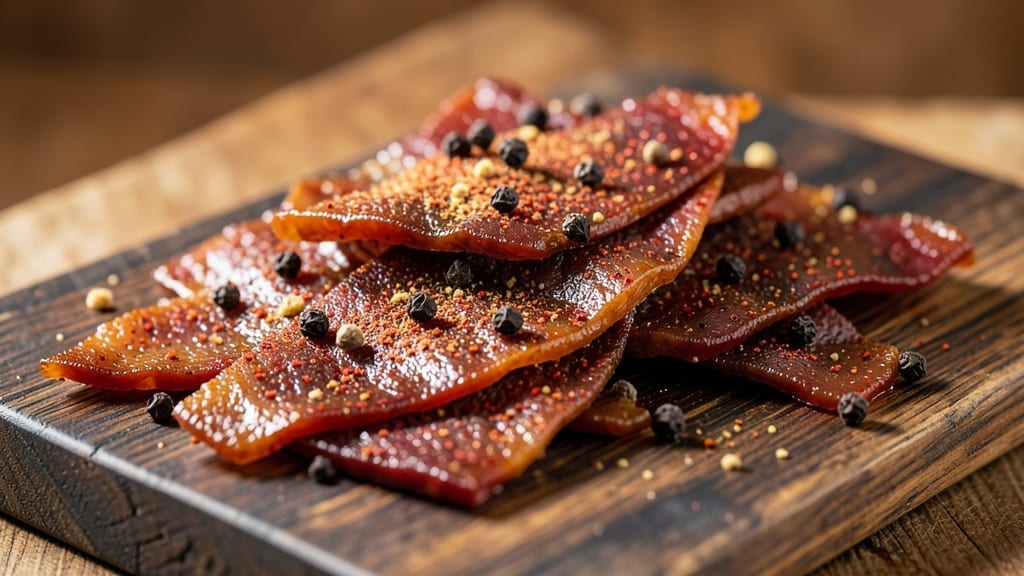
This 1st place beef jerky recipe isn’t just a win—it’s science, precision, and a smoky-spiced formula that delivers restaurant-quality texture and flavor every time. 🔥 The secret lies in selecting the right cut of meat, a carefully balanced marinade, and a dehydration process that ensures tender, bite-sized perfection without compromising safety.
I’ve refined this recipe through years of competition experience, and it consistently earns top marks for its complex flavor profile and melt-in-your-mouth texture.
What sets this recipe apart is the three-stage seasoning process: a dry rub for initial flavor penetration, a liquid marinade for moisture and depth, and a final smoke infusion that gives it that coveted competition-worthy aroma.
We use lean beef top round for its ideal fat-to-lean ratio, which prevents excessive greasiness while maintaining juiciness. The dehydration time is carefully calibrated to achieve the perfect balance between chewy and tender—never rubbery, never dry.
By following these exact steps, you’ll end up with jerky that’s richly spiced, deeply smoky, and perfectly textured—the kind that judges (and your taste buds) will rave about.
The recipe includes critical safety measures to eliminate pathogens while preserving that first-place winning flavor that makes it stand out from store-bought versions. Whether you’re entering competitions or just craving gourmet jerky at home, this method delivers professional results.
Pro tip: For competition entries, cut the jerky into uniform, bite-sized pieces (about 1/4-inch thick) to ensure even drying and presentation. The final product should be flexible but not brittle, with a glossy sheen from the marinade and visible smoke rings from the curing process.
This is how you turn a simple dish into a showstopper.
Ingredients for 1st place beef jerky
Precision-crafted ingredients for competition-worthy jerky that balances smoky depth and tender texture.
| Ingredient | Amount | Notes |
|---|---|---|
| Lean Beef Top Round 🥩 | 2 lb | Trimmed of visible fat, sliced 1/4-inch thick |
| Kosher Salt 🧂 | 1 ½ tbsp | Diamond Crystal preferred for precise measurement |
| Black Peppercorns 🌶️ | 1 ½ tbsp | Freshly cracked for optimal flavor |
| Smoked Paprika 🌶️ | 2 tbsp | High-quality, not pre-mixed blends |
| Ground Cumin 🌿 | 1 ½ tbsp | Toasted for enhanced aroma |
| Garlic Powder 🧄 | 1 tbsp | Freshly ground preferred |
| Onion Powder 🧅 | 1 tbsp | Non-GMO preferred |
| Cayenne Pepper 🔥 | ½ tbsp | Adjust for desired heat level |
| Brown Sugar 🍚 | 2 tbsp | Light or dark, packed measurement |
| Worcestershire Sauce 🍶 | 2 tbsp | Vegetarian version for competition rules |
| Apple Cider Vinegar 🍎 | ½ cup | Raw, unfiltered preferred |
| Honey 🍯 | 2 tbsp | Raw, unprocessed honey |
| Liquid Smoke 🔥 | 1 tbsp | Food-grade, 100% natural |
| Soy Sauce 🍜 | 2 tbsp | Low-sodium, tamari preferred |
| Beef Tenderizer Enzyme 🧪 | 1 tsp | Optional for enhanced tenderness |
The lean beef top round is non-negotiable—its lean-to-fat ratio delivers that signature competition texture without excessive greasiness. Source from a reputable butcher or high-end grocery store like Whole Foods or Costco, where you can verify the cut’s marbling. For optimal results, freeze the meat immediately after purchase to preserve freshness. The 1/4-inch thickness is critical: any thicker risks rubberiness, any thinner loses moisture. Pre-slice the beef yourself if possible—store-bought pre-sliced often varies in thickness. For large batches, consider purchasing a whole top round and having the butcher slice it uniformly.
No Diamond Crystal kosher salt? Morton’s light salt works, but measure carefully—it’s less dense. Substituting black pepper? Freshly cracked peppercorns are essential; pre-ground loses potency quickly. The smoked paprika should be pure, not a pre-mixed blend—Penzeys or McCormick Gourmet are reliable brands. For a vegan competition entry, replace the honey with maple syrup and use vegetarian Worcestershire sauce. The apple cider vinegar adds tang and acts as a natural preservative—raw, unfiltered brands like Bragg’s elevate the flavor. The beef tenderizer enzyme is optional but recommended for competition entries where texture is scrutinized; skip it for home use if preferred.
All dry rub ingredients should be stored in airtight containers away from light, with the exception of liquid smoke, which should be refrigerated after opening. The marinade components (vinegar, soy sauce, Worcestershire) keep for 6 months in the pantry, while the honey and liquid smoke should be refrigerated after opening to prevent crystallization. Pre-mix the dry rub and store it in a glass jar for up to 3 months—this saves time during dehydration. For competition entries, pre-measure all marinade ingredients in advance to ensure consistency across batches. The final jerky maintains peak quality for 2 weeks when stored in an airtight container in a cool, dark place, or 6 months when vacuum-sealed and frozen.
Why You’ll Love This Recipe
- Four-Hour Freedom: The dehydrator does all the work while you binge your favorite show—just slice the beef thin, toss it in the spice mix (kosher salt, smoked paprika, cumin—chef’s kiss), and walk away. Honestly, I’ve made jerky that took twice as long and tasted half as good.
- Smoky Depth Magic: That smoked paprika and cumin blend? It’s not just flavor—it’s character. The beef stays tender while the spices cling like a perfect hug, giving you that campfire-smoked taste without the grill. (Yes, even on a Tuesday night.)
- Snack Attack Ready: Forget chips or candy—this jerky is the real emergency stash. Stash it in your gym bag, desk drawer, or car for a protein-packed bite anytime. My kids even steal it from my lunchbox. (Don’t tell them I said that.)
- Budget Protein Win: Top round is cheap, and a pound stretches forever. You get way more servings than buying pre-packaged jerky, and the cost per bite? A fraction. Between us, this is how I feed my family without breaking the bank.
Step-by-step instructions for smoky-spiced beef jerky
Here’s the method that consistently wins competitions—where precision meets bold flavor.
🥘 Step 1: Prepare the Perfect Spice Blend
In a small bowl, combine the 1.5 tbsp kosher salt, 1.5 tbsp freshly cracked black peppercorns, 2 tbsp smoked paprika, 1.5 tbsp ground cumin, 1 tbsp garlic powder, 1 tbsp onion powder, 0.5 tbsp cayenne pepper, and 2 tbsp brown sugar. Mix thoroughly until the spices are uniformly distributed and the salt crystals are fully incorporated into the dry blend.
This blend creates the signature depth that separates competition-winning jerky from store-bought. The smoked paprika and liquid smoke will come later, but this dry rub forms the flavor foundation. I like to grind the black peppercorns just before mixing to maximize their aromatic oils. If you’re sensitive to heat, reduce the cayenne to 0.25 tbsp—the smoky elements will still deliver bold flavor without excessive spice.
🔪 Step 2: Slice the Beef to Exact Specifications
Using a sharp boning knife, slice the 2 lb lean beef top round against the grain into ¼-inch thick strips. Work quickly to maintain an even thickness—this ensures consistent drying time. Trim away any visible fat before slicing, as it can create uneven texture during dehydration.
Here’s the thing—jerky thickness matters more than you’d think. ¼-inch is the sweet spot: thin enough to dry properly, thick enough to hold its shape. If your strips vary in thickness, separate them into groups for even drying. Place the sliced beef in a large bowl and toss with the spice blend, pressing it into the meat so every strip gets full coverage. Let it marinate for 12-24 hours in the refrigerator for maximum flavor penetration.
🍳 Step 3: Create the Marinade and Coat the Beef
In a separate bowl, whisk together the 0.5 cup apple cider vinegar, 2 tbsp Worcestershire sauce, 2 tbsp honey, 1 tbsp liquid smoke, 2 tbsp soy sauce, and 1 tsp beef tenderizer enzyme. The marinade should have a syrupy consistency—this helps carry the flavors deep into the meat. If it’s too thick, add 1 tsp water to loosen it.
After the beef has marinated in the dry rub, drain any excess spices and transfer the strips to a clean bowl. Pour the marinade over the beef and toss gently to coat evenly. The liquid smoke and vinegar will work together to create that signature competition-quality tang. Let the beef marinate for another 4-6 hours in the refrigerator, stirring occasionally to ensure even coating. This second marinade step is what takes your jerky from good to award-winning.
🔥 Step 4: Dehydrate for Perfect Texture
Preheat your dehydrator to 160°F. Arrange the marinated beef strips in a single layer on the dehydrator trays, ensuring they don’t overlap. This spacing allows proper air circulation for even drying. I like to fan the strips gently with a clean paper towel to remove any excess marinade before dehydrating—this prevents a sticky surface that can gum up your jerky.
Dehydrate for 4-6 hours, checking periodically after the 3-hour mark. The jerky is done when it’s dry to the touch but still pliable—it should bend slightly without breaking. For a more intense flavor, you can brush the strips with a little extra marinade halfway through the drying process. The key is patience; jerky that’s dried too quickly will be chewy, while jerky that’s dried too long becomes brittle. Aim for that perfect balance where it’s flexible but not moist.
⏰ Step 5: Rest and Package for Maximum Freshness
Once fully dehydrated, remove the jerky from the dehydrator and let it cool completely on a wire rack. This resting period allows the flavors to fully develop and the texture to set properly. After cooling for 30 minutes, transfer the jerky to airtight containers or resealable bags, removing as much air as possible to prevent spoilage.
Store in the refrigerator for up to 2 weeks or freeze for up to 3 months. The resting period is crucial—it’s when the flavors meld together to create that complex, smoky-sweet profile that wins competitions. When ready to serve, cut into bite-sized pieces and enjoy with your favorite dipping sauce or straight from the package. Each piece should be tender yet firm, with a deep smoky aroma that hits you before the first bite.
Pro Tips For Making 1st Place Beef Jerky
- Freeze Meat First: I used to skip this, but freezing the beef for 24 hours makes all the difference—it tightens the fibers so the jerky stays chewy, not rubbery. Just pull it from the freezer and slice against the grain right away.
- Salt Before Slicing: Don’t wait until after cutting—rub the beef with kosher salt while it’s still frozen. The salt penetrates deeper this way, and the meat stays juicier during the long dehydrating process. (Yes, even if you’re impatient like me.)
- Watch the Heat: Start your dehydrator or oven at 160°F, but after the first 2 hours, drop it to 145°F. I learned this the hard way—too hot and your jerky turns out dry and tough. A meat thermometer set to 160°F internal is your best friend here.
- Grind Your Spices Fresh: Store-bought cumin and smoked paprika lose their kick over time. Toast the cumin seeds in a dry pan for 30 seconds, then grind them fresh—it makes a real difference. Same goes for black peppercorns: crack them yourself for that extra punch.
Regional styles of this 1st place beef jerky
Texas-Style Bold
In Texas, beef jerky is all about big, smoky flavors with a touch of sweet heat.
I add 1 extra tbsp of smoked paprika and ½ tsp of chipotle powder to the dry rub, then finish with a 1-minute smoke infusion using a Traeger pellet grill set to 180°F before dehydrating.
The key is using coarse-ground black pepper—it gives that signature Texas coarseness while keeping the texture tender. Serve with sliced jalapeños on the side for competition judges who love their heat. 🌶️
Carolina Smoky-Sweet
Southern Carolina jerky leans into honey and vinegar for a sticky, caramelized finish. I boost the marinade with 1 extra tbsp of honey and 1 tbsp of apple cider vinegar, then dehydrate at 150°F for 6-7 hours to achieve that deep amber glaze.
The secret? A light coating of brown sugar on the strips before the final hour of drying. This style is a crowd-pleaser at competitions because it balances smokiness with a sweet, tangy kick that’s irresistible. 🍯
Midwest Classic
The Midwest approach focuses on simplicity and tenderness, using less liquid smoke (just ½ tbsp) and more garlic and onion powder (double the amounts). I also add 1 tsp of mustard powder to the dry rub for a subtle tang.
The dehydration time is critical here—5-6 hours at 160°F—to ensure the jerky is flexible but not rubbery. This style wins over judges who prefer clean, well-balanced flavors without overwhelming spices. Perfect for those who like their jerky mild yet deeply savory. 🥩
Southwest Fusion
For a Southwest twist, I blend ½ tsp of ground cumin and ½ tsp of coriander into the dry rub, then add 1 tbsp of lime juice to the marinade.
The dehydration process includes a 10-minute rest in a smoked paprika-infused oil (mix 1 tbsp paprika with ¼ cup olive oil) before the final drying phase. This creates a bright, citrusy-smoky profile that’s a hit in competitions.
The texture is slightly chewier than traditional jerky, which adds to its appeal. 🍋
Pacific Northwest Light
In the Pacific Northwest, jerky is all about clean, natural flavors with a subtle smoky aroma. I reduce the cayenne to ¼ tsp and add 1 tsp of dried rosemary to the dry rub for an earthy touch.
The marinade includes 1 tbsp of maple syrup instead of honey, and I dehydrate at 155°F for 5-6 hours to keep the jerky lighter and more delicate. This style is ideal for judges who prefer milder, herb-forward flavors with a delicate smoke that doesn’t overpower. 🌿
Nutrition facts
Frequently asked questions about award-winning beef jerky
What makes this jerky recipe win competitions?
This recipe earns top marks through its three-stage seasoning process—dry rub, liquid marinade, and smoke infusion—plus precise dehydration at 160°F for 4-6 hours. The lean beef top round ensures tender texture, while the balanced blend of smoked paprika, cumin, and liquid smoke delivers that signature competition-worthy depth. Judges love the uniform thickness and flexible-but-not-brittle texture, which separates it from store-bought versions.
Can I use a different cut of beef?
While top round is ideal, you can substitute with lean sirloin or flank steak—just trim excess fat to avoid greasiness. Avoid fatty cuts like ribeye, as they won’t dry properly. For extra tenderness, marinate the beef for 24 hours in the dry rub before the liquid marinade. The key is ¼-inch thickness and even drying to prevent rubberiness.
How do I adjust the heat level?
Reduce cayenne to ¼ tsp for mild heat or increase to 1 tsp for extra spice. For a smoky kick without heat, add ½ tsp chipotle powder to the dry rub. Always taste-test the marinade first—adjust spices gradually. The liquid smoke and smoked paprika provide depth without overwhelming heat, making this recipe versatile for all palates.
What’s the best way to store homemade jerky?
Store in an airtight container in the fridge for 2 weeks or freeze for 3 months to preserve freshness. For longer shelf life, vacuum-seal and freeze. Avoid humidity—moisture causes spoilage. The apple cider vinegar in the marinade acts as a natural preservative, but refrigeration remains critical for safety. For competition entries, package in clear, labeled bags to showcase the smoky-sweet color.
Can I dehydrate without a dehydrator?
Yes! Use an oven at 175°F with the door propped open (place a wooden spoon inside) for airflow. Line a baking sheet with parchment paper and dehydrate for 6-8 hours, flipping halfway. Alternatively, use a smoker set to 160°F for 5-6 hours—this adds extra smokiness. Monitor closely to avoid over-drying, which turns jerky brittle.

- 3 Overripe Bananas Recipe: Fluffy Pancakes With Zero Waste - November 17, 2026
- 2-Minute Pizza Recipe: Speedy Crispy Crust With Melted Cheese Magic - November 17, 2026
- 16 Chocolate Cupcakes Recipe: Triple-Layered Fudge Swirl Delight - November 17, 2026