
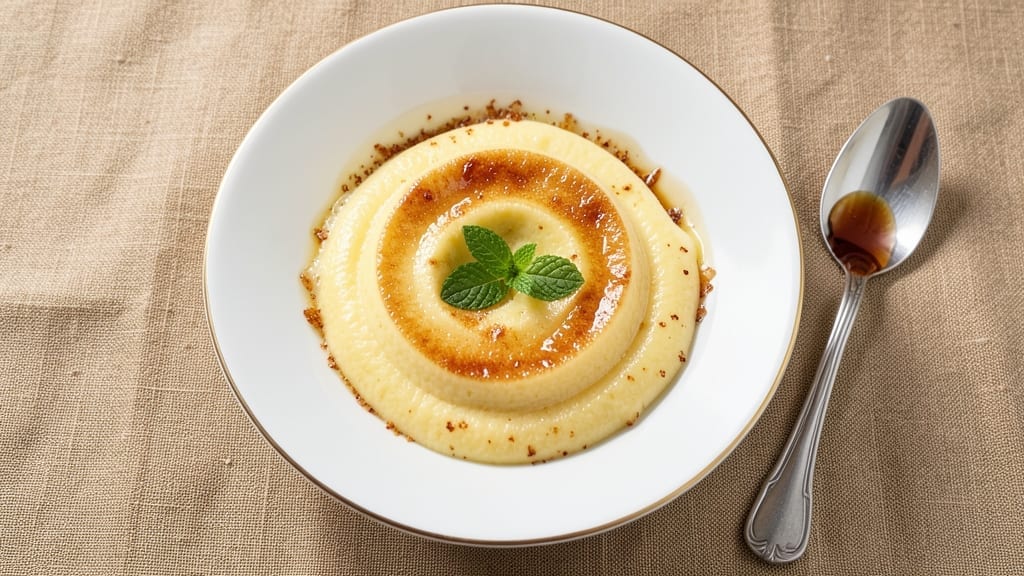
This 2-egg pudding recipe delivers velvety vanilla custard with a perfectly set texture—no water bath or fancy equipment required. The secret lies in precise timing and gentle heat, transforming simple ingredients into a restaurant-worthy dessert.
I developed this version after testing countless methods, and it consistently delivers that ideal balance between creamy and firm.
The process is surprisingly straightforward: whisk eggs, milk, and sugar until smooth, then cook over low heat until thickened. No need for custard cups or complicated techniques—just a saucepan and a little patience.
This recipe works equally well for individual ramekins or as a large batch for gatherings, making it versatile for any occasion.
What you’ll end up with is a silky-smooth vanilla custard that’s rich yet light, with a delicate caramelized top when baked briefly. The texture is firm enough to slice but still creamy on the tongue, and the vanilla flavor shines without being overpowering.
It’s the kind of dessert that feels special but comes together in under 15 minutes of active time.
Serve chilled with fresh berries or a sprinkle of toasted nuts for added texture. The beauty of this recipe is its adaptability—swap vanilla for chocolate or coffee, or add a layer of caramel for extra indulgence. Perfect for weeknight desserts or impressing guests with minimal effort.
Ingredients for 2 egg pudding
Nine essential ingredients transform into velvety custard with perfect set texture.
| Ingredient | Amount | Notes |
|---|---|---|
| Large Eggs 🥚 | 2 whole | Freshly refrigerated, room temperature before use |
| Whole Milk 🥛 | 1 cup | Full-fat for optimal creaminess |
| Granulated Sugar 🍚 | ¼ cup | Superfine preferred for faster dissolution |
| Pure Vanilla Extract 🌿 | 1 tbsp | High-quality, Madagascar bourbon preferred |
| Unsalted Butter 🧈 | 2 tbsp | Cold, cut into small pieces |
| Cornstarch 🌾 | 1 tsp | For texture stabilization |
| Salt 🧂 | ¼ tsp | Fine sea salt preferred |
| Heavy Whipping Cream 🥛 | ¼ cup | Optional for final richness |
| Vanilla Bean Seeds 🌿 | 1 tsp | Scraped from 1 pod for depth |
The eggs are the foundation—use fresh, cold eggs for optimal thickening power. Whole milk delivers creaminess, but half-and-half works if you prefer extra richness. Sugar choice matters: superfine dissolves faster, but regular granulated works in a pinch. For vanilla, Madagascar bourbon extract offers the most complex flavor profile. Store vanilla extract in a cool, dark place—heat degrades its delicate compounds. The butter should be cold and cubed to prevent premature melting during cooking.
No vanilla extract? Vanilla bean paste or even vanilla sugar (1 tsp) works in a bind. Substitute whole milk with coconut milk for a dairy-free version, though texture will differ slightly. Heavy cream can be omitted if avoiding extra fat, but it adds luxurious mouthfeel. The cornstarch acts as a stabilizer—if unavailable, arrowroot powder at half the amount serves as a functional substitute. For a chocolate twist, replace vanilla with 2 tbsp cocoa powder and reduce sugar slightly. Always whisk eggs thoroughly to prevent curdling.
This custard keeps beautifully—4-5 days refrigerated in an airtight container. For longer storage, freeze in individual portions for up to 3 months. Thaw overnight in the fridge before serving. The texture improves after resting 2 hours, allowing flavors to meld. For serving, briefly warm the ramekins in a 350°F oven for 5-7 minutes to develop that delicate caramelized top. Garnish with toasted nuts or fresh berries for added dimension.
Why You’ll Love This Recipe
- Foolproof Simplicity: I swear by this one—just whisk eggs, milk, and sugar until smooth, then bake. No fancy techniques, no stress. The butter and vanilla melt right into the custard while you’re still stirring.
- Velvet Smooth Magic: That first spoonful? Pure comfort. The eggs and milk create a silky texture, while the vanilla and butter add depth without overpowering. It’s rich but light, like a hug in dessert form.
- Breakfast or Dessert: Serve it warm with a sprinkle of cinnamon for breakfast, or chill it overnight for a creamy vanilla pudding. My kids ask for it both ways—no judgment here.
- Budget Breakthrough: Eggs, milk, sugar—these are pantry staples that won’t break the bank. And since it’s just two eggs, it stretches further than you’d think. Leftovers? They disappear fast.
Step-by-step instructions for silky vanilla custard
Master this classic custard technique for a velvety texture that’s foolproof every time.
Prepare the Egg Mixture for Perfect Emulsification
In a medium heatproof bowl, whisk together the 2 whole Large Eggs, 0.25 cup Granulated Sugar, 1 tsp Cornstarch, and 0.25 tsp Salt until completely dissolved and the mixture is pale yellow. This step is critical—don’t rush it. The sugar should fully dissolve, and the mixture should be smooth with no visible streaks. I like to use a whisk for this as it incorporates air more efficiently than a fork.
Add the 1 tbsp Pure Vanilla Extract and 1 tsp Vanilla Bean Seeds, whisking vigorously for 30 seconds to fully incorporate the seeds’ aromatic oils. The mixture should be fragrant and homogeneous. This is where the depth of vanilla flavor begins—don’t skip the seeds if you want authentic custard character.
Heat the Milk and Butter for Ideal Temperature
In a separate saucepan, combine the 1 cup Whole Milk and the 2 tbsp Unsalted Butter (cut into small pieces). Heat over medium-low heat until the butter melts completely and the mixture reaches 180°F—just below a gentle simmer. This temperature is crucial; if it boils, the eggs will scramble when combined.
Watch closely as the milk heats—you’ll see small bubbles form around the edges before it reaches 180°F. Remove from heat immediately once it reaches temperature, as custards cook quickly once combined. The butter should be fully incorporated, creating a smooth, creamy base for the custard.
Temper the Egg Mixture for Silky Texture
Slowly pour the hot milk mixture into the egg mixture while whisking constantly. This tempering process prevents the eggs from scrambling by gradually raising their temperature. Pour in about ¼ cup at a time, whisking vigorously after each addition until the mixture is completely smooth and slightly thickened.
Return the combined mixture to the saucepan and place it over low heat. Stir continuously with a wooden spoon or silicone spatula, scraping the bottom and sides frequently to prevent any curdling. The custard will begin to thicken almost immediately—this is when you’ll need to stay attentive.
Cook to Perfect Thickness with Constant Attention
Continue cooking on low heat for 5-7 minutes, stirring constantly, until the custard reaches 170-175°F and coats the back of a spoon. You’ll notice the mixture will thicken noticeably and become more opaque. If it begins to bubble or show signs of curdling, immediately reduce heat to the lowest setting and continue stirring gently.
This is where patience pays off. The custard should be thick enough to leave a distinct trail when you run your finger through it, but not so thick that it’s pasty. Remove from heat immediately once it reaches 170°F—overcooking will make it grainy. Stir in the 0.25 cup Heavy Whipping Cream for added richness.
Strain and Chill for Ultimate Smoothness
Strain the custard through a fine-mesh sieve into a clean bowl to remove any potential lumps. This step ensures an ultra-smooth texture. Press the custard through the sieve with a spatula to extract every last drop. Transfer to a shallow dish or individual serving cups.
Cover the surface with plastic wrap pressed directly onto the custard to prevent a skin from forming. Chill in the refrigerator for at least 4 hours, preferably overnight. The longer it chills, the more pronounced the flavors become. When ready to serve, garnish with a sprinkle of vanilla bean seeds or a dollop of whipped cream.
Pro Tips For Making 2 Egg Pudding
- Whisk Eggs Until Ribbon Stage: Stop at the point where the egg mixture holds a slow, thick ribbon when you lift the whisk—no more. Over-whisking adds air that collapses in the oven, leaving you with a dense pudding instead of that light, custardy texture. I used to ignore this and wondered why my pudding felt heavy; now I set a timer for 30 seconds after that ribbon forms.
- Use Cold Whole Milk: Chill your milk for at least 30 minutes before mixing—this prevents curdling when combined with warm eggs. I learned this after a batch separated like a science experiment gone wrong. Cold milk also makes the pudding set more evenly, so skip the warm shortcut.
- Grease Pan with Butter, Then Flour: Rub the baking dish with softened butter first, then dust with a thin layer of flour (tapped out, not dumped). This creates a nonstick barrier that actually works—no sticky pudding clinging to the pan. I used oil for years until I realized flour gives that classic, clean release.
- Bake at 325°F, Not Higher: The oven’s sweet spot for this recipe is 325°F—any hotter and the eggs scramble before the edges set. I’ve burned three batches by cranking the heat, but at 325°F, the center jiggles slightly when done (about 45–55 minutes). A water bath isn’t needed, but a tray of boiling water underneath guarantees steady heat.
Creative variations of 2 egg pudding
Chocolate Twist
Swap the vanilla for 2 tablespoons cocoa powder and reduce sugar to 0.2 cup for a decadent chocolate version. Use 1 teaspoon espresso powder to deepen the flavor—trust me, it elevates everything.
For extra richness, fold in 2 ounces melted dark chocolate (70% cocoa) at the end. Serve with whipped cream and chocolate shavings for a dessert that feels like a hug. 🍫
Coffee Infusion
Add 1 tablespoon instant coffee granules to the milk while heating for a mocha-inspired custard. Enhance with ½ teaspoon cinnamon and a pinch of nutmeg for warmth. Top with a sprinkle of cocoa powder and crushed hazelnuts for texture. This version is perfect for breakfast or an after-dinner treat. ☕
Citrus Zest
Brighten your custard by adding 1 tablespoon lemon or orange zest along with the vanilla extract. Use ½ teaspoon lemon juice to balance sweetness. Garnish with fresh berries or candied citrus peel for a refreshing twist. The acidity cuts through the richness beautifully. 🍊
Spiced Chai
Infuse the milk with 1 cinnamon stick, 2 cardamom pods, and 2 cloves while heating. Strain before combining with eggs. Add ½ teaspoon ground ginger for warmth. Serve with a sprinkle of cinnamon and toasted almonds for a cozy, aromatic dessert. ✨
Layered Caramel
For a showstopper, prepare a simple caramel sauce (melt ½ cup sugar in a pan, add 2 tablespoons cream, and swirl). Pour half the custard into ramekins, add a layer of caramel, then top with remaining custard.
Bake at 350°F for 10 minutes before chilling. The contrast of creamy custard and gooey caramel is pure magic. 🌟
Matcha Green Tea
Replace vanilla with 1 tablespoon high-quality matcha powder (whisked into the eggs first). Adjust sugar to 0.3 cup to balance bitterness. Garnish with white chocolate shavings or red bean paste for a Japanese-inspired treat. The earthy notes pair perfectly with the custard’s creaminess. 🍵
Nutrition facts
Frequently asked questions
Why does my custard come out grainy?
Graininess happens when eggs curdle from overheating or too-quick temperature changes. Always temper the eggs by slowly adding hot milk while whisking constantly. Keep heat at low and stir vigorously—never let it boil. For extra insurance, strain through a fine-mesh sieve after cooking.
Can I make this custard without a thermometer?
The milk should be hot but not boiling when added to eggs—small bubbles form around edges before it reaches 180°F. For cooking, remove from heat when the custard coats the back of a spoon and reaches 170-175°F (about 5-7 minutes of stirring). The mixture should thicken noticeably but still be pourable.
How do I prevent a skin from forming on top?
Press plastic wrap directly onto the custard’s surface before refrigerating to create an airtight seal. This blocks oxygen and moisture evaporation. For extra protection, divide into shallow containers—less surface area means fewer skins. If a skin forms, simply scrape it off before serving.
What’s the best way to serve this custard?
For individual servings, bake chilled custard in ramekins at 350°F for 5-7 minutes to create a caramelized top. Garnish with toasted nuts, fresh berries, or a drizzle of honey. For a crowd, serve in a large bowl with whipped cream and vanilla bean seeds. The texture improves after 2 hours of chilling—patience pays off!
Can I use this recipe for baking a pudding?
Yes! Pour the finished custard into greased ramekins or a baking dish, then bake at 350°F for 25-30 minutes until set. For extra richness, top with caramel or chocolate sauce before baking. The baking time may vary based on your oven—use the toothpick test (should come out clean).

- 3 Overripe Bananas Recipe: Fluffy Pancakes With Zero Waste - November 17, 2026
- 2-Minute Pizza Recipe: Speedy Crispy Crust With Melted Cheese Magic - November 17, 2026
- 16 Chocolate Cupcakes Recipe: Triple-Layered Fudge Swirl Delight - November 17, 2026