
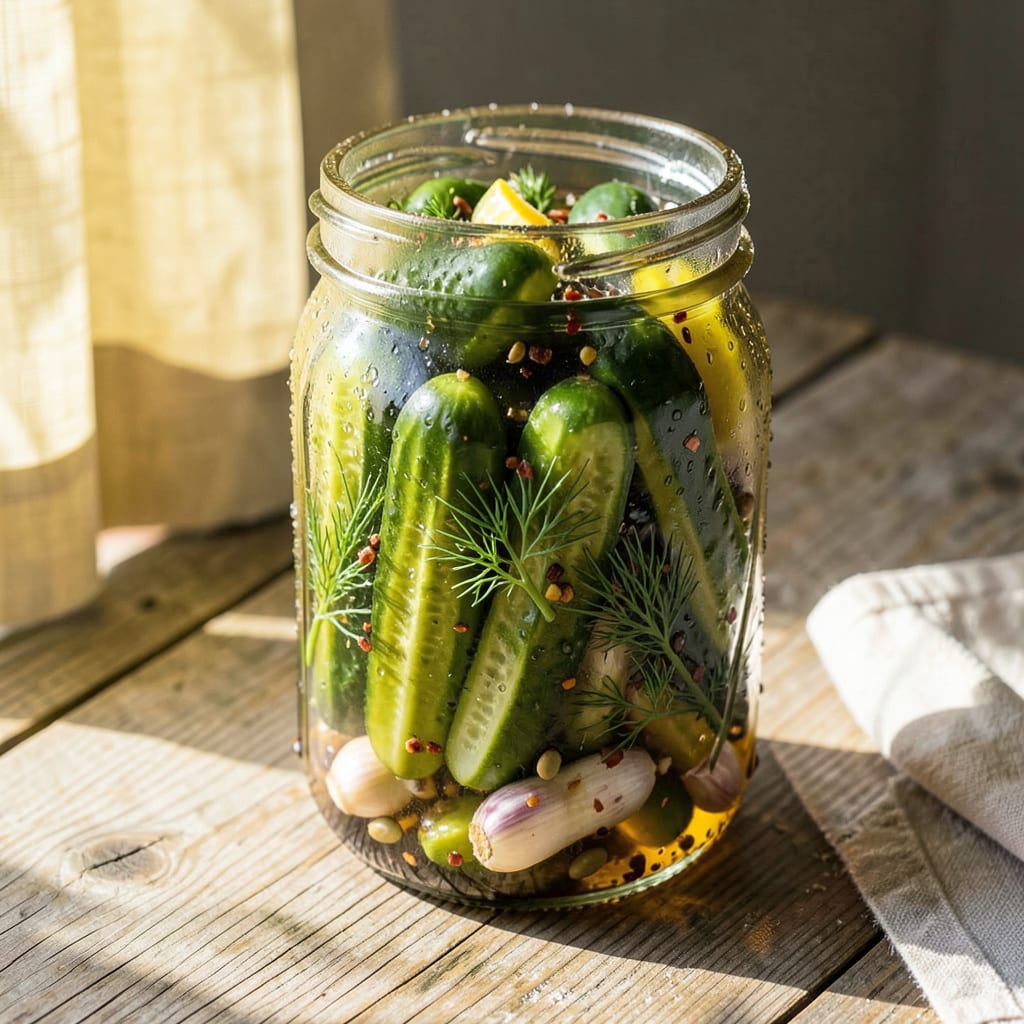
There’s something deeply satisfying about preserving summer’s bounty in jars of crisp, tangy-sweet pickles. This Amish-inspired recipe delivers the perfect balance of dill’s freshness and subtle sweetness, creating pickles that stand out from ordinary store-bought versions. The technique ensures that signature crunch is preserved through every bite.
The process combines simple ingredients with time-honored preservation methods, yielding jars of pickles that keep their flavor and texture for months. What sets this version apart is the careful ratio of sugar to vinegar, producing a pickle that’s tangy yet approachable, with just enough sweetness to make them irresistibly snackable. Proper sterilization and sealing ensure safe storage and consistent quality.
Ingredients for Amish Sweet Dill Pickle
This preservation recipe combines fresh garden cucumbers with a carefully balanced brine of vinegar, sugar, and signature Amish spices.
| Ingredient | Amount | Notes |
|---|---|---|
| Persian cucumbers 🥒 | 4 lb | Small, firm, 3-5 inches long |
| white vinegar 💧 | 4 cups | 5% acidity, no substitutions |
| filtered water 💧 | 2 cups | Chlorine-free for crispness |
| pickling salt 🧂 | ½ cup | Non-iodized, fine grain |
| granulated sugar 🍬 | 1 ½ cups | Balances vinegar's acidity |
| fresh dill heads 🌿 | 6 whole | With seed pods for flavor |
| garlic cloves 🧄 | 12 cloves | Fresh, unpeeled, halved |
| mustard seeds 🌶️ | 2 tbsp | Yellow or brown variety |
| black peppercorns 🌶️ | 1 tbsp | Whole, not pre-ground |
| celery seeds 🌿 | 1 tbsp | Essential for Amish flavor |
| red pepper flakes 🔥 | 1 tsp | Optional for subtle heat |
| grape leaves 🍃 | 6 whole | For natural crispness |
The cucumbers are paramount—Persian or Kirby varieties maintain optimal crunch. Source from farmers markets during peak season (June-August) for best texture. Vinegar acidity must be precisely 5%; Heinz or Ball brand white vinegar are reliable choices. Pickling salt (like Morton’s) ensures clarity in brine without cloudiness. Fresh dill with seed pods provides authentic flavor; supermarket bunches often lack maturity for proper pickling.
For vinegar substitutions, apple cider vinegar at 5% acidity works though flavor shifts slightly. Sugar can be reduced by 25% for less sweetness, but maintain minimum 1 cup for preservation. Mustard seeds are non-negotiable for Amish profile, but coriander seeds can supplement. Grape leaves (from Middle Eastern markets) contain tannins that preserve crunch—substitute with 1/4 tsp alum per quart if unavailable.
Sterilized jars are critical for 12-month shelf stability. Processed pickles require 4-6 weeks for flavor development before opening. Refrigerate after opening; maintains quality for 3 months. Brine can be reused once (boil 10 minutes) for subsequent batches, though flavor intensifies. Always use non-reactive utensils (stainless steel or glass) when handling brine to prevent metallic off-flavors.
Why You’ll Love This Recipe
- No Cooking Required: I just slice the Persian cucumbers, mix the brine, and let time do the work. No stove, no fuss—just crisp pickles ready when I am.
- Sweet-Tangy Balance: That first bite where the sugar and dill meet the vinegar’s sharpness? It’s like summer in a jar. The Persian cucumbers stay snappy, never mushy.
- Meal Prep MVP: I double the batch on Sunday and suddenly my lunches have zero boring moments. Toss them in salads, sandwiches, or just eat straight from the fridge at midnight.
- Pantry-Friendly Savings: Five ingredients, most of which I already have. Persian cucumbers are cheaper than fancy pickles at the store, and one jar lasts me two weeks—if I don’t share.
Step-by-Step Instructions for Amish Sweet Dill Pickles
This method ensures perfectly crisp, tangy-sweet pickles with authentic Amish flavor every time.
Step 1: Prepare the Cucumbers and Jars
Wash the 4 lb Persian cucumbers thoroughly under cold running water, scrubbing gently to remove any dirt. Trim off the blossom end (about 1/16 inch) from each cucumber—this prevents softening during fermentation. Leave the stem end intact to maintain crunch.
Sterilize six 1-quart canning jars and lids by boiling them for 10 minutes. Keep the jars hot until ready to fill. Place 1 grape leaf at the bottom of each jar, followed by 1 dill head and 2 garlic cloves. The grape leaves contain tannins that help preserve crispness.
Step 2: Create the Brine Solution
In a large non-reactive pot, combine the 4 cups white vinegar, 2 cups filtered water, 0.5 cup pickling salt, and 1.5 cups granulated sugar. Bring to a rolling boil over medium-high heat, stirring constantly until the salt and sugar fully dissolve.
Once dissolved, reduce heat to low and add the 2 tbsp mustard seeds, 1 tbsp black peppercorns, 1 tbsp celery seeds, and 1 tsp red pepper flakes. Allow the spices to steep in the hot brine for 5 minutes to release their essential oils and flavors.
Step 3: Pack the Jars and Add Brine
Pack the prepared cucumbers vertically into the sterilized jars, leaving about 1/2 inch headspace at the top. Distribute the remaining fresh dill heads and garlic cloves evenly among the jars. The cucumbers should fit snugly but not be crushed.
Ladle the hot brine into each jar, completely covering the cucumbers while maintaining the 1/2 inch headspace. Use a non-metallic utensil to remove any air bubbles by gently pressing down on the cucumbers. Wipe the rims clean with a damp cloth to ensure proper sealing.
Step 4: Process for Long-Term Storage
Place the lids on the jars and screw on the bands until fingertip-tight. Process the jars in a boiling water bath for 15 minutes, ensuring the water covers the jars by at least 1 inch. Start timing when the water returns to a full rolling boil.
After processing, carefully remove the jars and place them on a towel-lined countertop to cool undisturbed for 12-24 hours. You’ll hear the satisfying “ping” of seals forming as they cool. Check the seals before storing—properly sealed lids won’t flex when pressed.
Step 5: Store and Age for Optimal Flavor
Store the sealed jars in a cool, dark place for at least 4 weeks before opening. This aging period allows the flavors to develop fully. The pickles will maintain their crisp texture and balanced sweet-tangy flavor for up to 12 months when stored properly.
When ready to serve, refrigerate the opened jar and consume within 1 month for best quality. The pickles will continue to develop more complex flavors over time, with the celery seeds and dill creating that distinctive Amish profile.
Regional Styles of This amish sweet dill pickle
Pennsylvania Dutch Tradition
In Lancaster County, Pennsylvania, this recipe takes on a slightly sweeter profile to complement hearty Amish meals. The brine often includes an extra ¼ cup brown sugar for depth, and some families add 1 cinnamon stick per jar during processing. The cucumbers are typically harvested in late July when they’re at peak crispness. 🌾
Midwest Farmhouse Style
Ohio and Indiana Amish communities prefer a more herb-forward approach, doubling the fresh dill heads to 12 total and adding 3 bay leaves to the brine. They often use smaller pint jars for single-serving portions, perfect for church potlucks. The pickles develop a more pronounced dill flavor after 6 weeks of aging.
Southern Appalachian Twist
In Tennessee’s Amish settlements, they incorporate 1 tsp ground turmeric for golden color and earthy notes. The brine gets a splash of apple cider vinegar (about ½ cup) alongside the white vinegar. They prefer Kirby cucumbers for their extra-crisp texture, and often add 1 tsp alum to the brine for guaranteed crunch.
Upper Midwest Adaptation
Wisconsin Amish communities make this recipe with 1 cup honey instead of granulated sugar, creating a smoother sweetness. They add 1 tbsp coriander seeds to the spice mix and use rainwater for the liquid component. The pickles are typically processed in half-gallon jars for family-sized portions.
New Order Amish Variation
More progressive Amish groups in New York State experiment with 1 tsp smoked paprika in the brine for subtle depth. They’ve adopted food-grade plastic buckets for initial brining before jar packing. Their version often includes 1 sliced onion per jar, creating a more complex flavor profile after 8 weeks of aging.
Old Order Traditional
The most conservative Amish communities stick strictly to the original method, using only wooden barrels for fermentation instead of canning. Their brine contains no sugar at all, relying solely on the natural sweetness of perfectly ripe cucumbers. They maintain the 6-week minimum aging period, believing patience yields the best flavor. ✨
Nutrition Facts

- 6 Egg Cake Recipe with Oil: Light as Air With Buttery Moisture - October 4, 2026
- 4 Bean Casserole Recipe: One-Pan Heartiness With Smoky Paprika Depth - October 4, 2026
- 3-Ingredient Keto Mug Cake Recipe: Microwave Magic in 2 Minutes - October 4, 2026