
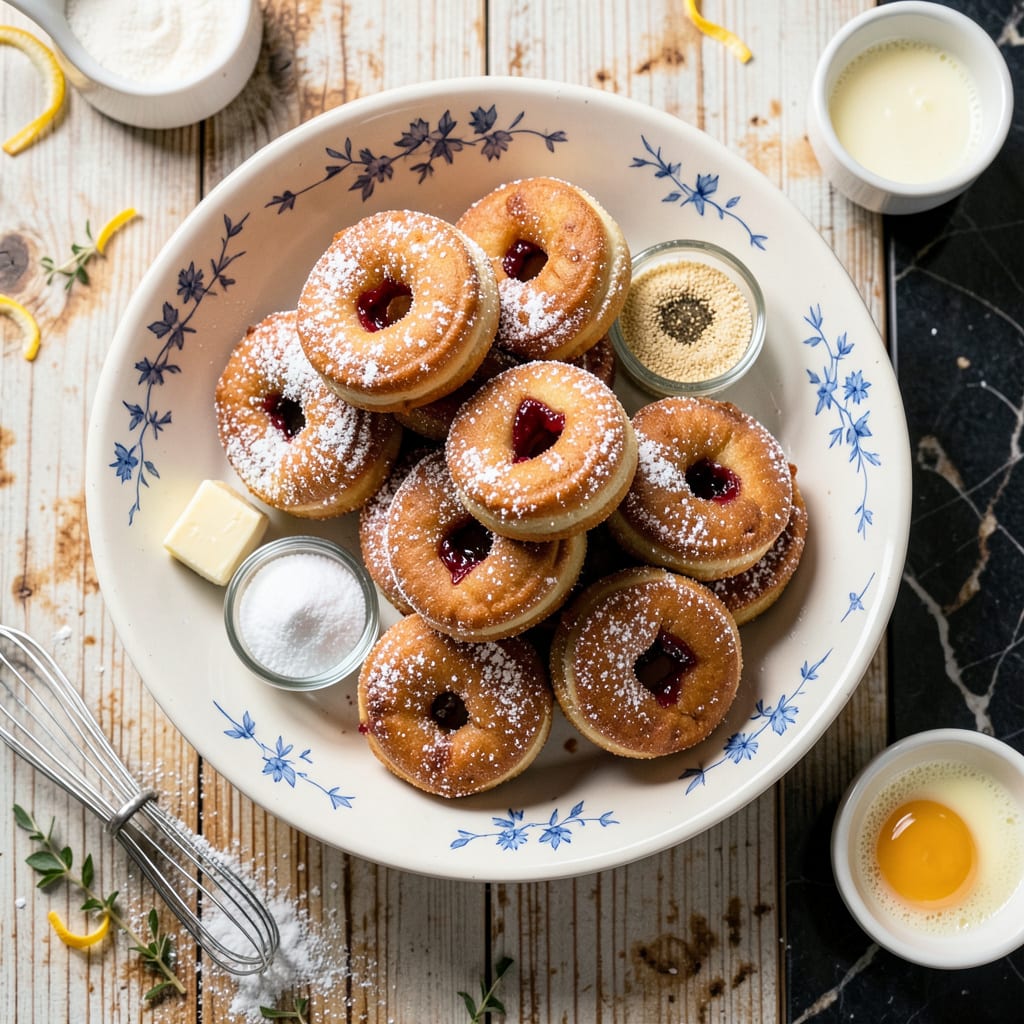
There’s a reason Bismarck doughnuts remain a bakery favorite—they combine pillowy, yeast-raised dough with a luscious creamy vanilla filling that’s impossible to resist. This recipe delivers professional results at home, with precise techniques for achieving that signature light, airy texture that makes these pastries so addictive.
The secret lies in proper dough proofing and maintaining the right oil temperature during frying. I’ve refined this method to ensure golden, evenly cooked exteriors that give way to soft, tender centers. The vanilla pastry cream filling adds just the right amount of sweetness without overwhelming the delicate dough. Perfect for weekend brunches or special occasions.
Ingredients for Bismark
Professional-quality ingredients ensure pillowy dough and luscious vanilla pastry cream for these signature bakery-style doughnuts.
| Ingredient | Amount | Notes |
|---|---|---|
| Whole Milk 🥛 | 1 cup | Warm to 110°F for activation |
| Active Dry Yeast 🍞 | 2 ¼ tsp | One standard packet equivalent |
| Granulated Sugar 🍬 | ¼ cup | Divided for dough and filling |
| All-Purpose Flour 🌾 | 4 cups | Plus extra for dusting |
| Unsalted Butter 🧈 | 6 tbsp | Softened, divided for dough and filling |
| Large Egg Yolks 🥚 | 3 whole | Room temperature for filling |
| Vanilla Bean Paste 🌱 | 1 tbsp | Or pure vanilla extract |
| Cornstarch 🌽 | 2 tbsp | For thickening pastry cream |
| Salt 🧂 | 1 tsp | Fine sea salt preferred |
| Vegetable Oil 🫒 | 8 cups | For deep frying, neutral flavor |
| Powdered Sugar 🍚 | 1 cup | For dusting finished doughnuts |
| Heavy Cream 🥛 | ½ cup | Cold, for pastry cream |
The yeast and flour quality directly impact texture. King Arthur Flour provides consistent protein content for reliable rise, while SAF Instant Yeast offers superior activation. For the vanilla bean paste, Nielsen-Massey delivers concentrated flavor without alcohol burn. Butter should be European-style (82% fat) for optimal plasticity in both dough and filling. Measure all ingredients by weight for professional precision—especially the flour, which can vary dramatically by volume.
Substitutions require careful balance. Instant yeast can replace active dry at a 1:1 ratio, but reduce proofing time by 25%. For the filling, whole eggs substitute for yolks at a 1:1 ratio, though texture becomes slightly less rich. Coconut oil replaces butter in dough (1:1), but frying temperature must reduce by 10°F to prevent burning. Avoid vanilla extract if possible—the paste’s concentrated seeds provide visual appeal and superior flavor dispersion throughout the cream.
Dough requires immediate use after proofing—do not refrigerate. Pastry cream keeps 3 days refrigerated in an airtight container; press plastic wrap directly on surface to prevent skin formation. Fried doughnuts maintain quality 24 hours at room temperature in paper bags (never plastic). For longer storage, freeze unfilled doughnuts up to 1 month; thaw and fry 30 seconds to refresh before filling. Always bring refrigerated ingredients to room temperature before use to prevent dough seizing.
Why You’ll Love This Recipe
- No-Knead Magic: Honestly, the dough comes together in one bowl—just stir, let it rise, and roll. No stand mixer, no elbow grease, and the yeast does half the work while you sip coffee.
- Buttery Clouds: That first bite where crisp, golden layers shatter into a custardy center? It’s all thanks to the butter folded in like a cozy blanket around the sweet milk dough.
- Brunch Hero: I’ve served these at baby showers, lazy Sundays, and even as a “sorry I burned dinner” dessert. They’re equally at home with jam or fried eggs on top.
- Budget Baker’s Win: Five pantry staples, zero fancy ingredients. A stick of butter and flour turn into something that tastes like a bakery splurge—leftovers reheat like a dream, too.
Step-by-Step Instructions for Bismarks
This professional method ensures perfectly risen doughnuts with a rich vanilla cream filling every time.
Step 1: Activate the Yeast and Develop the Dough
Begin by warming the 1 cup Whole Milk to precisely 110°F—this temperature activates the 2.25 tsp Active Dry Yeast without killing it. I recommend using an instant-read thermometer for accuracy. In the bowl of a stand mixer, combine the warmed milk, yeast, and 0.25 cup Granulated Sugar. Let it sit for 5-7 minutes until the mixture becomes foamy and bubbly.
Add 4 cups All-Purpose Flour and 1 tsp Salt to the yeast mixture. Using the dough hook attachment, mix on low speed until a shaggy dough forms. Increase to medium speed and knead for 8-10 minutes, adding 2 tbsp of the 6 tbsp Unsalted Butter (softened) gradually during the last 2 minutes of kneading. The dough should be smooth, elastic, and slightly tacky but not sticky.
Step 2: Proof the Dough for Optimal Rise
Transfer the dough to a lightly greased bowl, cover with plastic wrap, and let it rise in a warm, draft-free environment for 1-1.5 hours or until doubled in volume. I like to place it in an oven with the light on (no heat) for consistent warmth. The dough should spring back slowly when gently pressed with a finger.
After the first rise, punch down the dough to release air bubbles. Divide it into 12 equal portions (about 2.5 oz each) and shape them into smooth balls. Place them on a parchment-lined baking sheet, leaving 2 inches between each. Cover loosely and let rise again for 45-60 minutes until nearly doubled in size.
Step 3: Prepare the Vanilla Pastry Cream Filling
While the dough proofs, make the filling. In a saucepan, heat the remaining 0.25 cup Granulated Sugar with 2 tbsp Cornstarch and 1/4 cup of the 1 cup Whole Milk over medium heat, whisking constantly. Gradually add the remaining milk and bring to a gentle boil.
In a separate bowl, whisk the 3 whole Large Egg Yolks with the 0.5 cup Heavy Cream and 1 tbsp Vanilla Bean Paste. Temper the egg mixture by slowly pouring the hot milk mixture into it while whisking vigorously. Return the combined mixture to the saucepan and cook for 2-3 minutes until thickened to a pudding-like consistency. Transfer to a bowl, cover with plastic wrap directly on the surface, and chill for at least 2 hours.
Step 4: Fry the Doughnuts to Golden Perfection
Heat the 8 cups Vegetable Oil in a deep, heavy-bottomed pot to 350°F. Use a thermometer to maintain this temperature—fluctuations will affect the doughnuts’ texture. Fry the proofed dough balls 2-3 at a time for 2-3 minutes per side until they’re deep golden brown and puffed.
Drain on a wire rack set over a baking sheet to allow excess oil to drip off. While still warm, roll the doughnuts in 1 cup Powdered Sugar until fully coated. Let them cool completely before filling—this prevents the cream from melting.
Step 5: Fill the Doughnuts with Cream
Transfer the chilled pastry cream to a piping bag fitted with a Bismarck tip (or a small round tip). Insert the tip into the side of each doughnut and pipe 1-2 tbsp of filling into the center until you feel slight resistance. The doughnut should feel heavier but not overfilled.
For a professional finish, dust the filled doughnuts with additional powdered sugar just before serving. The ideal Bismarck has a crisp exterior, fluffy interior, and a generous but not excessive amount of creamy filling that oozes slightly when bitten into.
Make-Ahead Tips for This Recipe
Overnight Dough Prep
You can prepare the dough the night before to save morning time. After kneading, place the dough in a greased bowl, cover tightly with plastic wrap, and refrigerate for up to 12 hours. The cold slows fermentation, allowing flavors to develop. Remove it 2 hours before shaping to let it warm slightly. 💡
Pastry Cream Advance
The vanilla pastry cream actually benefits from overnight chilling. Prepare it up to 2 days ahead and store in an airtight container with plastic wrap pressed directly on the surface. This prevents skin formation and lets flavors meld beautifully. Stir well before piping into doughnuts.
Shape and Freeze
After shaping the dough balls, place them on a parchment-lined tray, cover loosely, and freeze for up to 1 month. When ready to fry, thaw in the refrigerator overnight, then let rise at room temperature for 1-2 hours before frying as usual.
Frying Shortcut
For same-day prep, shape the dough balls and let them rise 30 minutes at room temperature, then refrigerate for 4-12 hours. This cold proof develops flavor while controlling rise time. Fry directly from the fridge—they’ll puff beautifully.
Sugar Coating Prep
Mix the powdered sugar with 1 tsp cornstarch the night before to prevent clumping. Store in an airtight container. The cornstarch helps the sugar adhere better to warm doughnuts while keeping it free-flowing for easy coating.
Assembly Timeline
For stress-free morning assembly: Night 1 – make pastry cream; Night 2 – prep dough through first rise; Morning – shape, proof, fry, and fill. This breaks the work into manageable steps while ensuring fresh, warm doughnuts for brunch. ⏰
Nutrition Facts

- 6 Egg Cake Recipe with Oil: Light as Air With Buttery Moisture - October 4, 2026
- 4 Bean Casserole Recipe: One-Pan Heartiness With Smoky Paprika Depth - October 4, 2026
- 3-Ingredient Keto Mug Cake Recipe: Microwave Magic in 2 Minutes - October 4, 2026