
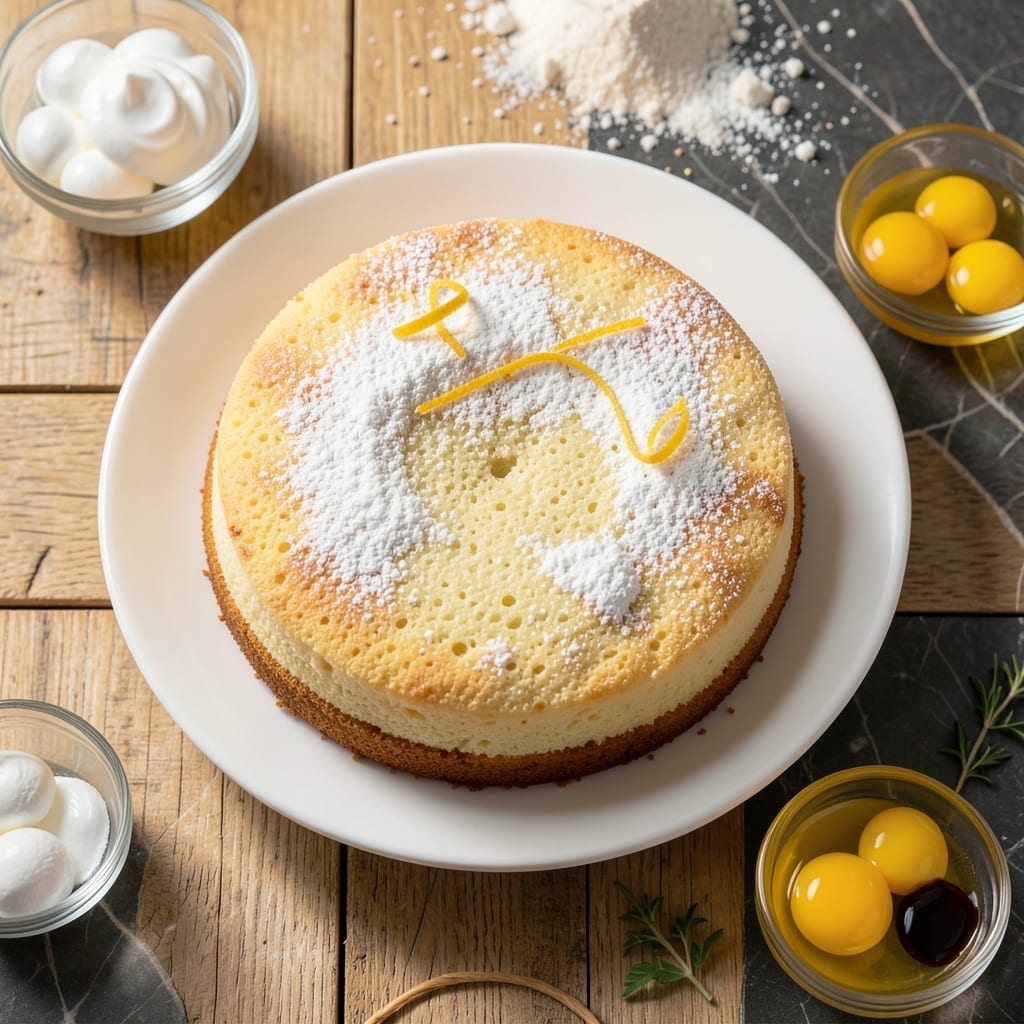
There’s an art to achieving the perfect light and airy sponge cake texture using just a handful of ingredients. This proven method delivers a delicate crumb with minimal effort.
The secret lies in proper egg beating and gentle folding techniques. With precise timing and temperature control, you’ll create a cake that’s tender, moist, and perfectly risen every time.
Ingredients for Cake Recipe Sponge Cake
Precise ingredients create that delicate, airy texture everyone loves in classic sponge cake.
| Ingredient | Amount | Notes |
|---|---|---|
| Cake Flour 🌾 | 1 cup | Sifted for lightness |
| Granulated Sugar 🍚 | ¾ cup | Fine grain preferred |
| Large Eggs 🥚 | 4 whole | Room temperature, separated |
| Vanilla Extract 🌿 | 1 tsp | Pure, not imitation |
| Salt 🧂 | ¼ tsp | Fine sea salt |
| Cream of Tartar 🧂 | ½ tsp | Stabilizes egg whites |
| Unsalted Butter 🧈 | 2 tbsp | Melted and cooled |
| Whole Milk 🥛 | ¼ cup | Room temperature |
| Lemon Zest 🍋 | 1 tsp | Freshly grated |
The eggs are non-negotiable here. Room temperature is critical for maximum volume—cold eggs won’t whip properly. I source mine from local farms when possible, but standard grocery store large eggs work fine. Cake flour is ideal for its lower protein content, but all-purpose flour minus 2 tbsp per cup can substitute in a pinch. The vanilla should be pure extract—imitation lacks depth.
No cake flour? All-purpose flour sifted with 2 tbsp cornstarch per cup gets you close. Out of cream of tartar? White vinegar or lemon juice at 1/2 tsp per egg white works. The butter can be swapped for coconut oil if avoiding dairy. Whole milk is best, but 2% works too—just don’t use skim as the fat matters for tenderness.
Store eggs in their original carton for 3-4 weeks. Cake flour keeps 1 year in a cool, dark place. Baked sponge holds at room temperature for 2 days (tightly wrapped) or freezes beautifully for 3 months.
Why You’ll Love This Recipe
- I’ll be real: leftovers taste just as good the next day, and it freezes beautifully for last-minute desserts.
- One Bowl Wonder: I just dump the cake flour, sugar, eggs, vanilla, and salt in one bowl and mix—no fancy steps.
- Pure Vanilla Magic: The vanilla extract shines through, giving that warm, sweet aroma that makes my kitchen smell like a bakery.
- Blank Canvas Cake: Honestly, it’s my base for everything—layer it with jam, frost it, or just dust with powdered sugar.
Step-by-Step Instructions for Sponge Cake
Master the technique and you’ll produce a light, ethereal cake with a tender crumb every time.
Step 1: Prepare the Egg Whites for Maximum Volume
Separate the 4 whole Large Eggs into yolks and whites, placing the whites in a clean, grease-free bowl. Add the 0.5 tsp Cream of Tartar and 0.25 tsp Salt to the whites. The cream of tartar stabilizes the egg whites, allowing them to hold more air and reach greater volume.
Using a stand mixer or hand mixer, beat the egg whites on medium-high speed until they form soft peaks. Gradually add 0.5 cup of the 0.75 cup Granulated Sugar, reserving the remaining 0.25 cup for the yolks. Continue beating until the meringue forms stiff, glossy peaks that hold their shape when the whisk is lifted. This process should take 4-6 minutes.
Step 2: Whisk the Yolk Mixture to Ribbon Stage
In a separate bowl, combine the egg yolks, remaining 0.25 cup Granulated Sugar, 1 tsp Vanilla Extract, and 1 tsp Lemon Zest. Whisk vigorously by hand or with a mixer on medium speed until the mixture thickens and lightens to a pale yellow color, forming ribbons when the whisk is lifted.
Slowly drizzle in the 2 tbsp Unsalted Butter (melted and cooled) and 0.25 cup Whole Milk, whisking continuously to emulsify the mixture. This step ensures the liquid ingredients are fully incorporated and creates a smooth, homogeneous base for the cake batter.
Step 3: Fold in the Dry Ingredients Gently
Sift the 1 cup Cake Flour directly over the yolk mixture. Using a silicone spatula, gently fold the flour into the yolks using a J-shaped motion. Rotate the bowl as you fold to ensure even distribution of the flour without deflating the mixture.
This gentle folding technique prevents the development of gluten, which would toughen the cake. The batter should be smooth and free of lumps, with a slightly thick consistency.
Step 4: Combine Meringue and Yolk Mixture
Add one-third of the meringue to the yolk mixture and fold gently to lighten the base. This step makes it easier to incorporate the remaining meringue without deflating it. Pour the lightened yolk mixture into the bowl with the remaining meringue.
Fold everything together gently until no streaks of meringue remain. Be careful not to overmix—stop as soon as the batter is uniform. The final batter should be light, airy, and slightly glossy.
Step 5: Bake to Perfection
Pour the batter into an ungreased 9-inch round cake pan. Do not grease the pan, as the batter needs to cling to the sides to rise properly. Smooth the top gently with a spatula.
Bake in a preheated 350°F oven for 25-30 minutes, or until the top is golden brown and springs back when lightly pressed with a finger. The cake should pull away slightly from the edges of the pan. Avoid opening the oven during the first 20 minutes to prevent collapsing.
Remove the cake from the oven and invert it immediately onto a wire rack. Let it cool completely upside down to maintain its height and prevent sagging. Once cooled, run a thin knife around the edges to release it from the pan if needed.
Pro Tips For Making Cake Recipe Sponge Cake
- Room Temp Eggs: Take your eggs out 30-60 minutes before mixing—I learned this the hard way after my first few sponges turned dense from cold eggs not whipping properly.
- Fold Don’t Stir: Use a spatula and gentle circular motions to combine the flour with the egg mixture, or you’ll deflate all that air you just beat in.
- Skip Cold Flour: Measure your cake flour first, then let it sit out while you prep the rest—cold flour can cause lumps that ruin the texture.
- Preheat Properly: Give your oven a full 20 minutes to reach 350°F, and double-check with an oven thermometer—underheating leads to a sunken middle.
Essential Equipment for Great cake recipe sponge cake
Must-Have Tools
To whip up the perfect cake recipe sponge cake, start with the basics. A reliable stand mixer or hand mixer is essential for achieving that light, airy texture by properly beating eggs and sugar. 🥘 Don’t forget a set of measuring cups and spoons—precision is key for consistent results.
A 9-inch round cake pan (or two for layering) is a must, and a cooling rack ensures your sponge cake cools evenly without sogginess. A whisk and spatula will help you fold ingredients gently, keeping the batter fluffy.
Nice-to-Have
For an extra edge, consider a kitchen scale for weighing ingredients—this boosts accuracy. 🎯 A sifter helps aerate flour, while parchment paper prevents sticking and makes removal effortless.
A cake turntable and offset spatula are great for smooth frosting application, and a thermometer ensures your oven is at the perfect temperature for even baking.
Budget Alternatives
No stand mixer? A large bowl and whisk work just fine—just put in some elbow grease! 💡 Use a loaf pan instead of round pans if that’s what you have. A fork can substitute for a sifter to fluff up flour.
Skip the turntable and use a plate on a bowl for stability while frosting. These swaps keep your sponge cake dream alive without breaking the bank!
Nutrition Facts

- 6 Egg Cake Recipe with Oil: Light as Air With Buttery Moisture - October 4, 2026
- 4 Bean Casserole Recipe: One-Pan Heartiness With Smoky Paprika Depth - October 4, 2026
- 3-Ingredient Keto Mug Cake Recipe: Microwave Magic in 2 Minutes - October 4, 2026