
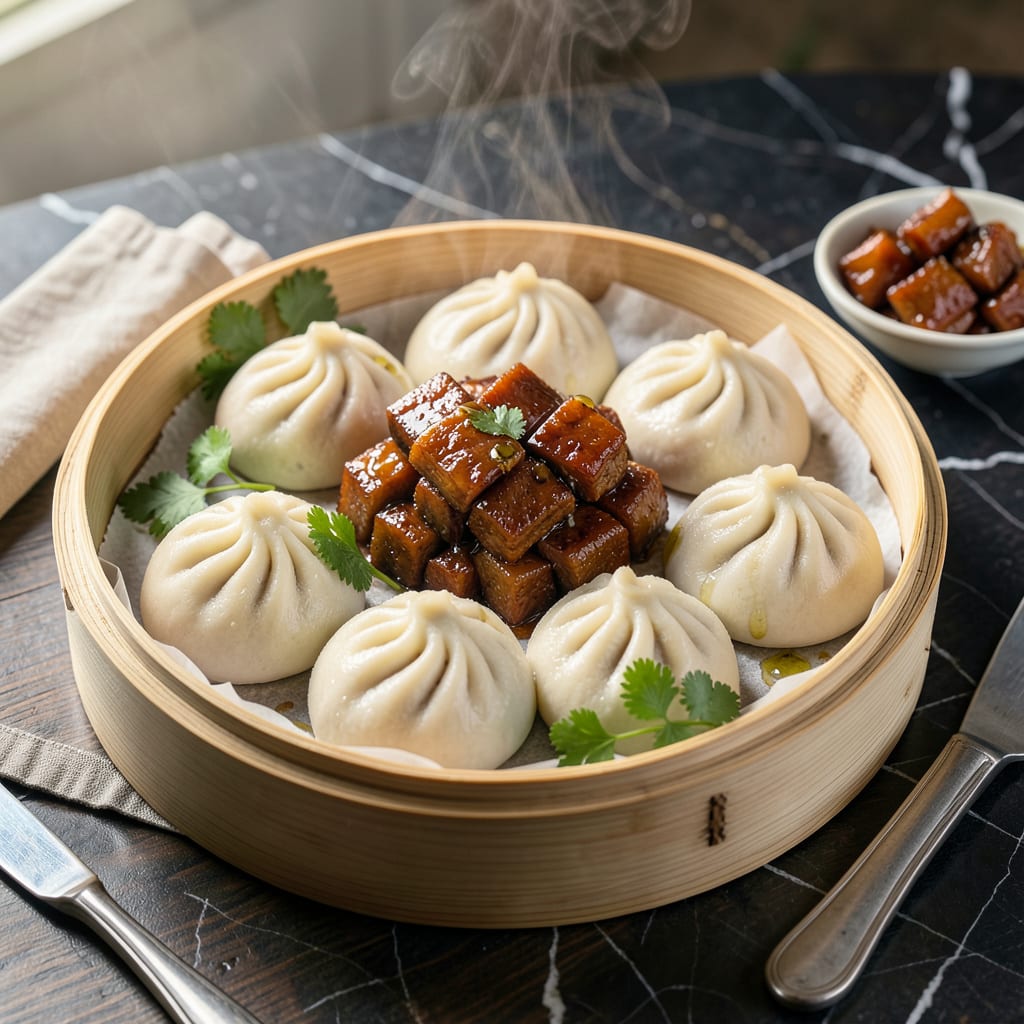
These soft, cloud-like buns are a staple of Chinese cuisine, offering endless possibilities with both sweet and savory fillings. The dough comes together with simple ingredients but requires precise steaming to achieve that signature fluffy texture.
Mastering the fold and pleat technique ensures beautiful presentation, while the steaming process creates the perfect pillowy bite. Whether you choose pork, vegetables, or red bean paste, the result is always satisfying.
Ingredients for Chinese Steamed Bao
Simple pantry staples and a few specialty items create these cloud-like steamed buns with endless filling possibilities.
| Ingredient | Amount | Notes |
|---|---|---|
| All-Purpose Flour 🌾 | 4 cups | Plus extra for dusting work surface |
| Granulated Sugar 🍚 | ¼ cup | Activates the yeast properly |
| Active Dry Yeast 🍞 | 1 package | 2 1/4 tsp equivalent |
| Warm Water 💧 | 1 ¼ cups | 110°F to 115°F ideal temperature |
| Vegetable Oil 🫒 | 3 tbsp | Divided for dough and bowl |
| Baking Powder 🧂 | 1 tbsp | For added lift in dough |
| Kosher Salt 🧂 | 1 tsp | Diamond Crystal preferred |
| Sesame Oil 🫒 | 1 tsp | For authentic flavor in dough |
| Pork Belly 🥩 | 1 lb | Diced, for traditional filling |
| Green Onions 🧅 | 4 whole | Thinly sliced for filling |
| Fresh Ginger 🌿 | 1 tbsp | Grated for filling |
| Soy Sauce 🫕 | 2 tbsp | Low-sodium preferred |
| Hoisin Sauce 🥄 | 2 tbsp | For sweet-savory filling |
| Red Bean Paste 🍫 | 1 cup | Canned or homemade for sweet filling |
| Napa Cabbage 🥬 | 2 cups | Shredded for vegetarian filling |
[recipeingredientscaler]
The flour is foundational—King Arthur all-purpose is my go-to for consistent texture. Yeast freshness is non-negotiable; check the expiration date and store it in the freezer if you won’t use it quickly. For the vegetarian filling, Napa cabbage from Asian markets has the sweetness and crunch you want. The sesame oil should be toasted variety for depth.
No pork belly? Mushrooms or tofu make excellent vegetarian fillings. Swap red bean paste for lotus seed paste if you prefer a different sweet filling. Low-sodium soy sauce prevents the filling from becoming too salty. Green onions can be substituted with chives in a pinch. Hoisin sauce is key for authenticity—Koon Chun is a reliable brand.
Dough can be refrigerated overnight (let it come to room temp before shaping). Steamed bao keep 2-3 days in the fridge—reheat by steaming again. Unfilled dough freezes for 1 month. Always use parchment paper squares under each bun to prevent sticking during steaming.
Why You’ll Love This Recipe
- Pillowy Softness: I love how the yeast and warm water create that cloud-like texture with just a few simple pantry staples.
- Sweet & Savory: That hint of sugar in the dough balances perfectly with whatever filling I choose—pork, veggies, or even just a smear of hoisin.
- Feeds a Crowd: These freeze beautifully, so I make a big batch and reheat them straight from the freezer when unexpected guests drop by.
- Budget Stretch: Honestly, a bag of flour and yeast costs pennies but feels like a restaurant treat at home.
Step-by-Step Instructions for Chinese Steamed Bao
Master the technique for achieving pillowy, cloud-like dough and perfectly balanced fillings every time.
Step 1: Activate the Yeast and Prepare the Dough
Begin by dissolving the 1 package Active Dry Yeast and 0.25 cup Granulated Sugar in 1.25 cups Warm Water heated to 110°F to 115°F. Let it sit for 5-7 minutes until the mixture becomes foamy—this confirms the yeast is active and ready to work its magic.
In a large mixing bowl, combine the 4 cups All-Purpose Flour, 1 tbsp Baking Powder, and 1 tsp Kosher Salt. Make a well in the center and pour in the yeast mixture along with 2 tbsp Vegetable Oil and 1 tsp Sesame Oil. The sesame oil adds a subtle nutty aroma that enhances the authenticity of the dough.
Step 2: Knead and Proof the Dough
Using a dough hook attachment on a stand mixer or by hand, knead the dough on a lightly floured surface for 8-10 minutes until it becomes smooth and elastic. The dough should spring back slowly when pressed with a finger, indicating proper gluten development.
Lightly grease a large bowl with the remaining 1 tbsp Vegetable Oil, place the dough inside, and cover with a damp kitchen towel. Let it rise in a warm, draft-free place for 1 to 1.5 hours, or until it has doubled in size. This fermentation step is crucial for achieving the light, airy texture characteristic of traditional bao.
Step 3: Prepare the Fillings
For the savory filling, combine the 1 lb Pork Belly (diced), 4 whole Green Onions (thinly sliced), 1 tbsp Fresh Ginger (grated), 2 tbsp Soy Sauce, and 2 tbsp Hoisin Sauce in a bowl. The hoisin sauce adds a sweet and savory depth that pairs beautifully with the rich pork.
For the sweet filling, use 1 cup Red Bean Paste, ensuring it’s smooth and free of lumps. For a vegetarian option, sauté 2 cups Napa Cabbage (shredded) with a touch of soy sauce until tender and slightly wilted. Both fillings should be cooled completely before assembling to prevent soggy dough.
Step 4: Shape and Fill the Bao
Once the dough has risen, punch it down and divide it into 12 equal portions. Roll each portion into a 3-inch circle, keeping the edges thinner than the center. Place 1-2 tbsp of your chosen filling in the center of each circle.
To shape, pleat the edges of the dough by pinching and folding them upward, twisting slightly as you go to seal the bao tightly. The pleats not only look traditional but also ensure the filling stays secure during steaming. Place each finished bao on a square of parchment paper to prevent sticking.
Step 5: Steam to Perfection
Arrange the bao in a steamer basket lined with parchment paper, leaving 1 inch of space between each to allow for expansion. Bring water to a boil in the steamer pot, then reduce heat to medium. Steam the bao for 15-18 minutes until they puff up significantly and the dough becomes translucent and slightly glossy.
Remove the lid carefully to avoid condensation dripping onto the bao. Serve immediately while hot, as the texture is best fresh from the steamer. The ideal bao will have a soft, slightly sticky exterior with a fluffy, tender interior that melts in your mouth.
Pro Tips For Making Chinese Steamed Bao
- Test the Yeast: I learned this the hard way—always proof your active dry yeast in the warm water with a pinch of sugar first. If it doesn’t bubble within 5 minutes, your bao won’t rise, no matter how long you wait.
- Knead Thoroughly: Don’t rush the kneading—work the dough for at least 10 minutes until it’s smooth and elastic. Sounds tedious, but it’s the only way to get that soft, pillowy texture.
- Skip Cold Water: Warm water should feel like bathwater, around 110°F. Too hot kills the yeast, too cold slows it down—I used to guess and ended up with dense, sad bao.
- Oil the Dough: Brush the dough with a little vegetable oil before the first rise. My grandmother swore by this, and it keeps the surface from drying out while it proofs.
Essential Equipment for This Dish
Steamer Basket Basics
Invest in a bamboo steamer basket—I use a 10-inch diameter with 2 tiers for making multiple batches at once. The bamboo allows steam to circulate while absorbing excess moisture, preventing soggy bottoms. Look for unbleached bamboo to avoid chemical residues.
Parchment Paper Prep
Cut 2×2-inch squares of parchment paper to place under each bao before steaming. This prevents sticking and makes removal easier. I prefer pre-cut parchment steamer liners for convenience. Never skip this step—it’s a game-changer for clean presentation. 💡
Dough Rising Tools
A stand mixer with dough hook saves time and effort for kneading. I swear by my KitchenAid Artisan for consistent results. If kneading by hand, use a large wooden cutting board and be prepared for a 10-minute workout to develop proper gluten.
Precision Scaling
A digital kitchen scale ensures accurate dough portions—2.5 oz balls yield consistent bao. I use an OXO Good Grips scale for its precision and easy-to-read display. Even distribution means even cooking and professional-looking results.
Thermometer Necessity
An instant-read thermometer checks water temperature for yeast activation (110-115°F). Too hot kills the yeast, too cool prevents activation. My ThermoWorks ThermoPop gives readings in 3 seconds and is dishwasher safe. 🌡️
Rolling Essentials
Use a French rolling pin without handles for better control when rolling dough circles. A ruler helps maintain consistent 3-inch diameters. Dust your surface with King Arthur flour to prevent sticking while rolling.
Nutrition Facts
Frequently Asked Questions
Why did my bao not rise properly?
Old yeast or water that’s too hot or cold is usually the culprit. Always check yeast expiration and use water at 110-115°F. The dough should double in 1-1.5 hours in a warm spot.
Can I make bao without a steamer basket?
Yes! Use a colander or heatproof plate over a pot of boiling water. Just ensure it’s elevated above water and covered tightly. Line with parchment to prevent sticking.
How do I prevent filling from leaking?
Seal edges tightly with pleats and don’t overfill—use 1-2 tbsp max per bun. Chill fillings first to avoid soggy dough. The pleats should look like a gathered purse.
Can I freeze uncooked bao?
Freeze on parchment-lined trays, then transfer to bags. Steam from frozen for 20-25 minutes. No need to thaw first.

- 6 Egg Cake Recipe with Oil: Light as Air With Buttery Moisture - October 4, 2026
- 4 Bean Casserole Recipe: One-Pan Heartiness With Smoky Paprika Depth - October 4, 2026
- 3-Ingredient Keto Mug Cake Recipe: Microwave Magic in 2 Minutes - October 4, 2026