
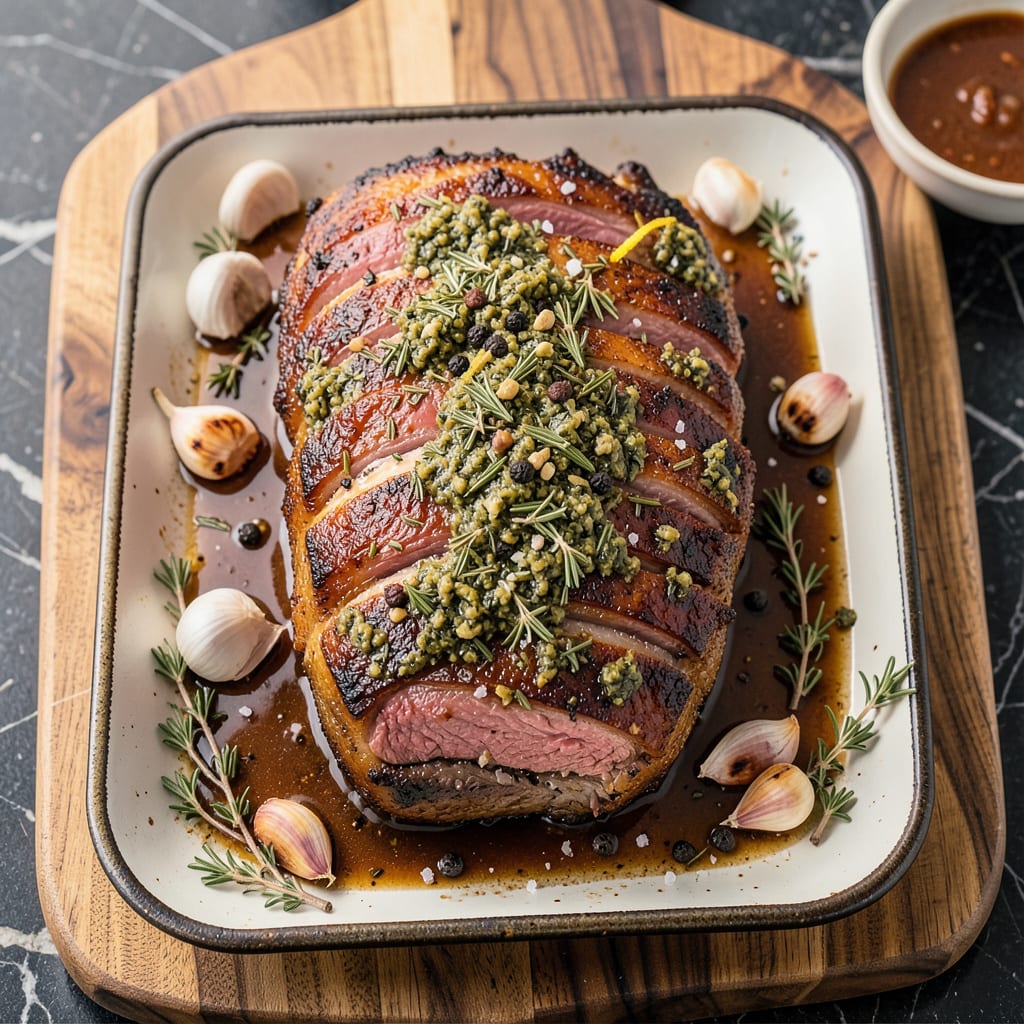
Few dishes command a holiday table like Julia Child’s prime rib—perfectly rosy inside with a fragrant herb crust that forms a golden seal of flavor. This isn’t just another roast; it’s a masterclass in French technique adapted for American kitchens, where precision meets approachable elegance. The method relies on slow roasting at moderate heat, allowing the meat’s natural juices to redistribute while the exterior develops that signature caramelized crust.
What sets this recipe apart is Julia’s insistence on starting with a well-marbled rib roast and treating it with respect: no aggressive searing, no rushed cooking. The result is meat so tender it nearly falls apart at the touch of a fork, with each slice revealing that ideal medium-rare gradient from edge to center. Serve it with au jus made from the pan drippings, and you’ve recreated the centerpiece that made Julia’s version legendary.
Ingredients for Julia Child Prime Rib
Six pounds of prime rib and a handful of aromatic herbs transform into Julia’s legendary holiday centerpiece.
| Ingredient | Amount | Notes |
|---|---|---|
| Bone-In Rib Roast 🥩 | 6 lb | Well-marbled, first-cut preferred |
| Kosher Salt 🧂 | 2 tbsp | Diamond Crystal brand recommended |
| Freshly Ground Black Pepper 🌶️ | 2 tbsp | Coarsely ground for crust |
| Fresh Thyme 🌿 | 2 tbsp | Leaves stripped from stems |
| Fresh Rosemary 🌿 | 2 tbsp | Finely chopped for even distribution |
| Garlic Cloves 🧄 | 6 cloves | Minced to a fine paste |
| Dijon Mustard 🟡 | ¼ cup | Grey Poupon preferred |
| Unsalted Butter 🧈 | 4 tbsp | Softened to room temperature |
| Dry Red Wine 🍷 | 1 cup | Cabernet Sauvignon recommended |
| Beef Stock 🥩 | 2 cups | Low-sodium preferred |
| All-Purpose Flour 🌾 | 2 tbsp | For thickening au jus |
| Olive Oil 🫒 | 2 tbsp | For initial searing |
The rib roast quality is non-negotiable for this preparation. Optimal results require USDA Prime grade with abundant marbling—Whole Foods or a reputable butcher are ideal sources. The first-cut (ribs 10-12) provides the most uniform cooking. For the herb crust, fresh thyme and rosemary are essential; dried herbs lack the necessary moisture and fragrance. The garlic should be freshly minced to a paste consistency for even distribution across the roast surface.
Substitutions must be approached judiciously. While USDA Choice can substitute for Prime, expect slightly less marbling and tenderness. For the wine component, any bold red (Merlot, Syrah) works, though Cabernet Sauvignon provides optimal acidity balance. In a pinch, beef broth with 1 tbsp balsamic vinegar can replace wine. The Dijon mustard can be substituted with whole-grain mustard, though the crust texture will vary slightly. Always use unsalted butter to control sodium levels precisely.
Proper storage ensures peak results. The raw roast should rest uncovered in the refrigerator for 24 hours before cooking to develop the dry surface needed for crust formation. Post-cooking, the prime rib maintains quality for 3-4 days refrigerated, though flavor intensifies after 24 hours. For longer storage, slice and freeze portions in vacuum-sealed bags for up to 3 months. The au jus can be prepared ahead and reheated gently before serving.
Why You’ll Love This Recipe
- I’ll be real: the hardest part is tying the herbs. Just pat the roast dry, rub it with salt and pepper, toss on thyme and rosemary, and let the oven do the rest. No marinades, no fuss—just a bone-in roast and five minutes of hands-on work.
- Five-Minute Prep: I’ll be real: the hardest part is tying the herbs. Just pat the roast dry, rub it with salt and pepper, toss on thyme and rosemary, and let the oven do the rest. No marinades, no fuss—just a bone-in roast and five minutes of hands-on work.
- That Crust, Though: The combo of kosher salt and high-heat roasting gives you this crackly, golden crust while the inside stays juicy and pink. Honestly, the first time I pulled it out, I stood there staring at it like it was a miracle. (Then I ate three slices before it hit the table.)
- Holiday Hero, Weeknight Win: This is my Christmas centerpiece and my “I need to impress the in-laws” move—but it’s also unfussy enough for a Sunday supper when I’m craving something indulgent. One recipe, zero stress, all the compliments.
Step-by-Step Instructions for Julia Child’s Prime Rib
This method delivers a perfectly rosy center with a fragrant herb crust every time.
Step 1: Prepare the Herb Crust and Season the Roast
Begin by combining the 2 tbsp fresh thyme, 2 tbsp fresh rosemary, 6 cloves garlic cloves (minced to a fine paste), 2 tbsp kosher salt, and 2 tbsp freshly ground black pepper in a small bowl. The garlic should be minced so finely it almost dissolves into the herbs, creating a uniform paste that will adhere beautifully to the meat.
Pat the 6 lb bone-in rib roast completely dry with paper towels—this is crucial for achieving a proper sear. Rub the herb mixture evenly over the entire surface of the roast, pressing gently to ensure it adheres. The roast should be completely coated with no bare spots. Let it sit at room temperature for 1 hour before cooking; this allows the salt to penetrate and the meat to cook more evenly.
Step 2: Sear the Roast for Maximum Flavor
Preheat your oven to 450°F. In a large oven-safe skillet or roasting pan, heat the 2 tbsp olive oil over medium-high heat until it shimmers but doesn’t smoke. Place the roast fat-side down in the pan and sear for 3-4 minutes until a deep golden crust forms. You’ll hear a steady sizzle—this is the Maillard reaction developing rich, complex flavors.
Using tongs, carefully turn the roast to sear the other sides, about 2 minutes per side. The goal is an even, dark brown crust on all surfaces except the bone side. Remove the pan from heat and transfer the roast to a wire rack set inside a roasting pan, fat-side up. This elevation allows hot air to circulate completely around the meat.
Step 3: Roast to Perfect Medium-Rare
Insert a meat thermometer into the thickest part of the roast, avoiding the bone. Roast in the preheated 450°F oven for 20 minutes, then reduce the temperature to 325°F and continue roasting. The initial high heat creates a beautiful crust, while the lower temperature ensures even cooking without overcooking the exterior.
Roast until the internal temperature reaches 120-125°F for medium-rare, which will take approximately 1.5-2 hours total cooking time. Begin checking the temperature after 1 hour. The roast is done when the thermometer slides in and out easily and the juices just begin to run clear. Remember that the temperature will rise 5-10°F during resting.
Step 4: Create the Red Wine Au Jus
While the roast rests, place the roasting pan over medium heat on the stovetop. Add the 1 cup dry red wine and scrape up all the browned bits from the bottom of the pan with a wooden spoon. These fond particles are packed with flavor and will form the base of your au jus. Simmer for 3-4 minutes until the wine reduces by half.
Whisk in the 2 tbsp all-purpose flour until completely dissolved, then gradually add the 2 cups beef stock, whisking constantly. Bring to a gentle simmer and cook for 5-7 minutes until the sauce thickens enough to coat the back of a spoon. Remove from heat and whisk in the 4 tbsp unsalted butter one tablespoon at a time until fully incorporated. This creates a rich, velvety finish.
Step 5: Rest, Slice, and Serve
Transfer the roast to a cutting board and tent loosely with foil. Let it rest for 20-30 minutes—this is non-negotiable for juicy results. The internal temperature will continue to rise to about 130-135°F during this time, and the juices will redistribute throughout the meat rather than spilling out when you cut into it.
To serve, remove the bones by cutting along the rib bones, then slice the meat against the grain into ½-inch thick slices. Arrange on a warmed platter and spoon some of the warm au jus over the top. Serve the remaining au jus on the side for dipping. Each slice should reveal a perfect pink center surrounded by the fragrant herb crust, with just enough resistance to indicate perfect doneness.
Regional Styles of This Recipe
Classic French Technique
Julia’s approach reflects her French training with a slow-roasted method that begins at 450°F for crust development, then drops to 325°F to gently coax the meat to perfect doneness. The key is monitoring internal temperature religiously—she insisted on removing the roast at 120°F for medium-rare, knowing carryover cooking would bring it to 130°F. This technique ensures edge-to-edge pink perfection. 💛
British Sunday Roast
Across the pond, they’d serve this with Yorkshire pudding and horseradish cream. The British version often uses a simpler salt-and-pepper rub but roasts at a lower 300°F for hours longer. I love adding 1 tbsp English mustard powder to the crust for that pub-style flavor. The au jus becomes gravy with a splash of Worcestershire sauce.
Texas Hill Country
Down in Texas, they’d crank the heat to 500°F for a quick sear, then finish at 250°F with post oak smoke. The rub gets bolder—chili powder and smoked paprika join the herbs. Instead of au jus, they’d serve it with peppercorn cream sauce. I once tried this method with mesquite chips—game-changing for outdoor cooking. 🔥
Italian Holiday Feast
In Italy, they’d replace the thyme with fresh sage and add 1 tbsp fennel pollen to the crust. The roast might get a prosecco and balsamic pan sauce instead of red wine. Serve with roasted fennel wedges and polenta—the anise notes complement the beef beautifully. My Nonna always added 1 crushed juniper berry to the rub.
Pacific Northwest
Seattle chefs would use local blackberries in the au jus, reducing ½ cup berries with the wine for a fruity contrast. The herb crust might include douglas fir tips for piney aroma. I love serving this with wild mushroom risotto—the earthy flavors ground the rich beef. A Pinot Noir from Willamette Valley pairs perfectly.
Argentinian Asado
In Argentina, they’d cook this over hardwood charcoal until the crust is nearly black. The only seasoning? Coarse salt and maybe chimichurri after slicing. They’d serve it with grilled provoleta (melted provolone) and salsa criolla. I learned this method from a gaucho—simple, but the smoky depth is unmatched. ⚡
Nutrition Facts

- 6 Egg Cake Recipe with Oil: Light as Air With Buttery Moisture - October 4, 2026
- 4 Bean Casserole Recipe: One-Pan Heartiness With Smoky Paprika Depth - October 4, 2026
- 3-Ingredient Keto Mug Cake Recipe: Microwave Magic in 2 Minutes - October 4, 2026