
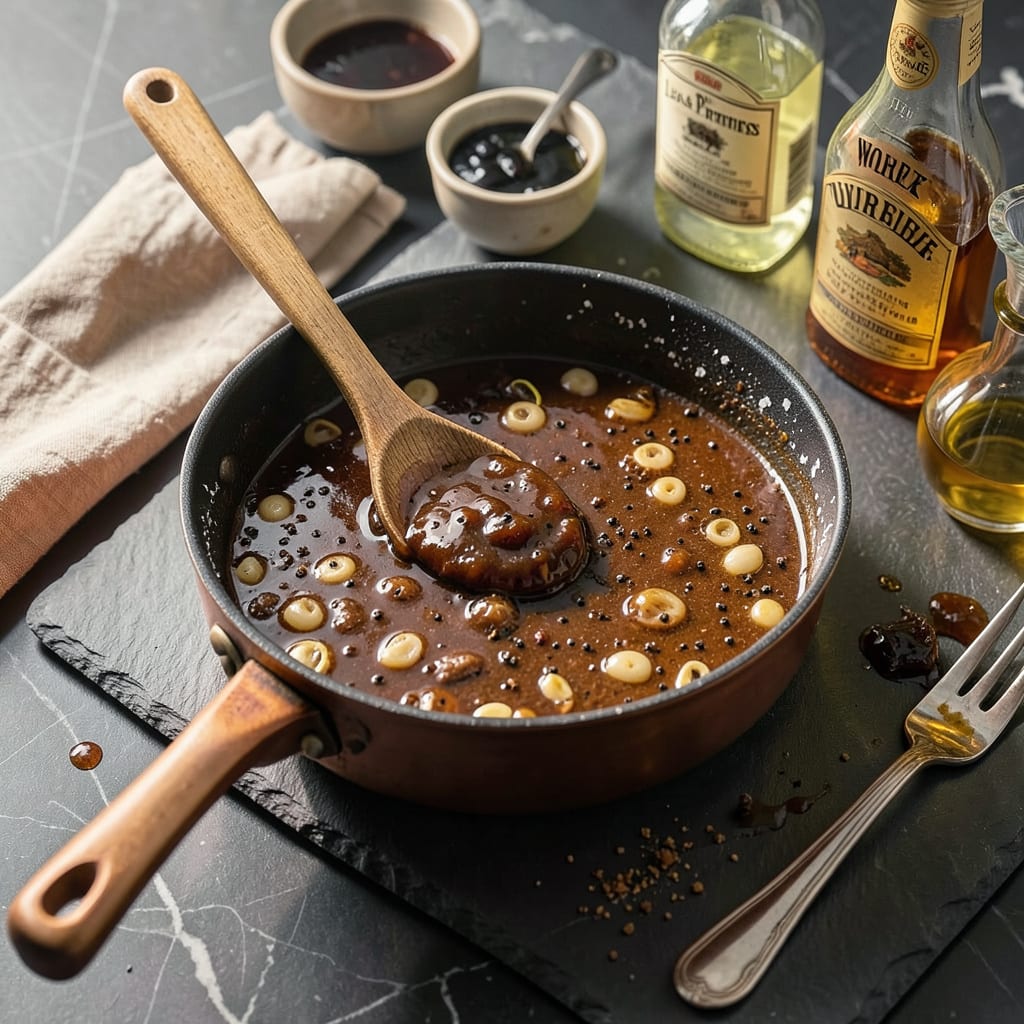
This homemade steak sauce captures the signature tangy, umami-rich flavor of classic Lea & Perrins with a perfect balance of vinegar sharpness and molasses sweetness. Developed through careful testing, the recipe replicates that distinctive complex flavor profile without relying on store-bought versions.
The sauce comes together through a simple simmering process that melds vinegar, tamarind, spices, and sweet elements into a versatile glaze. Use it as a marinade, finishing sauce for grilled meats, or bold dipping accompaniment—its concentrated flavor transforms ordinary dishes into restaurant-quality creations.
Ingredients for Lea and Perrins Steak Sauce
These carefully balanced ingredients replicate the signature tangy, umami-rich profile of classic steak sauce through precise vinegar, spice, and sweetener combinations.
| Ingredient | Amount | Notes |
|---|---|---|
| White wine vinegar 🍷 | 1 cup | Provides signature sharpness |
| Malt vinegar 🍺 | ½ cup | Essential for authentic depth |
| Tamarind paste 🌿 | 2 tbsp | For complex umami richness |
| Molasses 🍯 | ¼ cup | Balances vinegar sharpness |
| Dark brown sugar 🍚 | 2 tbsp | Packed, for caramel notes |
| Worcestershire sauce 🫒 | 2 tbsp | Anchovy-free for strict vegetarian |
| Ground cloves 🌶️ | ¼ tsp | Freshly ground preferred |
| Ground black pepper 🌶️ | 1 tsp | Freshly cracked for potency |
| Kosher salt 🧂 | 1 tsp | Diamond Crystal preferred |
| Shallots 🧅 | 2 whole | Finely minced for aromatic base |
| Garlic cloves 🧄 | 3 cloves | Freshly crushed for pungency |
The vinegar selection determines authenticity. White wine vinegar provides clean acidity, while malt vinegar contributes the characteristic malted depth—both are non-negotiable. For tamarind paste, Asian markets or Indian grocery stores offer superior quality to supermarket brands. Molasses should be unsulphured for purity; Br’er Rabbit remains the professional standard. The Worcestershire must be anchovy-free (like Annie’s) to maintain vegetarian integrity while preserving umami complexity.
Substitutions require careful balancing. Apple cider vinegar can replace white wine vinegar at a 1:1 ratio, though the flavor profile shifts slightly. For tamarind, equal parts lime juice plus brown sugar approximates the sour-sweet balance. Molasses alternatives (dark corn syrup or sorghum) lack depth but function texturally. The cloves are irreplaceable for their warming note, but allspice at half quantity provides a similar aromatic effect without overpowering. Shallots may be substituted with yellow onion at double volume, though the refinement diminishes.
Proper storage preserves the sauce’s concentrated flavor. Transfer to a glass bottle and refrigerate for up to 6 months—the flavors actually improve over the first 2 weeks. For long-term storage, freeze in ice cube trays (good for 12 months), then transfer cubes to airtight containers. Always bring to room temperature before using, as cold mutes the vinegar’s brightness and tamarind’s complexity. The high acidity prevents spoilage, but oxidation may darken the color over time without affecting quality.
Why You’ll Love This Recipe
- No Fancy Equipment: I make this in one saucepan with a wooden spoon—no blenders, no strainers, not even a whisk. The molasses and tamarind melt right into the vinegars while you stir, and honestly, the smell alone makes the minimal effort worth it.
- That Umami Punch: Here’s what sold me—the dark brown sugar caramelizes just enough to soften the sharp vinegars, while the tamarind adds this sneaky, tangy depth. It’s not just steak sauce; it’s the reason I now drizzle it on burgers, meatloaf, even roasted mushrooms.
- Meal Prep Hero: I double the batch every time because it keeps for weeks in the fridge, and suddenly my weeknight dinners feel like a steakhouse cheat. A spoonful transforms leftover beef into something intentional, or turns a sad sandwich into lunch worth looking forward to.
- Pantry Staples Only: Between us, I first made this when I forgot to buy sauce at the store. White wine vinegar, malt vinegar, and molasses? Already in my cabinet. No last-minute grocery runs, no obscure ingredients—just a reliable, homemade upgrade using what’s on hand.
Instructions
This sauce requires careful balance of flavors and precise simmering for optimal depth and consistency.
Step 1: Prepare the Aromatic Base
Finely mince the 2 whole shallots until you achieve a uniform texture with no large pieces. I recommend using a sharp chef’s knife and maintaining a consistent rocking motion for even results. Transfer to a heavy-bottomed saucepan.
Crush the 3 cloves garlic cloves using the flat side of your knife, then mince finely. Add to the shallots in the pan. The combination of these alliums creates the aromatic foundation that will support the sauce’s complex flavor profile.
Step 2: Bloom the Spices and Build Depth
Add the 1 tsp ground black pepper and 0.25 tsp ground cloves to the dry pan. Toast over medium heat for 45-60 seconds until fragrant, stirring constantly to prevent burning. This blooming process intensifies the spices’ essential oils.
Immediately add the 2 tbsp tamarind paste, 0.25 cup molasses, and 2 tbsp dark brown sugar. Stir vigorously to combine with the aromatics, creating a thick, glossy paste. The tamarind’s natural pectin will help emulsify the mixture as it cooks.
Step 3: Incorporate the Vinegars and Balance
Pour in the 1 cup white wine vinegar and 0.5 cup malt vinegar in a steady stream while stirring continuously. The mixture will initially seize up as the sugars react with the acid, then gradually loosen into a smooth liquid.
Add the 2 tbsp Worcestershire sauce, which contributes fermented depth without overpowering the vinegar base. Bring the mixture to a gentle simmer over medium-low heat, maintaining a temperature where small bubbles form consistently around the pan’s edges.
Step 4: Reduce and Develop Complexity
Simmer uncovered for 25-30 minutes, stirring occasionally, until the sauce reduces by approximately one-third. You’re looking for a viscosity that coats the back of a spoon with a thin, even layer that doesn’t immediately run off.
The sauce should develop a deep mahogany color and glossy sheen. As it reduces, the flavors will concentrate and harmonize. The final consistency should be pourable but with enough body to cling to grilled meats.
Step 5: Season and Finish
Remove from heat and stir in the 1 tsp kosher salt. Taste and adjust the balance if needed – the sauce should have a bright acidity upfront that mellows into sweet, spicy, and umami notes on the finish.
Let the sauce cool to room temperature before transferring to a glass container. The flavors will continue to develop over 24 hours, though it can be used immediately. Store refrigerated for up to 3 weeks in an airtight container.
Storing and Reheating This lea and perrins steak sauce
Refrigerator Storage
After your sauce has cooled completely, transfer it to a clean glass bottle or jar with an airtight lid. I prefer 16-ounce swing-top bottles for easy pouring. The high acidity means it will keep beautifully in the fridge for up to 3 months, though I notice the flavors peak around 2 weeks. 🌡️
Freezing for Long-Term
For batch cooking, freeze in ice cube trays for perfect single-serving portions. Once solid, transfer cubes to a freezer-safe bag—they’ll keep for 12 months without quality loss. To use, thaw overnight in the fridge or microwave individual cubes at 30% power for 30-second intervals.
Room Temperature Handling
While the acidity preserves the sauce, I don’t recommend leaving it out for more than 4 hours during serving. For parties, use a small ceramic crock with a lid to maintain freshness. The sauce actually tastes best when slightly chilled—it brightens the vinegar notes while mellowing the molasses sweetness.
Reheating Techniques
Gently warm in a small saucepan over low heat for 3-5 minutes, stirring constantly. Avoid boiling, as high heat can make the vinegar overly sharp. For quick fixes, microwave in 10-second bursts at 50% power, stirring between each. The sauce should be just warm enough to flow smoothly.
Flavor Revival Tips
If the sauce seems flat after storage, revive it with a splash of fresh vinegar (1 tsp) or a pinch of brown sugar. I also like to add ¼ tsp freshly ground black pepper to restore the spice notes. The tamarind flavor actually deepens with age, so older batches often taste more complex.
Container Recommendations
Dark glass bottles preserve quality best, but BPA-free plastic works for short-term storage. Avoid metal containers—the acidity can react and create off-flavors. I label everything with the date using masking tape and Sharpie. For gifts, amber Boston round bottles with custom labels make beautiful presentation. ✨
Nutrition Facts

- 6 Egg Cake Recipe with Oil: Light as Air With Buttery Moisture - October 4, 2026
- 4 Bean Casserole Recipe: One-Pan Heartiness With Smoky Paprika Depth - October 4, 2026
- 3-Ingredient Keto Mug Cake Recipe: Microwave Magic in 2 Minutes - October 4, 2026