
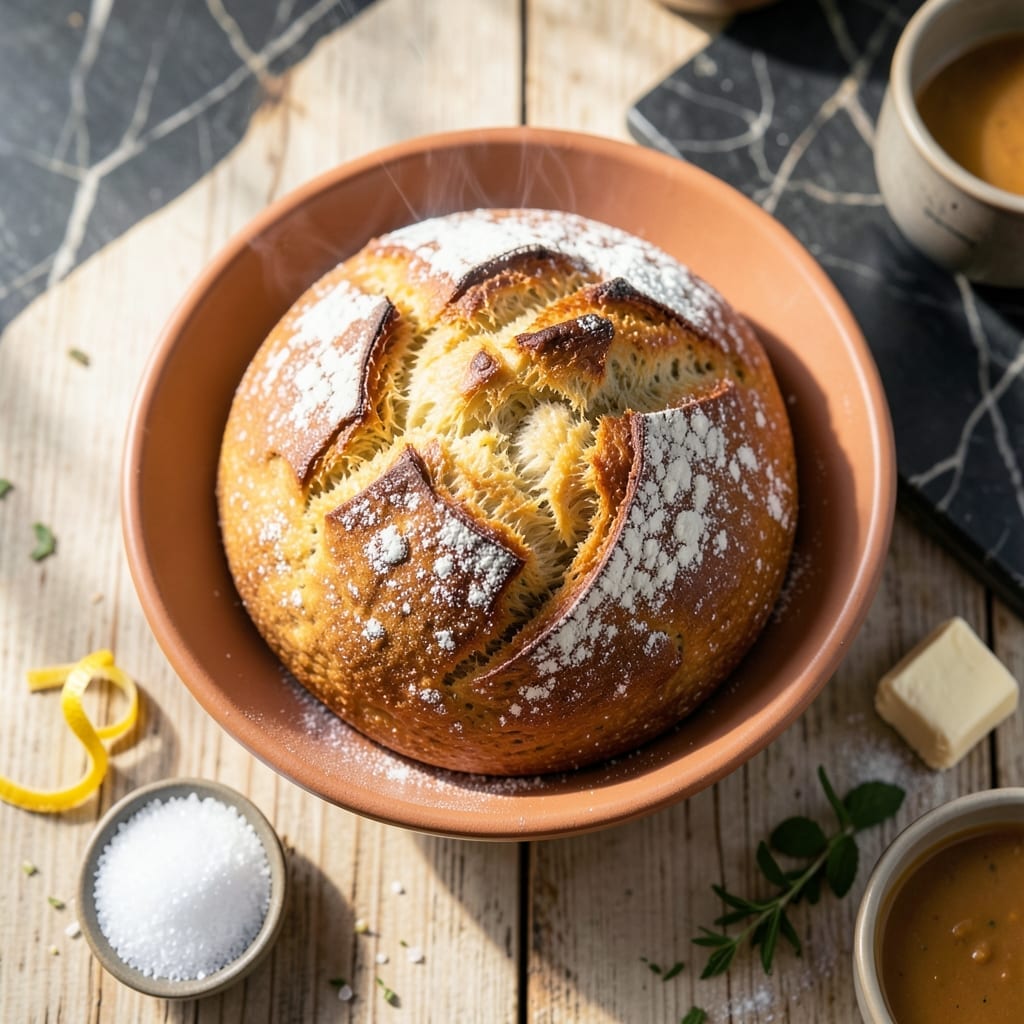
This traditional loaf carries generations of meaning in every slice, offering comfort that only homemade bread can provide.
I’ve refined this method to honor its roots while ensuring consistent results. The dough requires patience—about 2 hours to rise—but the wait is part of the tradition.
The final product is tender yet sturdy, with a golden crust and a soft, slightly sweet interior. It’s designed to be shared, just as it has been for decades.
Serve it warm with butter or alongside a hearty meal. This is bread that nourishes more than the body.
Ingredients for Memorial Bread
Traditional ingredients create a loaf rich with history and warmth in every bite.
| Ingredient | Amount | Notes |
|---|---|---|
| All-Purpose Flour 🌾 | 4 cups | Plus extra for dusting |
| Warm Water 💧 | 1 ¼ cups | 110°F to 115°F |
| Active Dry Yeast 🍞 | 2 ¼ tsp | One packet, proofed |
| Granulated Sugar 🍚 | 2 tbsp | Divided for yeast and dough |
| Unsalted Butter 🧈 | ¼ cup | Melted and cooled |
| Large Egg 🥚 | 1 whole | Room temperature, beaten |
| Kosher Salt 🧂 | 1 ½ tsp | Diamond Crystal preferred |
| Whole Milk 🥛 | ¼ cup | Warmed slightly |
| Honey 🍯 | 2 tbsp | For subtle sweetness |
| Vegetable Oil 🫒 | 1 tbsp | For greasing bowl |
| Old-Fashioned Rolled Oats 🥣 | ½ cup | For texture and tradition |
| Pure Vanilla Extract 🌿 | 1 tsp | Enhances flavor depth |
The flour is foundational here—King Arthur all-purpose is a professional standard for consistency. Yeast must be fresh and active; check the expiration date and proof it in warm water with a pinch of sugar. The butter and milk should be room temperature to integrate seamlessly into the dough. For the oats, Quaker Old-Fashioned works perfectly (avoid instant).
No honey? Maple syrup or agave at equal amounts will work. Short on whole milk? Half-and-half diluted with water approximates the richness. If you lack bread flour, the all-purpose here is fine, though the crumb may be slightly less chewy. The vanilla extract can be omitted, but it adds a subtle complexity that elevates the traditional flavor profile.
Store the cooled loaf wrapped in parchment paper, then foil, at room temperature for up to 3 days. For longer storage, slice and freeze in airtight bags for up to 3 months. Thaw slices overnight or toast directly from frozen for convenience.
Why You’ll Love This Recipe
- Minimal Effort: I mix the flour, yeast, and warm water, then let the dough do its thing—no fancy techniques required.
- Buttery Comfort: That rich, slightly sweet taste from the butter and sugar makes it irresistible straight out of the oven.
- Feeds a Crowd: I bake a big loaf for Sunday suppers, and it’s always the first thing to disappear.
- Budget Friendly: Honestly, a few cents’ worth of flour and yeast gives me fresh bread that tastes like a bakery’s best.
Step-by-Step Instructions for Memorial Bread
Here’s the method. Straightforward, tested, works every time.
Step 1: Activate the Yeast and Prepare Wet Ingredients
In a small bowl, combine the 1.25 cups Warm Water with 2.25 tsp Active Dry Yeast and 1 tbsp of the 2 tbsp Granulated Sugar. Let it sit for 5-7 minutes until the mixture becomes frothy and doubles in volume—this confirms the yeast is alive and active.
In a separate bowl, whisk together the remaining 1 tbsp Granulated Sugar, 0.25 cup Whole Milk, 2 tbsp Honey, 1 whole Large Egg, 0.25 cup Unsalted Butter (melted and cooled), and 1 tsp Pure Vanilla Extract. The butter should be just warm to the touch, not hot, to avoid killing the yeast.
Step 2: Combine Wet and Dry Ingredients
In a large mixing bowl, combine the 4 cups All-Purpose Flour, 1.5 tsp Kosher Salt, and 0.5 cup Old-Fashioned Rolled Oats. Create a well in the center and pour in the activated yeast mixture and the prepared wet ingredients.
Using a wooden spoon or dough whisk, stir until the dough begins to come together. It will be sticky and shaggy at first, but resist the urge to add more flour. The dough should pull away from the sides of the bowl when fully mixed.
Step 3: Knead and First Rise
Turn the dough out onto a lightly floured surface. Knead for 8-10 minutes until the dough is smooth, elastic, and slightly tacky but not sticky. If it sticks to your hands, add a teaspoon of flour at a time, but avoid over-flouring.
Lightly grease a large bowl with 1 tbsp Vegetable Oil, then place the dough in the bowl, turning to coat it evenly. Cover with a damp towel and let it rise in a warm, draft-free place for 1.5-2 hours, or until doubled in size.
Step 4: Shape, Second Rise, and Bake
Punch down the risen dough to release the air, then turn it out onto a lightly floured surface. Shape it into a loaf and place it in a greased 9×5-inch loaf pan. Cover and let it rise again for 45-60 minutes, until it domes 1 inch above the pan.
Preheat your oven to 375°F. Bake the loaf for 30-35 minutes, or until the top is deep golden brown and the internal temperature reaches 190-200°F. If the top browns too quickly, tent it with foil.
Remove from the oven and let it cool in the pan for 10 minutes, then transfer to a wire rack to cool completely. The bread should sound hollow when tapped on the bottom.
Pro Tips For Making Memorial Bread
- Test Your Yeast: I learned this the hard way—always proof your yeast in the warm water with a pinch of sugar for 5 minutes first. If it doesn’t foam up like a beer head, your bread won’t rise.
- Use Room-Temp Butter: Sounds weird, but it works: take the unsalted butter out 30 minutes before mixing. Cold butter tears the gluten, while room-temp blends in smooth.
- Skip Rush Rising: After burning three batches, I finally figured out that doubling time matters more than warmth—let it rise until it’s truly doubled, even if it takes an extra 20 minutes.
- Weigh Your Flour: My grandmother swore by this, and she was right: 1 cup of all-purpose flour can weigh 120g to 150g depending on how you scoop. Use a scale for consistent texture.
Common Mistakes When Making This Dish
Yeast Activation Failure
Using expired or inactive yeast is the top mistake. Always check the expiration date and proof your 2.25 tsp Active Dry Yeast in warm water with sugar. If it doesn’t foam within 5-7 minutes, start over with fresh yeast. I learned this the hard way with a flat, dense loaf. 💡
Over-Flouring the Dough
Resist adding too much flour during kneading. The dough should be slightly tacky—adding extra flour makes the bread dense. Use 1 tsp at a time only if absolutely necessary. Trust the process; the stickiness will improve as you knead for 8-10 minutes.
Skipping the Second Rise
Rushing the second rise results in a compact loaf. Let your shaped dough rise in the pan for 45-60 minutes until it domes 1 inch above the rim. This ensures a light, airy texture. Patience here truly pays off.
Incorrect Oven Temperature
Baking at too high or low a temperature can ruin your loaf. Preheat your oven to 375°F and verify with an oven thermometer. If the top browns too quickly, tent with foil after 20 minutes. The internal temp should reach 190-200°F.
Premature Slicing
Cutting into the bread too soon traps steam, making it gummy. Always let your loaf cool in the pan for 10 minutes, then transfer to a wire rack for another 30 minutes. This step ensures the perfect crumb structure.
Ignoring Ingredient Temps
Using cold butter or milk can shock the yeast. Ensure your 0.25 cup Unsalted Butter and 0.25 cup Whole Milk are room temperature. I warm my milk slightly to 110°F—just like the water—for consistent activation. 🔥
Nutrition Facts
Frequently Asked Questions
Can I use bread flour instead of all-purpose?
Yes, bread flour works well and may create a slightly chewier texture. The higher protein content helps develop more gluten, giving your loaf extra structure.
Why does the dough need two rises?
The first rise develops flavor, while the second gives the loaf its final shape and airy texture. Skipping either results in dense bread.
How do I know when the bread is fully baked?
Check for a deep golden brown crust and an internal temperature of 190-200°F. It should sound hollow when tapped on the bottom.
Can I make this ahead of time?
Bake up to 1 day ahead and store wrapped at room temperature. Reheat wrapped in foil at 300°F for 10 minutes before serving.

- 6 Egg Cake Recipe with Oil: Light as Air With Buttery Moisture - October 4, 2026
- 4 Bean Casserole Recipe: One-Pan Heartiness With Smoky Paprika Depth - October 4, 2026
- 3-Ingredient Keto Mug Cake Recipe: Microwave Magic in 2 Minutes - October 4, 2026