
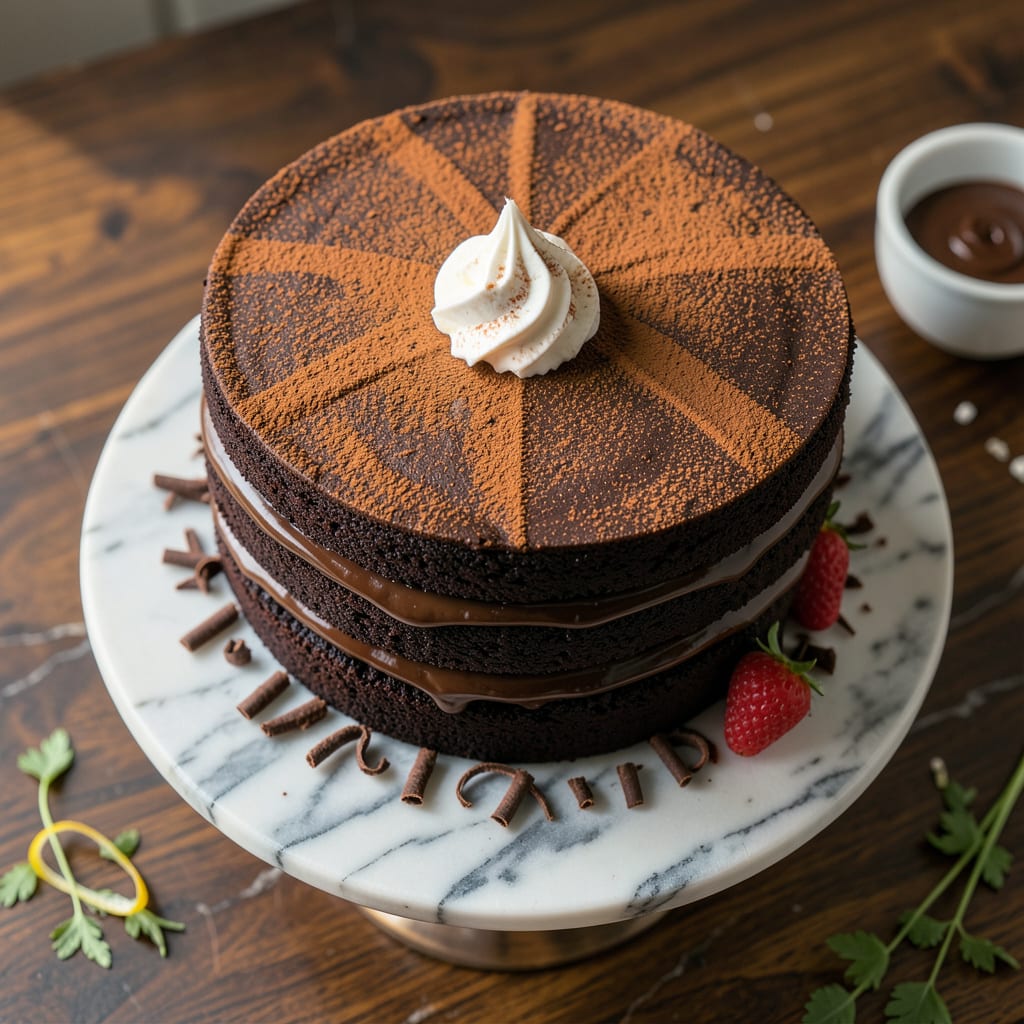
Swiss chocolate cake represents the pinnacle of European baking—where precision meets indulgence. This recipe delivers the signature dense yet tender crumb and deep chocolate flavor that defines authentic Swiss desserts, using high-quality chocolate for unmatched richness.
What sets this cake apart is the meticulous layering technique and Swiss meringue buttercream, creating a balance of textures and flavors. The result is a showstopping dessert that rivals any patisserie creation, with every bite offering the perfect harmony of moist cake and velvety frosting.
Ingredients for Swiss Chocolate Cake
European chocolate, precise measurements, and patisserie-quality ingredients create this Swiss masterpiece.
| Ingredient | Amount | Notes |
|---|---|---|
| High-quality dark chocolate (70% cacao) 🍫 | 12 oz | Finely chopped for even melting |
| Unsalted butter 🧈 | 1 cup | European-style preferred, room temperature |
| Granulated sugar 💎 | 1 ½ cups | Superfine for smoother texture |
| Large eggs 🥚 | 6 whole | Room temperature, separated |
| All-purpose flour 🌾 | 1 ¾ cups | Sifted for lighter crumb |
| Dutch-process cocoa powder 🍫 | ½ cup | Valrhona or Guittard recommended |
| Baking powder 🧂 | 1 tsp | Aluminum-free for neutral flavor |
| Vanilla bean paste 🌱 | 1 tbsp | Or pure vanilla extract |
| Espresso powder ☕ | 1 tsp | Enhances chocolate depth |
| Heavy cream 🥛 | 1 ½ cups | Cold, for Swiss meringue buttercream |
| Powdered sugar 💨 | 3 cups | Sifted for silky frosting |
| Salt 🧂 | ½ tsp | Diamond Crystal kosher preferred |
| Almond flour 🌰 | ¼ cup | For subtle nutty complexity |
| Sour cream 🥛 | ½ cup | Full-fat for moisture |
| Cognac or dark rum 🥃 | 1 tbsp | Optional for depth |
Optimal quality requires Valrhona chocolate or comparable 70% cacao—available at Whole Foods or specialty grocers. European-style butter (82-86% fat) is essential for the meringue buttercream; Plugrá or Vermont Creamery are excellent choices. Dutch-process cocoa powder (alkalized) provides the characteristic dark color and smooth flavor; Guittard or Hershey’s Special Dark are reliable brands. The almond flour should be finely ground—Bob’s Red Mill offers consistent quality.
For the chocolate, semi-sweet chips at 60% cacao can substitute in a pinch, though flavor intensity will diminish. Espresso powder may be replaced with instant coffee granules at half the quantity. If avoiding alcohol, substitute the cognac with vanilla extract plus 1/2 tsp almond extract. Sour cream alternatives include full-fat Greek yogurt or crème fraîche, maintaining the cake’s moist texture. Ensure all ingredients are at room temperature unless specified otherwise—critical for proper emulsification.
Store chocolate and cocoa powder in a cool, dark place (65°F) for up to 1 year; butter freezes well for 6 months when wrapped airtight. The assembled cake keeps refrigerated for 5 days or frozen for 3 months—thaw overnight in the refrigerator before serving. Almond flour should be used within 1 month of opening for peak freshness, stored in an airtight container to prevent rancidity.
Why You’ll Love This Recipe
- I’ll be real: Day-one cake is great, but day-two? The flavors get cozy. The crumb softens just enough, the chocolate taste deepens—perfect with coffee or straight from the fridge at midnight. Leftovers? Ha. Rarely happen.
- One Bowl Magic: I’ve made this cake half-asleep at 9pm—just melt the chocolate and butter together, dump everything else in, and stir. No mixer, no fancy steps, just a single bowl and a spatula to lick clean.
- That 70% Cacao Moment: Here’s what sold me—the first bite where the deep, slightly bitter dark chocolate hits, then melts into this buttery richness from the eggs and sugar. It’s not cloying sweet; it’s adult chocolate cake.
- Dress It Down or Up: Honestly, I’ve served this dusted with powdered sugar for a Tuesday dessert and layered with whipped cream for a birthday. Same recipe, zero judgment. (My kid even eats it plain for breakfast. No regrets.)
Step-by-Step Instructions for Swiss Chocolate Cake
This method combines Swiss precision with French technique to create a cake of exceptional texture and depth.
Step 1: Prepare the Chocolate Base
Begin by finely chopping the 12 oz high-quality dark chocolate (70% cacao) if not pre-chopped. Place it in a heatproof bowl with the 1 cup unsalted butter. Create a bain-marie by setting the bowl over a saucepan of barely simmering water, ensuring the bottom doesn’t touch the water.
Melt the chocolate and butter together, stirring occasionally with a silicone spatula until completely smooth. The mixture should reach 115°F and appear glossy. Remove from heat and stir in the 1 tbsp vanilla bean paste and 1 tsp espresso powder. This creates the flavor foundation for your cake.
Let the chocolate mixture cool to 85°F before proceeding. This temperature control prevents the eggs from cooking when combined later. The mixture should feel warm to the touch but not hot.
Step 2: Create the Cake Batter
In a separate bowl, whisk together the 1.5 cups granulated sugar with the 6 whole large eggs (separated) until pale and slightly thickened, about 3 minutes at medium speed. The mixture should form ribbons when the whisk is lifted.
Gently fold the cooled chocolate mixture into the egg-sugar mixture using a spatula. Work in three additions, alternating with the dry ingredients: 1.75 cups all-purpose flour, 0.5 cup dutch-process cocoa powder, 1 tsp baking powder, and 0.5 tsp salt. The batter should be smooth and velvety.
Finally, fold in the 0.5 cup sour cream and 0.25 cup almond flour. The almond flour adds subtle complexity while the sour cream ensures moisture retention. The finished batter should have a thick, fudgy consistency that holds its shape briefly when the spatula is lifted.
Step 3: Bake with Precision
Divide the batter evenly between three 8-inch cake pans lined with parchment paper. Spread the batter to the edges and smooth the tops with an offset spatula. Bake in a preheated 350°F oven for 25-30 minutes, or until a toothpick inserted in the center comes out with moist crumbs.
The cakes are done when they begin to pull away from the sides of the pans and the tops spring back when gently pressed. Avoid overbaking, as the residual heat will continue cooking the cakes after removal from the oven.
Cool the cakes in their pans for 15 minutes, then transfer to a wire rack to cool completely. The cakes should be room temperature before frosting to prevent melting the buttercream.
Step 4: Prepare the Swiss Meringue Buttercream
Combine the 1.5 cups heavy cream with 3 cups powdered sugar in a stand mixer fitted with the whisk attachment. Whip on medium-high speed until soft peaks form, about 4-5 minutes. The meringue should be glossy and hold its shape when the whisk is lifted.
Gradually add the remaining 1 cup unsalted butter (from the original amount), one tablespoon at a time, while continuing to whip. The buttercream should become thick and silky. If it appears curdled, continue whipping—it will emulsify.
Finish by whipping in the 1 tbsp cognac or dark rum for depth. The buttercream should be smooth, pale, and hold stiff peaks. Use immediately to frost the completely cooled cake layers.
Make-Ahead Tips for swiss chocolate cake
Prep Ahead Strategy
You can prepare the chocolate base up to 3 days in advance. After melting the 12 oz dark chocolate with butter and cooling to 85°F, transfer to an airtight container and refrigerate. When ready to bake, gently rewarm in a bain-marie to 110°F before proceeding. This actually improves flavor as the chocolate mellows. 💡
Batter Make-Ahead
The complete cake batter can be made 24 hours ahead and stored in the refrigerator. Cover the bowl tightly with plastic wrap pressed directly onto the surface to prevent skin formation. Before baking, let it sit at room temperature for 30 minutes and give it a quick stir to restore its velvety texture.
Layer Baking Timeline
Bake the cake layers 1 day before assembling. Once completely cooled, wrap each layer individually in plastic wrap and store at room temperature. This makes assembly easier and actually improves moisture distribution. I’ve found layers stay fresher this way than refrigerated.
Buttercream Prep
The Swiss meringue buttercream can be made 2 days ahead. Store it in an airtight container in the refrigerator. Before using, let it come to room temperature, then rewhip briefly to restore its silky texture. Add a splash of heavy cream if needed to adjust consistency.
Assembly Efficiency
For stress-free assembly, prepare all components in advance: baked layers, buttercream, and any garnishes. I like to level my layers the day before and store them wrapped. This way, when you’re ready to assemble, you can focus entirely on creating those perfect, even layers without rushing.
Freezing Option
The fully assembled (but unfrosted) cake freezes beautifully for up to 1 month. Wrap the layers tightly in plastic wrap, then aluminum foil. Thaw overnight in the refrigerator before frosting. This is perfect for holiday planning—just add fresh buttercream when ready to serve. ❄️
Nutrition Facts

- 6 Egg Cake Recipe with Oil: Light as Air With Buttery Moisture - October 4, 2026
- 4 Bean Casserole Recipe: One-Pan Heartiness With Smoky Paprika Depth - October 4, 2026
- 3-Ingredient Keto Mug Cake Recipe: Microwave Magic in 2 Minutes - October 4, 2026