
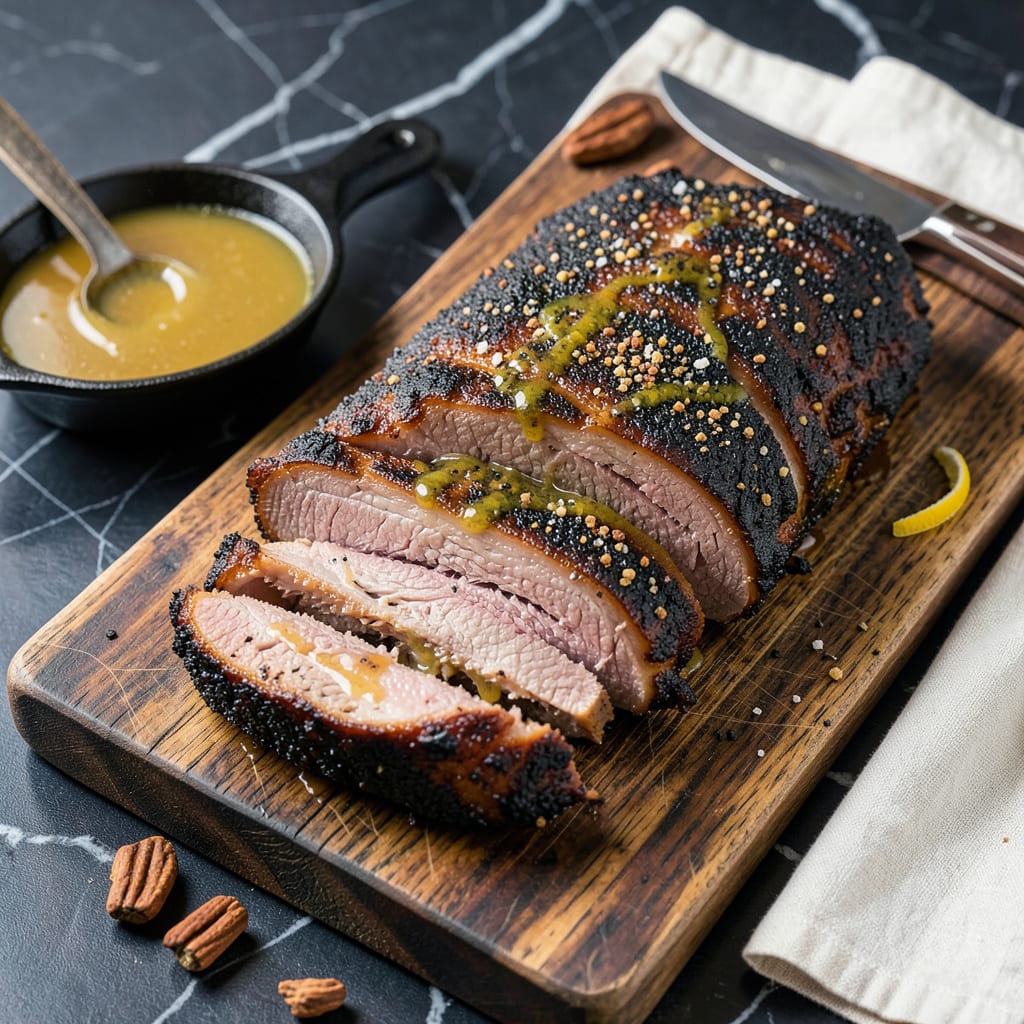
Texas brisket isn’t just barbecue—it’s a tradition perfected through decades of smoke and patience. This recipe replicates the legendary Terry Black’s approach, focusing on post oak smoke, a bold salt-and-pepper rub, and the low-and-slow technique that defines Central Texas BBQ. The result is a perfect balance of smoky bark and tender, juicy meat that falls apart at the touch of a fork.
What sets this brisket apart is the commitment to process: 12+ hours at 225°F, careful attention to wood selection, and a resting period that ensures every slice delivers maximum flavor. Whether you’re feeding a crowd or mastering a new skill, this method delivers smokehouse-quality results right in your backyard. The proof is in the first bite—no sauce required.
Ingredients for Terry Black’s Bbq Brisket
Central Texas BBQ essentials: prime beef, post oak, and a salt-pepper foundation that defines legendary brisket.
| Ingredient | Amount | Notes |
|---|---|---|
| Beef Brisket (packer cut) 🥩 | 12 lb | Untrimmed, with fat cap intact |
| Coarse Kosher Salt 🧂 | ½ cup | Diamond Crystal preferred for texture |
| Coarsely Ground Black Pepper 🌶️ | ½ cup | 16-mesh grind for optimal bark |
| Post Oak Wood Chunks 🪵 | 8 lb | Large chunks, not chips |
| Yellow Mustard 🟡 | ½ cup | Binder for rub adhesion |
| Beef Tallow 🫒 | ¼ cup | For optional fat cap reinforcement |
| Butcher Paper 📄 | 1 sheet | Peach paper preferred, 24-inch width |
| Apple Cider Vinegar 🍏 | ½ cup | For spritzing during cook |
| Water 💧 | ½ cup | For spritz mixture |
| Granulated Garlic 🧄 | 2 tbsp | Optional for rub enhancement |
| Granulated Onion 🧅 | 2 tbsp | Optional for rub depth |
| Cayenne Pepper 🔥 | 1 tsp | Optional for heat layer |
The brisket selection is non-negotiable for authentic results. Packer-cut brisket (12-15 lbs) with a thick, even fat cap ensures proper rendering during the long cook. Source from reputable butchers like Creekstone Farms or Snake River Farms for premium quality. Post oak wood must be 100% pure—avoid blends containing mesquite or hickory, which overpower the beef. The Diamond Crystal kosher salt is critical; its coarse texture and clean flavor create the signature bark without bitterness. For commercial-grade black pepper, 16-mesh grind from suppliers like Spicewalla delivers optimal texture and adhesion.
Substitutions compromise authenticity but can accommodate constraints. White oak may replace post oak in emergencies, though flavor profiles differ. For salt, Morton’s kosher requires a 25% reduction due to denser crystals. The mustard binder can be replaced with beef broth, though adhesion suffers. Omit optional granulated garlic/onion if pursuing pure salt-pepper tradition. Cayenne may be increased to 2 tsp for pronounced heat, though Terry Black’s original omits it entirely. Butcher paper alternatives like pink peach paper from BBQ supply stores maintain breathability critical for bark formation.
Storage demands precision to preserve investment. Uncooked brisket remains viable 3-5 days refrigerated or 12 months vacuum-sealed and frozen. Post-cook, wrapped brisket holds 4 days refrigerated or 3 months frozen—though texture degrades post-freeze. Wood chunks require dry storage in breathable containers to prevent mold. Rub components maintain potency 6 months in airtight containers away from light. Always verify beef tallow hasn’t rancidified before use—3-month shelf life refrigerated.
Why You’ll Love This Recipe
- I’ll be real: the hardest part is remembering to buy the brisket. Salt, pepper, and a smear of yellow mustard—that’s it. No measuring cups, no fancy spice blends, just what you already have in your pantry.
- No-Fuss Rub: I’ll be real: the hardest part is remembering to buy the brisket. Salt, pepper, and a smear of yellow mustard—that’s it. No measuring cups, no fancy spice blends, just what you already have in your pantry.
- That Post Oak Magic: Honestly, the first time I tasted this after smoking with post oak, I understood the hype. The wood gives the brisket this deep, almost buttery richness that plays off the crispy black pepper crust like a perfect duet.
- Low-and-Slow Reward: Set it, forget it, then wake up to a house that smells like a Texas BBQ joint. The long cook does the work for you—no babysitting, just patience paying off in tender, fall-apart slices that make the wait worth every second.
Step-by-Step Instructions for Texas-Style Smoked Brisket
This method delivers competition-quality results with precise temperature control and proper smoke management.
Step 1: Prepare and Season the Brisket
Begin by trimming the 12 lb Beef Brisket (packer cut) to remove any hard fat deposits while leaving the fat cap intact. I maintain about ¼-inch of fat coverage for protection during the long cook. Apply a thin layer of 0.5 cup Yellow Mustard as a binder—this helps the rub adhere without adding flavor.
Combine the 0.5 cup Coarse Kosher Salt, 0.5 cup Coarsely Ground Black Pepper, 2 tbsp Granulated Garlic, 2 tbsp Granulated Onion, and 1 tsp Cayenne Pepper in a bowl. Apply the rub generously to all surfaces, pressing firmly to ensure maximum contact. Let the seasoned brisket rest at room temperature for 1 hour before smoking—this allows the salt to begin penetrating the meat.
Step 2: Set Up the Smoker for Optimal Heat and Smoke
Load your smoker with 8 lb Post Oak Wood Chunks, arranging them for consistent combustion. Preheat to 250°F—this temperature provides the ideal balance between cooking efficiency and smoke absorption. Maintain clean, thin blue smoke throughout the cook; thick white smoke indicates incomplete combustion and will impart bitter flavors.
Place the brisket fat-side up on the cooking grate. The fat cap will render slowly, basting the meat as it cooks. Insert a probe thermometer into the thickest part of the flat, avoiding the point. Close the lid and resist the urge to open it frequently—each peek adds 15-20 minutes to your total cook time by allowing heat to escape.
Step 3: Monitor and Spritz During the Cook
After 4 hours of smoking, begin spritzing the brisket every 60-90 minutes with a 50/50 mixture of 0.5 cup Apple Cider Vinegar and 0.5 cup Water. This prevents the surface from drying out and helps develop a beautiful bark. The brisket will typically stall around 165°F internal temperature—this is normal as moisture evaporates from the surface.
Continue cooking until the brisket reaches 203°F internally and passes the probe test: the thermometer should slide in with minimal resistance, like inserting it into room-temperature butter. This process typically requires 12-14 hours total, depending on your smoker’s consistency and the brisket’s size.
Step 4: Wrap and Rest for Perfect Texture
Once the brisket reaches the desired tenderness, remove it from the smoker and wrap tightly in 1 sheet Butcher Paper. The paper allows the brisket to breathe while retaining moisture—unlike foil, which can steam the bark. Place the wrapped brisket in a dry cooler or warm oven (170°F) to rest for 2-4 hours.
This extended rest period allows the muscle fibers to relax and the juices to redistribute throughout the meat. The internal temperature will equalize, resulting in uniform tenderness from the flat through the point. Never skip this step—it’s what separates good brisket from exceptional brisket.
Step 5: Slice Against the Grain for Serving
Unwrap the brisket and separate the flat from the point by following the natural seam between the muscles. Slice the flat against the grain into ¼-inch thick pieces, adjusting your knife angle as needed since the grain direction changes near the center. The point can be cubed for burnt ends or sliced similarly.
Serve immediately while still warm. Each slice should exhibit a dark, crusty bark; a pronounced smoke ring just beneath the surface; and a tender, juicy interior. The texture should allow for clean separation with a fork but maintain enough structure to hold its shape on the plate.
Troubleshooting Perfect Results
Bark Won’t Form
If your brisket lacks that signature dark crust, the issue is usually moisture or temperature. First, verify your smoker maintains 225-250°F consistently—I use a ThermoWorks Signals to monitor both pit and meat temps. Excessive spritzing (more than every 90 minutes) can wash away rub before it sets. Try reducing vinegar spray to ¼ cup mixed with ¾ cup water for milder surface softening. 🔥
Stall Lasts Too Long
When your brisket stalls beyond 6 hours at 165°F, check your smoker’s airflow. Restricted vents create dirty smoke that slows cooking. I open my intake ¼-inch and exhaust fully to maintain clean combustion. If using a water pan, remove it—Central Texas pits run dry. For stubborn stalls, wrap in butcher paper at 170°F to power through.
Dry or Tough Meat
Dryness often comes from overcooking or insufficient resting. Pull your brisket at 203°F internal temp—never higher. If already dry, serve with beef tallow drizzled over slices to restore moisture. For future cooks, rest wrapped in a cooler with towels for 3-4 hours minimum. I once ruined a brisket by slicing too soon—lesson learned the hard way!
Uneven Cooking
The flat cooks faster than the point due to different muscle density. Separate them when the flat hits 195°F and the point reaches 203°F. Return the point to the smoker for another 30-60 minutes if needed. Always slice each section against its grain—the flat’s grain runs lengthwise, while the point’s grain circles the muscle.
Smoke Flavor Too Strong
Overly bitter smoke means your wood isn’t burning cleanly. Use only post oak chunks (never chips) and ensure they’re completely charred before adding meat. Soak wood for 30 minutes if your smoker runs hot. I keep a spray bottle of water to douse any flames that appear—white smoke is the enemy of good brisket.
Fat Cap Issues
If the fat cap doesn’t render properly, you likely maintained too low a temperature. The ideal range is 250°F—this melts fat without drying the meat. For future cooks, trim the cap to ¼-inch thickness and score it lightly in a diamond pattern. This helps fat render evenly while protecting the meat below from direct heat.
Nutrition Facts

- 6 Egg Cake Recipe with Oil: Light as Air With Buttery Moisture - October 4, 2026
- 4 Bean Casserole Recipe: One-Pan Heartiness With Smoky Paprika Depth - October 4, 2026
- 3-Ingredient Keto Mug Cake Recipe: Microwave Magic in 2 Minutes - October 4, 2026