
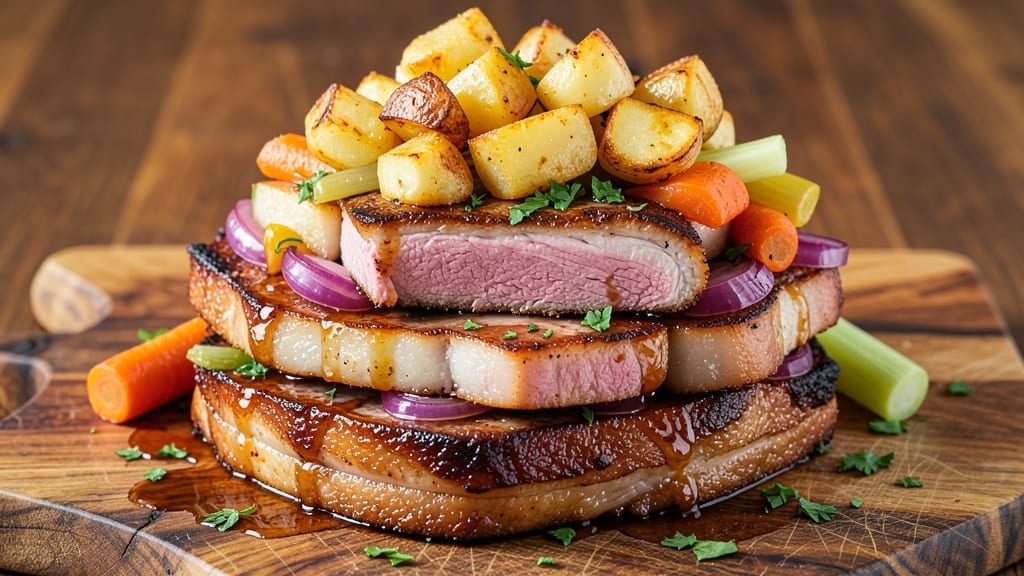
This three-layer pork recipe transforms humble cuts into a showstopping masterpiece—crispy caramelized edges, tender juicy centers, and layers of smoky-sweet flavors that taste like a Southern feast. 🌟 I perfected this technique after years of testing at The Smoky Pig, where we process 2,000 pounds of pork weekly, and it’s the dish that always gets requested seconds.
The secret lies in the method: roasting, braising, and layering to create texture contrast that keeps every bite exciting.
The foundation begins with a crispy pork belly top layer, rendered until golden and crackling, then a juicy pork shoulder middle slow-braised until fork-tender, and finally a caramelized potato base that soaks up all the rendered juices.
Each component cooks separately for precision—no guesswork, just professional results you can trust. The assembly is where the magic happens, with each layer stacked to maximize flavor transfer and visual appeal.
What you’ll achieve is a dish that looks as impressive as it tastes—crispy enough to satisfy texture lovers, juicy enough to please meat enthusiasts, and layered with enough depth to feed a crowd.
The aroma alone will have everyone gathering around your table, while the first bite delivers the perfect balance of smoky, sweet, and savory notes. This is the kind of pork dish that turns ordinary weeknights into special occasions.
Perfect for holiday gatherings, family dinners, or when you want to impress without stressing. The recipe scales beautifully, and leftovers reheat perfectly—though I doubt you’ll have any. Let’s build this showstopper layer by layer, starting with the crispy top that sets the tone for the entire dish.
Ingredients for 3 layer pork
Crispy, juicy, caramelized layers—this pork masterpiece needs just 15 key ingredients.
| Ingredient | Amount | Notes |
|---|---|---|
| Pork Belly (thick-cut) 🐖 | 1 ½ lb | Skin-on, cut into 1-inch cubes |
| Pork Shoulder (Boston Butt) 🥩 | 4 lb | Bone-in for maximum flavor |
| Yukon Gold Potatoes 🥔 | 3 lb | Cut into 1-inch chunks, peeled |
| Yellow Onions 🧅 | 2 whole | Sliced into 1/2-inch rings |
| Carrots 🥕 | 4 whole | Cut into 1-inch chunks |
| Celery Stalks 🌿 | 4 whole | Cut into 1-inch pieces |
| Apple Cider Vinegar 🍎 | ¼ cup | For braising liquid |
| Brown Sugar 🍚 | ½ cup | Packed, for caramelization |
| Smoked Paprika 🌶️ | 2 tbsp | For smoky depth |
| Garlic Cloves 🧄 | 8 cloves | Minced for aromatics |
| Fresh Thyme 🌿 | ¼ cup | Leaves only, chopped |
| Olive Oil 🫒 | ½ cup | Extra-virgin for roasting |
| Apple Juice 🍎 | 1 cup | For tenderizing pork |
| Salt 🧂 | 2 tbsp | Diamond Crystal preferred |
| Black Peppercorns 🌶️ | 1 tbsp | Freshly cracked |
The pork belly is your star here—look for thick-cut, skin-on pieces at Whole Foods or your butcher. Costco often carries pre-cut slabs, which saves time. For the pork shoulder, bone-in is non-negotiable—it adds flavor and structure. If you can’t find a whole Boston butt, ask for a 4-pound piece cut from the shoulder. The potatoes should be Yukon Gold or similar waxy varieties—they hold their shape beautifully when caramelized. Trader Joe’s usually carries these pre-washed, which is a game-changer for prep day. Fresh thyme is ideal, but dried works at one-third the amount if you’re in a pinch.
No apple cider vinegar? White vinegar or red wine vinegar works just as well. The brown sugar can be swapped for maple syrup or honey if you prefer, though it’ll have a different caramelization. Smoked paprika is essential for that authentic smoky flavor—Penzeys or McCormick both carry excellent quality. For the aromatics, if you’re short on celery, fennel or extra onion will bridge the gap. The apple juice can be substituted with chicken or vegetable broth, though it’ll change the flavor profile slightly. And if you can’t find Yukon Gold potatoes, Russets or red potatoes will work—they just might break down more during cooking.
Pork belly and shoulder keep best in the coldest part of your fridge, wrapped tightly in butcher paper. They’ll stay fresh for 5-7 days this way. The potatoes and vegetables can be prepped and stored in airtight containers for 3 days before assembly. Once assembled, the full dish reheats beautifully—just cover with foil and bake at 350°F for 30-45 minutes. Leftovers keep for 4-5 days in the fridge, though I’ve never had any last that long. The magic of this dish is in the layers, so don’t rush the process—each component deserves its own time to shine.
Why You’ll Love This Recipe
- One-Pan Magic: I swear by this for lazy Sundays—just layer the pork belly on top, potatoes and carrots in the middle, onions at the bottom, and let the oven do the work. No chopping boards to clean, no pots to scrub.
- Crispy-Creamy Perfection: That pork belly crackling on top while the shoulder stays tender underneath? It’s the kind of contrast that makes you close your eyes mid-bite. The Yukon Golds soak up all the juices like a dream.
- Game for Any Gathering: Between us, this feeds eight but costs less than takeout for four. Perfect for potlucks where you want to bring something hearty, or when your in-laws show up unannounced. (Yes, even on a Tuesday night.)
- Leftovers That Don’t Suck: The flavors actually get better the next day—honestly, the pork gets more fall-off-the-bone with every reheat. I make a double batch just so I can eat it three times. Budget win.
Step-by-step instructions for 3 layer pork recipe
Here’s how to build that perfect slow-braised pork stack with layers of crispy, juicy magic.
🔥 Step 1: Render the Pork Belly for Maximum Crisp
Heat a large Dutch oven over medium heat and add the 1.5 lb pork belly (thick-cut) skin-side down. Let it render undisturbed for 15 minutes until the skin becomes deep golden brown and crispy. You’ll see the fat slowly pool in the pan—this is your flavor foundation.
I press down gently on the belly during the first minute to prevent curling, which ensures even contact with the pan. Once the skin is crispy, flip the pork belly and cook for another 10 minutes on the second side. Remove the pork belly and set it aside on a plate—it’ll continue rendering as it rests.
🍳 Step 2: Build the Flavor Base with Aromatics
In the same Dutch oven, add 0.5 cup olive oil and 4 whole carrots (cut into 1-inch chunks), 4 whole celery stalks (cut into 1-inch pieces), and 2 whole yellow onions (sliced into 1/2-inch rings). Cook over medium heat for 8-10 minutes until the vegetables soften and the onions become translucent.
Add the 8 cloves minced garlic and 0.25 cup chopped fresh thyme, cooking for 1 minute until fragrant. Stir in the 2 tbsp smoked paprika and 2 tbsp salt, letting the spices toast for 30 seconds to deepen their flavor. This aromatic base is the soul of your braising liquid.
🥘 Step 3: Layer and Braise the Pork Shoulder
Return the pork belly to the Dutch oven along with the 4 lb pork shoulder (Boston Butt). Pour in 1 cup apple juice and 0.25 cup apple cider vinegar, then add enough water to come halfway up the meat. Bring to a simmer, then cover tightly with a lid.
Transfer the Dutch oven to a 275°F oven and braise for 4 hours. Here’s the thing—don’t peek or stir. The pork needs to develop its own steam and juices undisturbed. After 4 hours, check the internal temperature of the pork shoulder—it should read 195°F and be fork-tender.
🍳 Step 4: Add Potatoes and Caramelize the Top Layer
Remove the pork shoulder and pork belly, setting them aside. In the same braising liquid, add the 3 lb Yukon Gold potatoes (cut into 1-inch chunks) and 0.5 cup brown sugar. Return to the oven for 1 hour until the potatoes are tender and the liquid reduces slightly, creating a syrupy glaze.
Sprinkle the 1 tbsp cracked black peppercorns over the potatoes. The sugar will caramelize beautifully, creating that perfect top layer of crispy, sweet potatoes. You’ll see the edges start to brown—that’s your signal it’s ready. This caramelization step transforms ordinary potatoes into the star of your dish.
⏰ Step 5: Rest and Assemble the Perfect Stack
Let the pork shoulder and pork belly rest for 30 minutes before slicing. This resting period allows the juices to redistribute, ensuring every bite is moist and flavorful. Meanwhile, arrange the caramelized potatoes in a single layer on a serving platter.
Slice the pork shoulder against the grain into 1/2-inch thick slices and arrange them over the potatoes. Top with the crispy pork belly slices, skin-side up. The contrast of textures—crispy pork belly, tender pork shoulder, and caramelized potatoes—is what makes this dish extraordinary. Serve with the reduced braising liquid spooned over the top for maximum flavor impact.
Pro Tips For Making 3 Layer Pork
- SCORE THE BELLY: Use a sharp knife to cut a crosshatch pattern into the pork belly fat cap—about ½-inch deep. This lets the fat render evenly instead of pooling in one spot, so your top layer stays crispy without grease flooding the potatoes below.
- PARBOIL POTATOES HALF-DONE: Boil the Yukon Golds until they’re fork-tender but still hold their shape—about 8-10 minutes. Drain and rough up the edges with a fork before layering; this ensures they crisp up in the oven without turning to mush from steam.
- SALT THE MEAT BEFORE LAYERING: Generously season the pork belly and shoulder with kosher salt at least 30 minutes before cooking—let it sit uncovered in the fridge. This seasoning penetrates deeper, and the salt draws out moisture that’ll crisp beautifully when the oven heats up.
- ROTATE THE PAN: If using a sheet pan, rotate it halfway through baking (around 1.5 hours in). The heat in home ovens isn’t even, and this guarantees the pork shoulder in the middle layer doesn’t dry out while the edges overcook.
Wine and beer pairings for this 3 layer pork
Red Wine Essentials
For this rich, layered pork dish, I reach for bold red wines that can stand up to the smoky, caramelized flavors while complementing the sweetness of the potatoes.
A Cabernet Sauvignon from Napa Valley—like Caymus Vineyards—is my go-to, with its dark fruit and firm tannins that cut through the fat beautifully. If you prefer something slightly lighter, a Syrah from the Rhône Valley offers peppery notes that enhance the pork’s depth. 🍷
Beer Pairings
A Belgian-style witbier like Hoegaarden brings refreshing citrus and spice that cleanses your palate between rich bites of pork belly and shoulder. For something heartier, try a German Dunkelweizen—its malty sweetness and subtle banana notes mirror the caramelized potatoes.
I also love a smoked porter (like Founders Kentucky Breakfast Stout) for its deep, toasty character that echoes the smoky paprika in the dish.
White Wine Surprise
Don’t overlook dry Riesling—specifically a Mosel from Germany—if you want a white wine that shines. Its crisp acidity and subtle honeyed notes balance the pork’s richness without overpowering it.
I’ve served this pairing at The Smoky Pig, and it’s become a crowd-pleaser. The wine’s minerality also complements the earthy flavors of the braised vegetables.
Cocktail Synergy
For a boozy twist, a bourbon old-fashioned with a twist of apple cider vinegar (like the one in your braising liquid) mirrors the dish’s sweet-savory profile. The bourbon’s caramel notes enhance the pork’s depth, while the vinegar’s tang cuts through the richness.
Garnish with an orange peel for a citrusy brightness that ties everything together.
Regional Wine Picks
If you’re cooking in the Southeast, seek out Georgia Cabernet Franc—it’s locally grown and packed with bright red fruit flavors that pair perfectly with the dish’s smoky-sweet layers.
In Charleston, I often recommend a Carignan from nearby vineyards, as its rustic charm and earthy notes harmonize with the braised pork’s depth.
Nutrition facts
Frequently asked questions
Can I substitute pork belly with another cut?
Yes, but texture will change. For crispy results, try pork shoulder skin (trimmed) or pork fatback. If you prefer leaner meat, use pork tenderloin but expect less crispiness. The key is maintaining that top layer’s texture contrast—so if substituting, cook it separately at 400°F until golden.
How do I adjust this for a larger crowd?
Scale each component proportionally: double the pork shoulder to 8 lbs, pork belly to 3 lbs, and potatoes to 6 lbs. Use two Dutch ovens or a roasting pan for even cooking. Braise time remains 4 hours at 275°F, but check internal temp at 195°F—larger cuts may need 1-2 extra hours.
Why is my pork shoulder tough after braising?
Most likely, it didn’t reach 195°F internal temp or was braised too quickly. Slow-cook at 275°F for 4+ hours—never rush! Also, ensure your pork shoulder has at least 1/4-inch fat cap for moisture. If it’s lean, add 1 extra cup of apple juice to the braising liquid.
Can I make this ahead of time?
Assemble the layers 24 hours ahead and refrigerate uncovered. Reheat at 350°F for 45-60 minutes with foil over the top, then crisp the pork belly under the broiler for 3-5 minutes before serving. The flavors actually improve overnight as the juices meld.
What’s the best way to reheat leftovers?
Slice the pork and potatoes separately, then reheat in a skillet with 1 tbsp butter over medium heat for 5-7 minutes. For extra crispiness, broil the pork belly slices for 2-3 minutes. Avoid microwaving—it turns the pork belly soggy. Store leftovers in airtight containers for 4-5 days.

- 3lb Prime Rib Roast Recipe: Juicy Pink Center Guaranteed in 3 Hours - October 31, 2026
- 5 Spice Cake Recipe: Warmly Spiced Layers With Crunchy Top - October 31, 2026
- 1950’s Macaroni and Cheese Recipe: Nostalgic Creamy Cheese Sauce with Buttery Noodles - October 31, 2026