
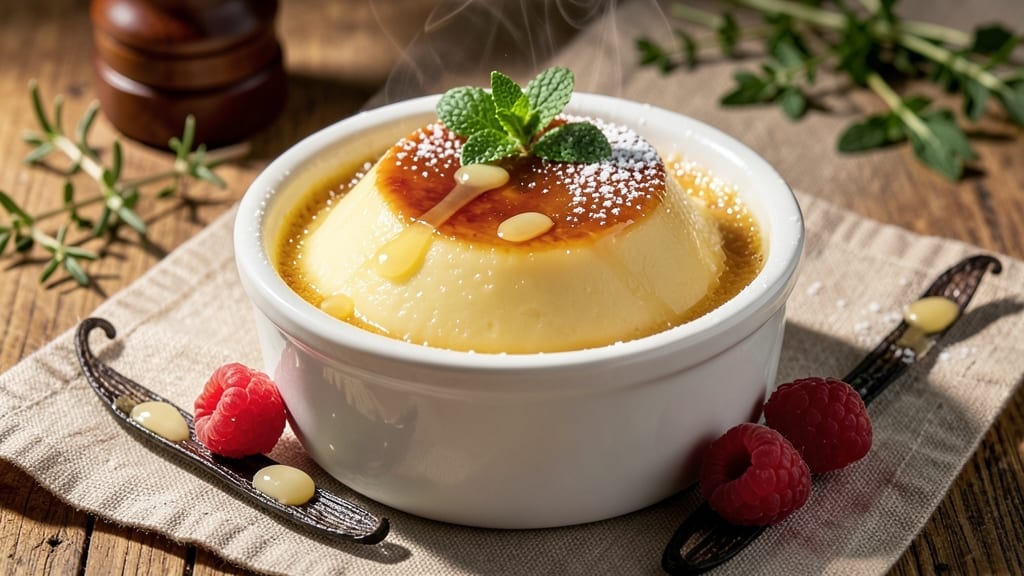
A 4-egg pudding recipe delivers that luxurious, velvety texture we crave—silky custard infused with real vanilla bean that transforms any dessert spread. The secret lies in precise technique: tempering eggs with warm milk, constant stirring over gentle heat, and a final steam bath that ensures perfectly set layers without graininess.
I’ve perfected this version over years of trial (and a few burnt attempts), and it’s now my go-to for elegant gatherings or quiet weeknight treats.
What sets this apart is the vanilla bean infusion—split and scraped directly into the custard for deep, aromatic flavor that store-bought extracts can’t match. The recipe uses simple pantry staples (eggs, milk, sugar, cornstarch) but delivers restaurant-quality results with minimal effort.
No fancy equipment needed—just a saucepan, whisk, and patience for the 30-minute process that yields custard so smooth it practically slides off the spoon.
By the time it’s done, you’ll have a golden, jiggly pudding with a tender center that’s neither runny nor rubbery. The vanilla scent lingers long after serving, and the creamy texture makes it irresistible with fresh berries or a dusting of powdered sugar.
This isn’t just dessert—it’s a showstopper that feels luxurious without requiring culinary expertise.
Serve chilled in individual ramekins for an elegant presentation, or as a centerpiece for holiday tables. The recipe scales easily, so you can make it for two or a crowd. Here’s how to achieve that silky perfection every time—no shortcuts, just reliable technique.
Ingredients for 4 egg pudding
Simple pantry staples elevated by vanilla bean create this luxurious 4-egg custard masterpiece.
| Ingredient | Amount | Notes |
|---|---|---|
| Large Eggs 🥚 | 4 whole | Room temperature for even cooking |
| Whole Milk 🥛 | 2 cups | Full-fat for creaminess (2% works too) |
| Granulated Sugar 🍚 | ½ cup | Superfine preferred for smooth texture |
| Cornstarch 🌾 | 2 tbsp | Lightly toasted for neutral flavor |
| Vanilla Bean 🌿 | 1 whole | High-quality Madagascar preferred |
| Unsalted Butter 🧈 | 2 tbsp | Cold, cubed for steam bath |
| Salt 🧂 | ¼ tsp | Diamond Crystal preferred |
| Heavy Cream 🥛 | ½ cup | Optional for extra richness |
| Powdered Sugar 🍚 | 2 tbsp | For dusting finished pudding |
The eggs are the foundation—room temperature ensures even cooking without scrambling. Whole milk delivers creaminess, but 2% works fine if you prefer. For the vanilla bean, Madagascar is ideal (split lengthwise, scrape seeds into the custard), but Tahitian. If you can’t find whole beans, high-quality extract works in a pinch—just use half the amount. The cornstarch is crucial for that silky texture; don’t substitute flour, which can make the pudding grainy. For the best results, source your eggs from local farms or specialty grocers—they have richer yolks that yield a more velvety custard.
No vanilla bean? Pure vanilla extract (like Madagascar or Bourbon) works at half the quantity, but the flavor won’t be as complex. Running short on milk? Heavy cream can replace up to half the milk for a richer texture, but reduce the sugar slightly to balance. For a dairy-free twist, full-fat coconut milk works but may alter the set slightly—expect a denser pudding. The powdered sugar is just for garnish, but if you prefer a sweeter pudding, add an extra tablespoon of granulated sugar to the custard mixture. Always whisk the eggs and sugar together first—they should be pale and slightly thickened before adding the milk, which prevents curdling.
Store finished pudding in airtight containers in the fridge for up to 5 days. For best texture, chill for at least 4 hours before serving. To reheat, warm gently in a water bath or microwave at 50% power for 20 seconds. The vanilla bean pods can be reused once by soaking in warm water for 10 minutes—perfect for infusing simple syrup or cocktails. For a make-ahead shortcut, prepare the custard mixture up to 24 hours ahead and refrigerate until ready to steam. This recipe scales beautifully for crowds—just double the ingredients and use a larger heatproof dish.
Why You’ll Love This Recipe
- Four Eggs, Zero Stress: I swear, this recipe is my secret for days when I’m too tired to think. Just whisk eggs, milk, and sugar—no fancy techniques—then let the cornstarch do the heavy lifting while I sip my coffee.
- Silky Vanilla Magic: That split vanilla bean? Oh, it’s worth every penny. The custard comes out so smooth, with a whisper of floral sweetness that makes store-bought pudding look sad by comparison.
- Meal Prep MVP: Make a big batch on Sunday, and you’ve got breakfast, dessert, or a quick snack ready all week. It reheats beautifully—just stir in a splash of milk if it thickens overnight.
- Budget Breakthrough: Four eggs, a splash of milk, and a pinch of sugar? This is dessert without guilt. I’ve fed my whole family (plus leftovers for lunch) for under $5—no fancy ingredients, just pure comfort.
Step-by-step instructions for silky vanilla bean pudding
Mastering this custard requires precision timing and gentle heat control—here’s how to achieve flawless texture every time.
Infuse the Vanilla and Prepare the Base
Split the whole vanilla bean lengthwise and scrape out the seeds with the tip of a knife. Place both halves and seeds in a small saucepan with the 2 cups whole milk and 0.5 cup granulated sugar. Bring to a gentle simmer over medium-low heat for 5 minutes, stirring occasionally, until the sugar fully dissolves and the milk develops a subtle vanilla aroma.
Remove from heat and let steep for 10 minutes—this ensures maximum vanilla extraction. Meanwhile, whisk together the 4 whole large eggs, 2 tbsp cornstarch, and 0.25 tsp salt in a separate bowl until smooth. The mixture should be uniform with no visible streaks of cornstarch.
Temper the Egg Mixture
Slowly pour about 1 cup of the warm vanilla-infused milk into the egg mixture while whisking constantly. This gradual addition prevents the eggs from scrambling due to temperature shock. Once incorporated, return the entire egg mixture to the saucepan and whisk vigorously over low heat for 2-3 minutes until slightly thickened.
Watch closely—you’ll see the mixture transform from a pale liquid to a glossy, ribbon-like consistency. Remove from heat immediately once it reaches 170°F on an instant-read thermometer. The custard should coat the back of a spoon but still flow smoothly when stirred.
Finish with Cream and Butter
Transfer the custard to a heatproof bowl and place it in an ice bath to cool rapidly. Once cooled to 100°F, whisk in the 0.5 cup heavy cream and 2 tbsp cold cubed unsalted butter, one piece at a time, until fully incorporated. The butter should melt completely, adding luxurious richness without breaking the custard’s silky texture.
Strain the mixture through a fine-mesh sieve into serving glasses to ensure absolute smoothness. Cover with plastic wrap, pressing it directly onto the surface to prevent skin formation, and refrigerate for at least 4 hours or overnight. This resting period allows flavors to meld perfectly.
Serve with Powdered Sugar Dusting
Before serving, dust the surface of each pudding with 2 tbsp powdered sugar using a fine-mesh sieve. This creates an elegant presentation while adding a delicate sweetness that complements the vanilla. Serve chilled with fresh berries or a sprinkle of toasted nuts for added texture contrast.
The pudding should be silky yet firm enough to hold its shape when spooned. Each bite should deliver a perfect balance of creamy vanilla flavor with just the right amount of sweetness—never cloying, always refined. The secret lies in precise temperature control and proper resting time.
Pro Tips For Making 4 Egg Pudding
- Whisk Eggs Hard: Use a stand mixer or whisk until the egg mixture is thick, pale, and actually ribbony—not just slightly frothy. I learned this the hard way when my pudding turned out gluey instead of silky. Beat for at least 3-4 minutes, scraping the bowl once halfway.
- Toast the Cornstarch: Lightly dry-roast the cornstarch in a small pan over medium heat for 30 seconds before mixing it into the milk. This removes any raw taste and prevents that faint floury afternote. (Yes, it’s weird, but it works—trust me.)
- Split the Vanilla Bean: Scrape the seeds into the mixture and drop the empty pod in too. The pod’s oils infuse the pudding over time, giving it a deeper flavor. Skip this, and you’re missing half the vanilla’s magic.
- Strain Before Pouring: After cooking, strain the pudding through a fine-mesh sieve into your serving dish. This catches any stray bits of vanilla pod or unevenly thickened spots, ensuring a flawless texture. (I know, it’s an extra step—but your pudding will look restaurant-worthy.)
Regional styles of 4 egg pudding
Classic British Custard
The British version of this pudding is all about simplicity and elegance. Replace the vanilla bean with 1 teaspoon high-quality vanilla extract and add ½ teaspoon ground cinnamon to the custard mixture. Serve in individual ramekins with a dusting of powdered sugar and a few raspberries on top.
The British love their custards slightly firmer, so increase the cornstarch to 3 tablespoons for a thicker texture. 🥄
French Crème Anglaise
This French adaptation is lighter and often served as a sauce rather than a standalone pudding. Use 1 cup whole milk and 1 cup heavy cream for the liquid base, and reduce the sugar to ¼ cup.
After tempering the eggs, strain the custard through a fine-mesh sieve and chill it completely. Serve over poached pears or vanilla sponge cake for an authentic French dessert experience. The texture should be velvety but not set, almost like a thick sauce. 🍐
Italian Panna Cotta
For an Italian twist, replace the eggs with 2 tablespoons unflavored gelatin dissolved in ¼ cup warm milk. Add this to the custard mixture along with 1 cup heavy cream and ½ cup whole milk.
Infuse the liquid with 1 vanilla bean and 1 strip of lemon zest for a citrusy note. Chill until set, then serve with a berry compote or caramel sauce. The result is a silky, jiggly dessert with a lighter texture than traditional custard. 🍋
American Vanilla Pudding
This classic American version is simpler and often made in a slow cooker. Combine all ingredients in a 6-quart slow cooker and cook on low for 2-3 hours, stirring occasionally, until thickened. The slow cooking method ensures a creamy texture without the risk of curdling.
Serve with whipped cream and a sprinkle of nutmeg for a nostalgic dessert experience. This version is perfect for potlucks or family gatherings. 🍦
Spanish Crema Catalana
For a Spanish-inspired variation, add 1 tablespoon cornstarch to the custard mixture and infuse the milk with 1 cinnamon stick and 1 strip of orange zest. After chilling, top with a caramelized sugar crust (made by melting ¼ cup sugar in a pan until golden).
The caramel adds a beautiful, crunchy contrast to the silky custard. This dessert is a must for special occasions. 🍯
Modern Twist: Matcha Green Tea
Swap the vanilla bean for 1 teaspoon high-quality matcha powder (whisked into the milk) and add ½ teaspoon vanilla extract for balance. The result is a vibrant green custard with a subtle earthy flavor.
Serve in clear glasses with a red bean paste drizzle or white chocolate shavings for a visually stunning dessert. This fusion of Japanese and Western flavors is perfect for tea lovers. 🍵
Nutrition facts
Frequently asked questions
Why does my custard turn out grainy?
Graininess happens when the eggs cook too quickly or aren’t properly tempered. Always whisk the eggs and sugar together first, then slowly add warm milk while stirring constantly. Remove from heat at 170°F—overcooking causes curdling. For extra silkiness, strain through a fine-mesh sieve before chilling.
Can I make this pudding without a vanilla bean?
Yes! Use ½ teaspoon high-quality vanilla extract instead, but the flavor won’t be as complex. For depth, add a pinch of cinnamon or orange zest to mimic vanilla’s aromatic notes. The texture remains identical—just the flavor changes.
How do I fix a pudding that’s too thin?
If your custard is runny, it likely didn’t reach the proper thickness. For immediate fixes, mix 1 teaspoon cornstarch with 1 tablespoon cold water, stir into the pudding, and heat gently for 2 minutes*. For prevention, always cook until it coats the back of a spoon (about 170°F).
Can I use this recipe for a make-ahead dessert?
Prepare the custard mixture up to 24 hours ahead and refrigerate it. When ready to cook, bring to a gentle simmer over low heat for 10-15 minutes, stirring constantly. The flavors develop more overnight, making it even richer. Perfect for holiday prep!
What’s the best way to serve this pudding?
For elegance, chill in individual ramekins and dust with powdered sugar before serving. Pair with fresh berries, toasted nuts, or a drizzle of caramel sauce. For a rustic touch, serve in bowls with whipped cream. The key is contrast—creamy pudding with crunchy or fruity elements elevates every bite.

- 3lb Prime Rib Roast Recipe: Juicy Pink Center Guaranteed in 3 Hours - October 31, 2026
- 5 Spice Cake Recipe: Warmly Spiced Layers With Crunchy Top - October 31, 2026
- 1950’s Macaroni and Cheese Recipe: Nostalgic Creamy Cheese Sauce with Buttery Noodles - October 31, 2026