
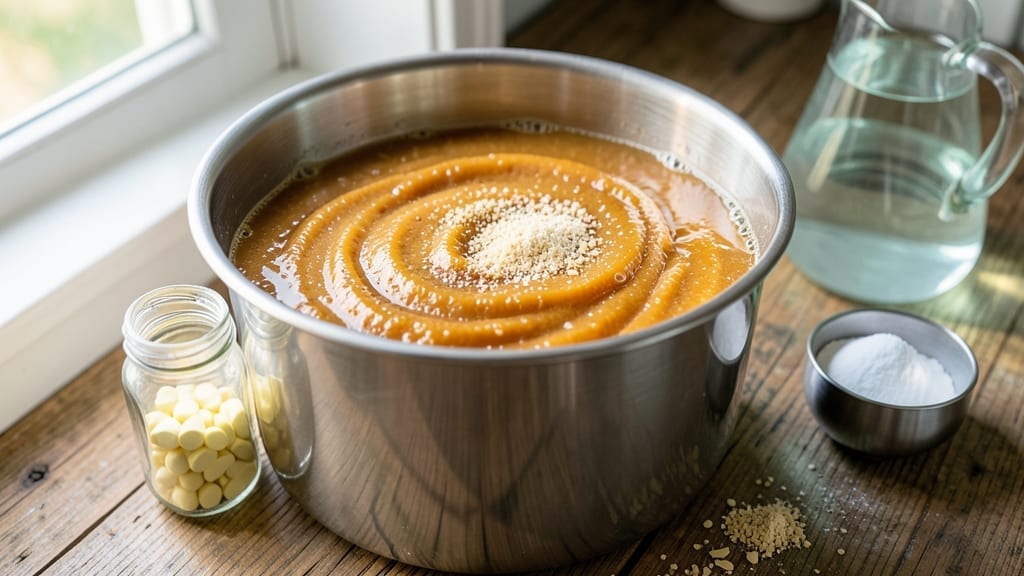
A 5-gallon sugar mash recipe transforms simple ingredients into the foundation of Southern moonshine, where caramelized sweetness meets fermentation magic.
This process starts with precise measurements—10 pounds of sugar, 5 gallons of water, and 1 pound of cornmeal—to create a fermentable wash that develops depth over time.
The science behind it is simple: sugar feeds yeast, yeast produces alcohol, and patience turns a basic mixture into something potent and complex.
What makes this mash special is its balance of simplicity and precision. The sugar dissolves completely in hot water, while the cornmeal provides fermentable starches for a richer flavor profile.
Fermentation typically takes 7 to 10 days, during which the mixture develops a caramel-like aroma and a slightly effervescent texture. This is where the “magic” happens—transforming raw ingredients into a liquid gold that’s ready for distillation or aging.
Safety is critical in this process, so always use food-grade containers and sanitize equipment thoroughly. The mash should reach a proof of 10-15% before distillation, ensuring a smooth, flavorful result.
Legal considerations vary by location, so research local regulations before proceeding—this isn’t just a recipe, it’s a craft that requires responsibility.
Once fermented, this mash can be distilled into moonshine, used as a base for flavored spirits, or even reduced into a caramel syrup for desserts. The possibilities are endless, but the foundation remains the same: precision, patience, and respect for the process.
Let’s get started on creating something truly extraordinary.
Ingredients for 5 gallon sugar mash
Precision meets tradition in this 5-gallon sugar mash foundation for Southern spirits.
| Ingredient | Amount | Notes |
|---|---|---|
| Granulated White Sugar 🍚 | 10 lb | Non-iodized preferred for fermentation |
| Distilled Water 💧 | 5 gallons | Chlorine-free, food-grade |
| Cornmeal 🌾 | 1 lb | Fine grind for even fermentation |
| Active Dry Yeast 🍞 | ¼ oz | Turbo or Red Star recommended |
| Potassium Sorbate 🧪 | 1 tbsp | Food-grade preservative (optional) |
| Campden Tablets 💊 | 1 tablet | For sterilization (1/4 tablet per gallon) |
| Food-Grade Barrel or Fermenter 🥫 | 1 5-gallon container | Sanitized stainless steel or food-safe plastic |
| pH Test Strips 🧪 | 1 package | 4.0-4.5 target range |
| Hydrometer 📏 | 1 piece | For measuring specific gravity |
| Cheesecloth or Fine Mesh Screen 🧵 | 1 piece | For straining mash |
| Rubber Fermentation Lock 🔒 | 1 piece | Prevents contamination |
| Sanitizing Solution 🧼 | 1 quart | Star San or equivalent |
The sugar is non-negotiable—Domino or C&H brands are ideal for consistent fermentation. Non-iodized sugar prevents yeast inhibition, so check labels. For the water, reverse osmosis filtered is best to avoid contaminants. Costco or local distillery supply stores often carry food-grade containers in 5-gallon sizes, but sanitize thoroughly before use. The cornmeal provides fermentable starches; Bob’s Red Mill fine grind works perfectly. Yeast quality matters—Turbo or Red Star are industry standards for alcohol production.
No Campden tablets? Potassium metabisulfite at 1/4 tsp per gallon works as a sterilizing alternative. Running low on potassium sorbate? Citric acid at 1/2 tsp per gallon can help preserve the mash, though it’s less effective. For pH testing, API brand strips are reliable and affordable. If you’re missing a hydrometer, a refractometer can double as a backup. The fermentation lock is critical—Everclear brand is widely used in home distilling communities for its reliability.
All equipment must be sanitized with Star San or equivalent before use. Store unused sugar in airtight containers away from moisture. The mash will ferment best at 68-75°F. Once fermented, it can be stored in the fermenter for up to 3 months before distillation. For long-term storage, transfer to food-grade barrels and keep in a cool, dark place. Always label containers with dates and contents for safety.
Why You’ll Love This Recipe
- No-Fuss Fermentation: I swear by this recipe because it’s literally dump-and-wait. Five gallons of sugar, water, and a pinch of yeast—no stirring like a mad scientist, no temperature checks every five minutes. Just mix, cover, and let it do its thing while I handle the rest of the day. That cornmeal? It’s the secret to keeping things smooth without extra work.
- Sweet & Clean Ferment: The flavor is ridiculously balanced—sweet but not cloying, with that subtle tang from the yeast. Honestly, the potassium sorbate keeps it fresh longer, so I don’t have to rush through batches. It’s the kind of mash that makes me want to pour another glass just to taste it again.
- Batch-and-Store Gold: This is my go-to for holiday gift baskets or when friends ask for moonshine starter. One five-gallon batch stretches into multiple bottles, and the cornmeal helps it shelf-stable for weeks. (Yes, even on a Tuesday night when I’m not feeling festive.)
- Budget-Friendly Binge: Between us, sugar and yeast are cheaper than a lot of grocery staples. A five-gallon run costs less than takeout for two, and I’ve turned leftovers into everything from caramel to fermented drinks. Not the prettiest, but the taste makes up for it—and my wallet thanks me.
Step-by-step instructions for 5 gallon sugar mash
This process transforms simple sugar and water into rich, fermentable mash—precision matters at every stage.
Sanitize Equipment and Prepare Water
First, thoroughly clean the 5-gallon container Food-Grade Barrel or Fermenter using the 1 quart Sanitizing Solution. Scrub all surfaces and rinse with hot water to remove any residue. This critical step prevents contamination that could ruin your fermentation. While the container dries, dissolve the 1 tablet Campden Tablets in the 5 gallons Distilled Water by crushing the tablet and stirring until fully dissolved. This sterilizes the water and helps prevent microbial competition during fermentation.
Let the water solution sit for 15 minutes before use—this ensures complete activation of the Campden Tablets. The water should remain clear with no visible particles. Test the pH using the pH Test Strips to confirm it falls within the 4.0-4.5 range. If needed, adjust with a small amount of citric acid or potassium metabisulfite, but this is rarely necessary with distilled water.
Create the Sugar Mash and Monitor Specific Gravity
In a large, sanitized pot, combine the 10 lb Granulated White Sugar with the treated water. Heat the mixture over medium heat, stirring constantly until the sugar fully dissolves—this should take about 10-15 minutes. The solution will become syrupy and clear, with a specific gravity of approximately 1.20-1.22 when measured using the Hydrometer. This high sugar concentration creates the ideal environment for yeast activity while preventing bacterial contamination.
Once dissolved, remove the pot from heat and let the mash cool to 70-75°F. This temperature range is optimal for yeast activation. While cooling, prepare the 1 lb Cornmeal by mixing it with 1 cup of the cooled mash to create a slurry. This cornmeal addition helps thicken the mash slightly and provides additional nutrients for the yeast during fermentation.
Pitch the Yeast and Initiate Fermentation
Add the 0.25 oz Active Dry Yeast to the cooled mash and stir gently to ensure even distribution. The yeast should begin activating immediately, creating small bubbles on the surface within 10-15 minutes. Transfer the mash to the sanitized 5-gallon container Food-Grade Barrel or Fermenter, leaving about 1 inch of headspace at the top. Secure the container with the Rubber Fermentation Lock to allow carbon dioxide to escape while preventing oxygen and contaminants from entering.
Place the container in a warm, dark location—70-75°F is ideal. Fermentation should begin within 6-12 hours, characterized by vigorous bubbling through the fermentation lock. Monitor the specific gravity daily using the Hydrometer. The reading should drop gradually over 5-7 days, indicating yeast activity and alcohol production. When the specific gravity stabilizes at 1.000-1.010, fermentation is complete.
Condition and Preserve the Mash (Optional)
If you plan to store the mash for later use, add the 1 tbsp Potassium Sorbate to the fermented mash and stir thoroughly. This preservative inhibits yeast activity and prevents spoilage. Transfer the mash to a clean, airtight container and store it in a cool, dark place. The mash will remain stable for several months under these conditions, though flavor may degrade slightly over time.
For immediate use, strain the mash through the Cheesecloth or Fine Mesh Screen to remove any remaining solids. This step is optional but results in a clearer, smoother final product. The strained mash can be used immediately in cocktails, caramel recipes, or other applications where a rich, fermented sugar base is desired. Always reheat the mash to 160°F before use to ensure safety and consistency.
Pro Tips For Making 5 Gallon Sugar Mash
- Sterilize First: DESCRIPTION: Your 5-gallon container and all tools must be bone-dry and sanitized before mixing—yeast and sugar mash hate moisture or bacteria lurking in corners. I learned this the hard way when a “clean enough” jar gave me a funky ferment; now I use a diluted bleach solution (1 tsp bleach per gallon of water), rinse, and let air-dry upside down.
- Dissolve Sugar Slowly: DESCRIPTION: Dump all that sugar in at once, and you’ll end up with a gritty, undissolved mess. Instead, sprinkle it in gradually while stirring—think of it like making a snowball: start small, then work it in. A warm (not hot) water bath helps, but don’t let the temp creep above 120°F or you’ll kill the yeast later.
- Yeast Needs Warmth: DESCRIPTION: Active dry yeast is a diva—it will fail if you drown it in cold water. Mix the yeast with a little warm (100–110°F) distilled water first, let it foam for 5–10 minutes, then add it to the mash. No foam? Toss it and start fresh; no second chances here.
- Cornmeal Matters: DESCRIPTION: Skip the cheap instant cornmeal—this isn’t a pancake batter. Use fine-ground white cornmeal (like Bob’s Red Mill) for a smoother texture and better fermentation control. Too coarse, and your mash will clump like glue; too fine, and it might over-absorb moisture. Aim for a consistency like wet sand.
Regional styles of this recipe
Southern Moonshine Tradition
This recipe draws from the deep-rooted tradition of Southern moonshine, where sugar mash was historically fermented in hidden stills during Prohibition. The 10 pounds of sugar and 1 pound of cornmeal create that signature caramel depth found in classic Appalachian white whiskey.
In the Ozarks, they’d often use hickory wood chips during fermentation for a smoky note—skip this if you’re not distilling, but it’s worth noting for flavor enthusiasts. 🌾
Caribbean Rum Influence
While this is a Southern recipe, Caribbean rum producers use similar sugar mashes but with molasses instead of cornmeal. For a fusion twist, replace half the cornmeal with 1 cup molasses to create a richer, darker mash perfect for rum-style cocktails.
The fermentation timeline remains the same, but the flavor profile shifts dramatically toward tropical fruit notes. Try it with lime zest for a mojito-inspired mash!
Midwest Corn Whiskey Style
In the Midwest, corn whiskey relies on a higher cornmeal ratio (up to 2 lbs per 5 gallons)—adjust this recipe by doubling the cornmeal to 2 pounds for a more traditional corn whiskey mash. The result is a lighter, crisper profile with subtle sweet corn undertones.
Ferment at 72-74°F for a cleaner taste, and if distilling, use a copper pot still—this region’s signature method preserves those delicate corn notes.
Modern Urban Adaptations
City dwellers often adapt this mash for non-alcoholic uses—skip the yeast and ferment for just 24 hours—then strain and reduce it into a thick caramel syrup. Add vanilla bean and sea salt—perfect for drizzling over ice cream or glazing donuts.
For a boozy twist, add 1/4 oz bourbon—ferment for 5 days—then use as a cocktail syrup. This urban hack keeps the Southern roots while making it accessible for home cooks.
Texas-Style Sweet Tea Mash
Texas takes the sugar mash concept further by infusing it with black tea and cinnamon—steep 4 black tea bags—and 1 cinnamon stick—in the hot water before mixing with sugar.
Ferment as usual, then strain and chill for a sweet tea cocktail base—mix with vodka and lemon for a Southern twist on a classic. The tea adds tannins that balance the sweetness beautifully. 🍯
Legal Considerations by Region
Fermentation laws vary wildly—check your state’s regulations before proceeding. In Tennessee, home distillation is legal with proper permits, while California—requires commercial licenses. Some states ban home fermentation entirely. Always label your mash clearly and research local TTB (Alcohol and Tobacco Tax and Trade Bureau)—**guidelines.
When in doubt, ferment for personal use only—this mash is delicious as a caramel syrup or cocktail base even without distillation! ⚖️
Nutrition facts
Frequently asked questions
Can I use brown sugar instead of white sugar in this mash?
While brown sugar works, it’s not ideal for fermentation. The molasses in brown sugar can introduce unwanted flavors and bacteria. Stick with non-iodized white sugar for consistent results. If you must use brown sugar, reduce the amount by 10% to account for its moisture content.
How do I know when fermentation is complete?
Fermentation is done when the specific gravity stabilizes at 1.000-1.010 for 24 hours using your hydrometer. You’ll also notice the bubbling through the fermentation lock slows dramatically. The mash should smell sweet with a faint vinegar-like aroma—no harsh or rotten odors.
What can I do with this mash if I don’t want to distill?
This fermented sugar mash is incredibly versatile! Strain it and reduce it into a rich caramel syrup for desserts, or mix it with coffee for a boozy glaze. For cocktails, dilute with water and add bourbon or vanilla for a homemade syrup. The fermented flavor adds depth to any sweet application.
Why is my mash not fermenting at all?
Several factors could cause this: the yeast might be dead (check expiration date), the temperature is too low (below 68°F), or the mash pH is too high (>4.5). First verify your yeast is active by testing in warm water—it should foam within 5-10 minutes. If the issue persists, try increasing the temperature to 75°F and check your pH again.
How long can I store the fermented mash before using it?
With 1 tbsp potassium sorbate added, your mash will stay stable for 3-6 months in a cool, dark place. Without preservatives, it’s best used within 1 month. Always store in a sanitized, airtight container. For long-term storage, consider freezing portions in 1-gallon batches—thaw overnight in the fridge before use.

- 3lb Prime Rib Roast Recipe: Juicy Pink Center Guaranteed in 3 Hours - October 31, 2026
- 5 Spice Cake Recipe: Warmly Spiced Layers With Crunchy Top - October 31, 2026
- 1950’s Macaroni and Cheese Recipe: Nostalgic Creamy Cheese Sauce with Buttery Noodles - October 31, 2026