
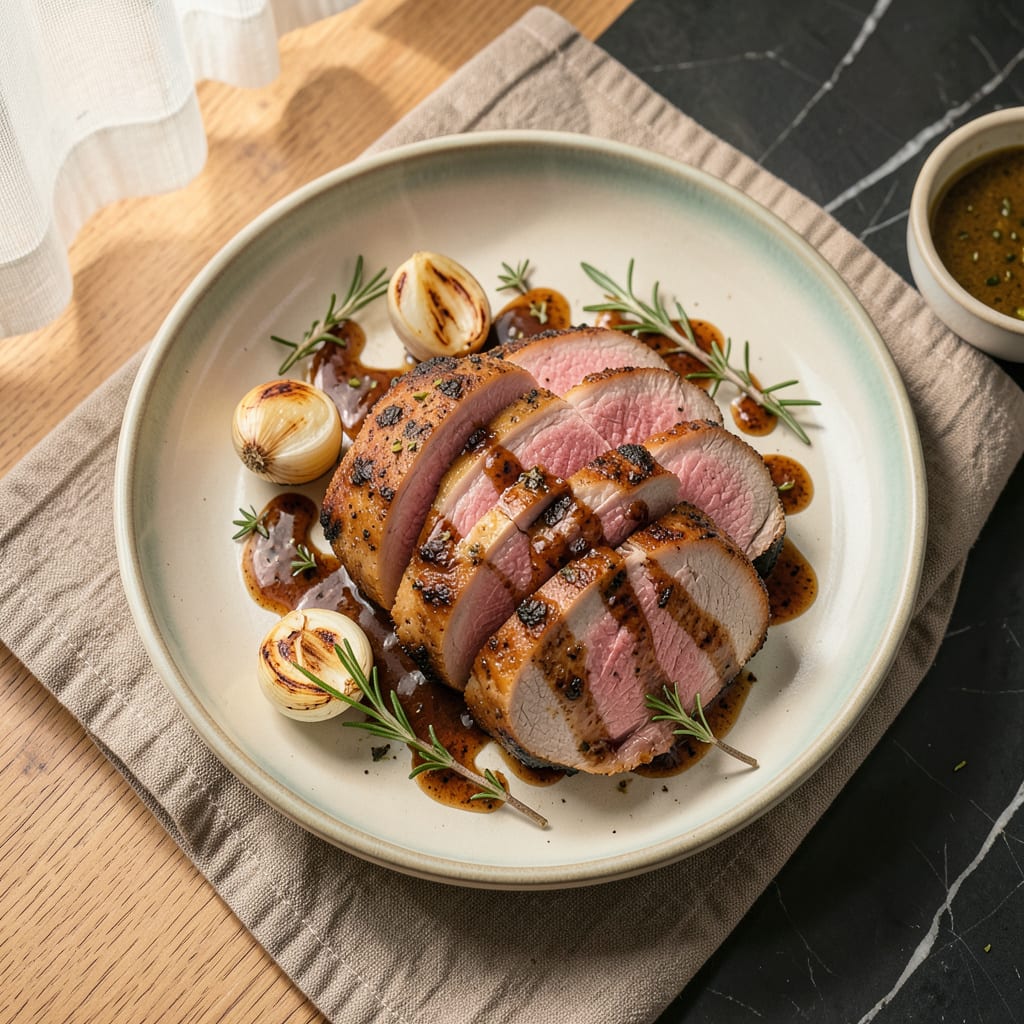
Achieving perfectly roasted pork tenderloin—juicy inside with a flavorful herb crust—requires just 30 minutes and a few precise techniques. This lean cut cooks quickly but demands careful temperature control to prevent dryness while ensuring tender, restaurant-quality results every time.
The method combines high-heat searing for caramelization with gentle finishing at 375°F, creating an ideal balance between crisp exterior and moist interior. A simple herb rub transforms the pork into a centerpiece dish worthy of special occasions, yet remains effortless enough for weeknight dinners. The key lies in proper resting before carving to preserve those coveted juices.
Ingredients for Recipe Roasted Pork Tenderloin
Twelve precision ingredients transform lean pork tenderloin into a restaurant-quality centerpiece with herbaceous depth and juicy texture.
| Ingredient | Amount | Notes |
|---|---|---|
| Pork Tenderloin 🥩 | 1 ½ lb | Trimmed of silver skin |
| Extra-Virgin Olive Oil 🫒 | 2 tbsp | Divided for searing and rub |
| Kosher Salt 🧂 | 1 ½ tsp | Diamond Crystal preferred |
| Freshly Ground Black Pepper 🌶️ | 1 tsp | Coarse grind optimal |
| Fresh Rosemary 🌿 | 2 tbsp | Finely chopped leaves only |
| Fresh Thyme 🍃 | 1 ½ tbsp | Leaves stripped from stems |
| Garlic Cloves 🧄 | 4 cloves | Minced to fine paste |
| Dijon Mustard 🟡 | 1 ½ tbsp | Smooth, not grainy variety |
| Dried Oregano 🌿 | 1 tsp | Mediterranean origin preferred |
| Smoked Paprika 🌶️ | 1 tsp | Spanish pimentón ideal |
| Unsalted Butter 🧈 | 1 tbsp | For finishing baste |
| Fresh Parsley 🌿 | ¼ cup | Chopped, for garnish |
The pork tenderloin quality is paramount for achieving the promised tender, juicy results. Optimal selection requires 1.5 lb cuts with minimal silver skin (trim any remaining yourself). Whole Foods and Costco consistently offer superior marbling compared to standard supermarket options. For the herb components, fresh rosemary and thyme must exhibit vibrant green coloration without woody stems—indicators of peak freshness essential for flavor development during the high-heat searing process described in the introduction.
Substitutions demand careful consideration to maintain the recipe’s precision balance. Dried thyme or rosemary at one-third the quantity may be used when fresh is unavailable, though flavor intensity will diminish. The Dijon mustard cannot be replaced with yellow mustard—its acidity and complexity are critical for crust formation. For dietary adaptations, ghee substitutes effectively for butter in the finishing baste, while avocado oil may replace olive oil at a 1:1 ratio without compromising sear quality.
Storage protocols ensure ingredient integrity for optimal execution. The pork tenderloin maintains quality for 2-3 days refrigerated or 6 months vacuum-sealed and frozen. Fresh herbs require damp paper towel wrapping and refrigerator storage, retaining potency for 5-7 days. Prepared herb rub components may be combined and refrigerated for 24 hours prior to use, though garlic’s pungency intensifies over time—adjust quantities accordingly if pre-mixing.
Why You’ll Love This Recipe
- Between us, this is my 5: 30 PM panic dinner. Twenty minutes of active time (mostly just patting the pork dry and chopping rosemary), then the oven does the work while I throw together a salad. One pan, one knife, and zero regrets.
- Five-Ingredient Magic: Honestly, I love recipes where I don’t have to dig through my spice drawer. Just pork, good olive oil, salt, pepper, and rosemary—no measuring cups, no fuss. The rosemary does most of the heavy lifting while the oven handles the rest.
- Crispy Outside, Juicy Inside: Here’s what sold me—the way the high heat transforms that tenderloin. The outside gets this golden, slightly crackly crust from the salt and olive oil, but inside? It’s so tender it practically falls apart when you slice it. (Yes, even if you overcook it by 2 minutes.)
- My Go-To Company Dish: I’ve served this to my in-laws, my book club, and even my picky nephew. It looks impressive on a platter with barely any effort, and the leftovers—if there are any—make killer sandwiches the next day. No stress, all praise.
Step-by-Step Instructions for Roasted Pork Tenderloin
This method delivers perfectly juicy pork with a fragrant herb crust in just thirty minutes.
Step 1: Prepare the Herb and Spice Rub
In a small bowl, combine the 1.5 tablespoons Dijon mustard, 2 tablespoons fresh rosemary, 1.5 tablespoons fresh thyme, 4 cloves minced garlic, 1 teaspoon dried oregano, and 1 teaspoon smoked paprika. The mustard acts as both a binder and flavor enhancer, while the fresh herbs provide aromatic complexity. Stir until you achieve a uniform paste with no dry spots remaining.
This rub should be thick enough to cling to the pork but not so dry that it won’t adhere. The smoked paprika adds depth without overpowering the fresh herb notes. Set aside while you prepare the pork tenderloin for maximum flavor penetration.
Step 2: Sear the Pork Tenderloin for Crust Development
Pat the 1.5 lb pork tenderloin completely dry with paper towels—this ensures proper browning. Season all sides with the 1.5 teaspoons kosher salt and 1 teaspoon freshly ground black pepper. Heat 1 tablespoon extra-virgin olive oil in an oven-safe skillet over medium-high heat until shimmering but not smoking.
Add the pork and sear for 2-3 minutes per side until you achieve a golden-brown crust. The tenderloin should release easily from the pan when properly seared. Don’t move it prematurely or you’ll prevent proper crust formation. Transfer to a plate temporarily while you prepare the pan for roasting.
Step 3: Apply Rub and Begin Roasting
Reduce oven temperature to 400°F. Brush the seared tenderloin with the prepared herb rub, coating all sides completely. The mustard in the rub will help the herbs adhere while creating a flavorful crust during roasting. Return the pork to the skillet, adding the remaining 1 tablespoon extra-virgin olive oil to the pan.
Place the skillet in the preheated oven and roast for 12-15 minutes. The pork is ready when it reaches an internal temperature of 145°F in the thickest part. You’ll notice the herbs becoming fragrant and slightly crisped when properly done. Avoid overcooking—pork tenderloin becomes dry quickly beyond this temperature.
Step 4: Baste and Rest for Optimal Juiciness
Remove the skillet from the oven and transfer the pork to a cutting board. Add the 1 tablespoon unsalted butter to the hot skillet and swirl until melted. Spoon this herbed butter over the pork tenderloin repeatedly for 1 minute—this basting step adds richness and enhances the herb crust.
Tent the pork loosely with foil and let rest for 10 minutes before slicing. This resting period allows the juices to redistribute throughout the meat. Slice against the grain into ½-inch thick medallions. The interior should be slightly pink and moist, not dry or gray.
Step 5: Garnish and Serve Immediately
Arrange the sliced pork on a serving platter and spoon any accumulated pan juices over the top. Sprinkle with the ¼ cup fresh parsley for a bright finish. The parsley adds freshness that balances the rich, herby flavors of the crust.
Serve immediately while warm. Each slice should have a crisp herb crust exterior with tender, juicy interior. The combination of smoked paprika and fresh herbs creates a complex flavor profile that pairs well with simple sides like roasted vegetables or mashed potatoes.
Troubleshooting recipe roasted pork tenderloin
Dry or Overcooked Pork
If your pork tenderloin turns out dry, it’s almost always because it was overcooked. Remember that pork only needs to reach 145°F internal temperature—any higher and the lean meat loses moisture rapidly. I always use a ThermoWorks Thermapen for instant-read accuracy. If you don’t have a thermometer, pull it when the center feels just slightly firm to the touch, like the base of your thumb when your hand is relaxed. 🌡️
Another common cause is skipping the resting step. That 10-minute rest under foil lets juices redistribute. Slice too soon and they’ll all run out onto your cutting board. I learned this the hard way after ruining my first three attempts!
Herb Crust Not Crispy
For a properly crisped herb crust, your skillet must be ripping hot before adding the pork. Heat the extra-virgin olive oil until it shimmers but doesn’t smoke—this creates the Maillard reaction that develops that golden-brown crust. If your herbs look burnt but the meat isn’t cooked through, your heat was too high during searing.
Also ensure you’re using fresh herbs—dried herbs won’t create the same textured crust. The mustard in the rub acts as a binder, so don’t skip it. I’ve found Grey Poupon Dijon gives the best adhesion and flavor balance for this technique.
Uneven Cooking
Pork tenderloin’s tapered shape means one end cooks faster than the other. To combat this, I tuck the thinner end under itself during searing to create more even thickness. You can also fold it under and secure with a toothpick before roasting. This simple trick prevents the thin end from drying out while waiting for the thicker portion to finish.
If you notice one end cooking too quickly, shield it with a small piece of aluminum foil during the oven phase. Check the temperature in multiple spots—the thickest part is always the last to reach 145°F.
Pork Sticks to Pan
The number one reason pork sticks is moving it too soon during searing. Let it develop a crust for 2-3 minutes per side without disturbing it. The meat will release naturally when properly browned. If it’s still sticking after 3 minutes, your pan wasn’t hot enough to begin with—remove the pork, let the pan reheat, and try again.
Using the right pan matters too. I swear by my Lodge cast iron skillet for even heat distribution. Stainless steel works well too, but avoid nonstick pans—they can’t reach the high temperatures needed for proper searing.
Bland Flavor Profile
If your pork lacks flavor, it’s usually because the rub didn’t have enough contact time or the herbs weren’t fresh enough. The smoked paprika and fresh rosemary/thyme combination is crucial here. Don’t substitute dried herbs unless absolutely necessary—they lose about 80% of their potency when dried.
For extra depth, let the rubbed pork sit at room temperature for 15-20 minutes before searing. This allows the flavors to penetrate. I also recommend finishing with a squeeze of fresh lemon juice just before serving to brighten all the flavors. ✨
Temperature Fluctuations
Oven temperature swings can ruin your timing. If your oven runs hot (like mine does), start checking at 10 minutes instead of 12. An oven thermometer is the only way to know for sure—I was shocked when I discovered my “375°F” oven was actually running at 400°F!
For electric ovens, avoid opening the door during cooking as it causes temperature drops. With gas ovens, you might need to rotate the pan halfway through for even cooking. The butter baste at the end helps compensate for any minor temperature variations during the roasting process.
Nutrition Facts

- 6 Egg Cake Recipe with Oil: Light as Air With Buttery Moisture - October 4, 2026
- 4 Bean Casserole Recipe: One-Pan Heartiness With Smoky Paprika Depth - October 4, 2026
- 3-Ingredient Keto Mug Cake Recipe: Microwave Magic in 2 Minutes - October 4, 2026