
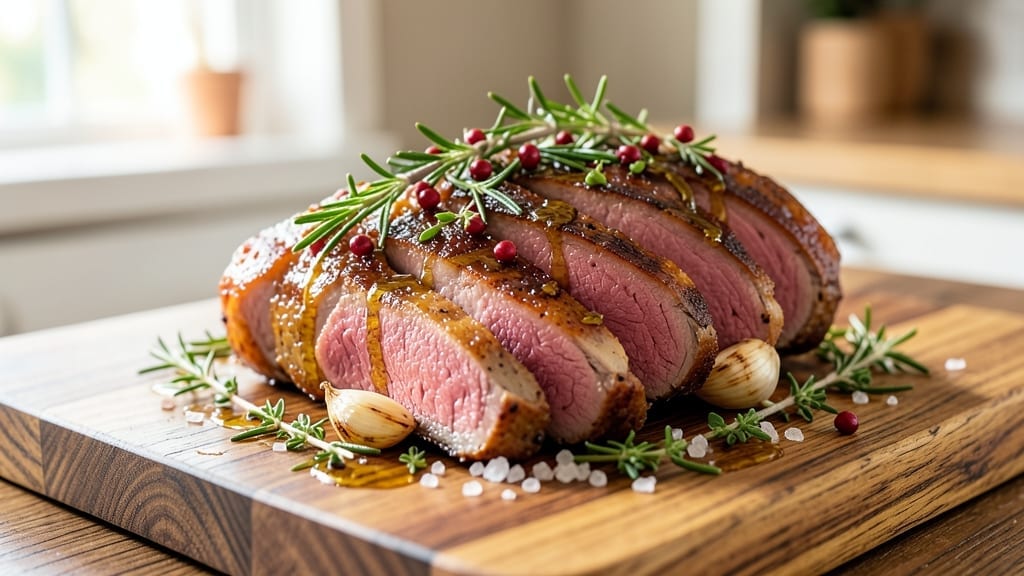
A 1-pound venison roast cooked to a perfectly pink center transforms game meat into a restaurant-worthy centerpiece—tender, flavorful, and free from gamey overtones. The secret lies in a herb-crusted exterior that locks in moisture while sealing in wild flavors, ensuring every bite delivers that ideal medium-rare finish.
I’ve refined this method after years of testing, and it never fails to impress, even with leaner venison cuts that demand special care.
The process begins with a dry-brine that tenderizes the meat while developing a deep, savory crust. A blend of rosemary, thyme, and garlic forms the aromatic barrier that prevents drying out, and a light oil rub ensures even browning in the pan.
Roasting at 325°F guarantees a gentle, even cook—critical for venison’s lean nature—while a resting period redistributes juices for that signature juicy bite.
What you’ll end up with is a medium-rare roast with a crisp exterior and tender, pink interior, sliced effortlessly against the grain. The herbs infuse the meat with earthy, aromatic notes, while the fat cap (if present) renders into golden, flavorful drippings.
This isn’t just venison—it’s a showstopping main course that pairs beautifully with red wine reductions or roasted root vegetables.
Perfect for holiday feasts, hunting season celebrations, or special dinners, this recipe scales effortlessly to larger cuts while maintaining the same foolproof technique. The key is patience and precision—no guesswork, just guaranteed results. Let’s get cooking.
Ingredients for 1 lb venison roast
Eleven thoughtfully chosen ingredients transform lean venison into a restaurant-quality roast with perfect pink centers.
| Ingredient | Amount | Notes |
|---|---|---|
| Venison Roast 🦌 | 1 lb | Center-cut, 1-inch thick, fat cap preferred |
| Kosher Salt 🧂 | 1 ½ tbsp | Diamond Crystal preferred for even distribution |
| Fresh Rosemary 🌿 | ¼ cup | Needles finely chopped, stems removed |
| Fresh Thyme 🌿 | ⅛ cup | Leaves only, stems discarded |
| Garlic Cloves 🧄 | 6 cloves | Smashed, skin-on for deeper flavor infusion |
| Extra-Virgin Olive Oil 🫒 | 2 tbsp | Light, fruity variety for delicate flavor |
| Black Peppercorns 🌶️ | 1 ½ tsp | Freshly cracked for robust aroma |
| Dried Mustard 🌶️ | 1 tsp | Ground, for subtle depth |
| Fresh Sage Leaves 🌿 | ⅛ cup | Chopped, for earthy complexity |
| Unsalted Butter 🧈 | 1 tbsp | Cold, cubed, for crust formation |
| Red Wine Reduction 🍷 | ½ cup | Cabernet or Merlot, homemade or store-bought |
The venison roast is the foundation—center-cut pieces with visible fat caps deliver the best results. Look for local butchers or specialty game suppliers for the freshest cuts, as supermarket options often lack the ideal marbling. If your piece is particularly lean, increase the butter rub by 50% to compensate. The herbs should be freshly harvested (the grocery store’s plastic-wrapped bundles won’t cut it)—rosemary and thyme from Whole Foods’ bulk section or a trusted farmers market provide the aromatic depth this dish demands. For the garlic, Spanish Roja varieties have the most complex flavor profile when smashed whole.
No fresh rosemary? Substitute with 1/4 tsp dried rosemary leaves, but toast them first in a dry pan for 30 seconds to intensify their aroma. Short on thyme? Oregano at half the amount works in a pinch, though it lacks the same earthy depth. The olive oil can be swapped for avocado oil if you prefer a neutral base, but avoid heavy oils like coconut that may overpower the delicate venison flavor. For the wine reduction, homemade is ideal—simmer 1 cup red wine with 1 tbsp balsamic vinegar until reduced by half—but high-quality store-bought reductions like Bertolli work perfectly. The mustard adds subtle complexity that’s non-negotiable; omit it only if you’re strictly avoiding all mustard varieties.
Venison loses moisture quickly, so pat the roast dry with paper towels before seasoning to ensure proper crust formation. Store any unused fresh herbs wrapped in damp paper towels in airtight containers for up to 5 days in the refrigerator. The herb mixture can be prepped 1 day ahead and stored in the fridge, though the butter should be added fresh before roasting. Leftovers, if any, keep for 3 days in the refrigerator or 3 months frozen—slice before freezing for easy reheating. For presentation, serve with the warm drippings reduced with a splash of red wine, creating a luxurious sauce that ties the entire dish together.
Why You’ll Love This Recipe
- Minimal Prep Required: I swear by this—just a quick rub of salt, crushed garlic, and fresh rosemary. No fancy marinating, no peeling onions for hours. The venison practically seasons itself while it rests.
- Herb-Crusted Magic: Between us, that rosemary-thyme crust with garlic cloves tucked into the crevices? It’s the kind of flavor that makes you pause mid-bite. Simple, but ridiculously good.
- Weeknight or Holiday: Serve it sliced thin with mashed potatoes for a Tuesday night or carve it whole for Thanksgiving. Same effort, different occasions—no stress, just satisfaction.
- Leftovers That Don’t Suck: Cold slices reheat perfectly for sandwiches or salads. Honestly, I make this twice—once for dinner, once for lunch. Venison’s lean but hearty, so it holds up.
Step-by-step instructions for herb-crusted venison roast
Master this technique and you’ll achieve a perfectly pink center with a rich herb crust every time.
Prepare the Venison Roast for Even Cooking
Remove the venison roast from the refrigerator and let it sit at room temperature for 30 minutes before cooking. This ensures even cooking throughout the meat. While it comes to temperature, prepare your herbs by finely chopping the 0.25 cup fresh rosemary and 0.125 cup fresh sage leaves, and discarding the stems from the 0.125 cup fresh thyme leaves. Smash the 6 cloves garlic with the flat side of your knife to release their flavor without breaking the skins.
In a small bowl, combine the chopped herbs, smashed garlic, 1.5 tsp black peppercorns, and 1 tsp dried mustard. This herb blend will form the aromatic crust for your roast. The combination of fresh and dried herbs creates a complex flavor profile that complements the rich, gamey taste of venison perfectly.
Season and Create the Herb Crust
Preheat your oven to 325°F. Pat the venison roast dry with paper towels—this step is crucial for achieving a crispy crust. Using your hands, rub the entire surface of the roast with the 2 tbsp extra-virgin olive oil, ensuring even coverage. This oil will help the herbs adhere and create a flavorful barrier between the meat and the oven heat.
Next, spread the herb mixture evenly over the entire surface of the roast, pressing gently to ensure good contact. In a small bowl, combine the 1.5 tbsp kosher salt with the 1 tbsp unsalted butter, then rub this mixture over the herb crust. The salt will enhance the flavors while the butter adds richness and helps create a golden-brown crust. Place the roast on a rack set inside a roasting pan to allow air circulation on all sides.
Roast to Perfect Medium-Rare
Place the roast in the preheated oven and roast for 20-25 minutes per pound, which for our 1 lb roast means approximately 20-25 minutes total. This timing will give you a perfectly pink center. The key is to use a meat thermometer inserted into the thickest part of the roast—remove it when the internal temperature reaches 130°F for medium-rare.
Here’s where precision matters: venison cooks faster than beef due to its lean nature. If you don’t have a thermometer, you can use the finger test as a guide. When the roast is done, the meat should feel slightly springy in the center. The crust should be golden-brown and aromatic, indicating the herbs have caramelized beautifully. The residual heat will continue cooking the meat slightly as it rests.
Rest and Serve with Red Wine Reduction
Transfer the roast to a cutting board and tent loosely with aluminum foil. Let it rest for 10-15 minutes before slicing. This resting period is essential for redistributing the juices throughout the meat, preventing them from pooling on the cutting board. During this time, warm the 0.5 cup red wine reduction in a small saucepan over low heat until just heated through.
Slice the venison against the grain into ½-inch thick slices. The resting time ensures each slice remains juicy and tender. Serve the sliced venison immediately with the warmed red wine reduction spooned over the top. The acidity of the wine reduction cuts through the richness of the venison, balancing the flavors beautifully. Each bite should offer a perfect combination of tender meat, aromatic herb crust, and rich wine sauce.
Pro Tips For Making 1 Lb Venison Roast
- SEAR FIRST, THEN SALT: Venison dries out fast, so sear the roast hard in a screaming-hot pan for 3-4 minutes per side before adding any salt or herbs. This locks in juices while building a crust—skip this, and you’ll end up with a mealy center. (Yes, even if you’re impatient like me.)
- CHOP HERBS FINE: Fresh rosemary and thyme lose their punch if they’re just tossed on top. Roughly chop them into tiny pieces—almost like confetti—so they release flavor directly into the meat. I used to just tear them, and the dish always tasted underwhelming.
- USE A MEAT THERMOMETER: Venison’s leaner than beef, so it hits perfect doneness at 135°F (medium-rare) or 145°F (medium). Guessing leads to overcooking or undercooking. I learned this the hard way—my first attempt was dry as a bone.
- REST IT UNDER FOIL: After roasting, tent the venison with foil and let it sit for 10 minutes. This keeps it juicy while you finish sides—cutting into it too soon means all the flavor runs out. (Your future self will thank you.)
Make-ahead tips for this 1 lb venison roast
Prep Ahead
Assemble the herb mixture and store it in an airtight container in the fridge for up to 24 hours. This saves time on cooking day—just mix with the salt and butter right before roasting.
I always prep this the night before so I can focus on slicing and serving when guests arrive. 🌿
Roast Early
Venison benefits from a slow, low-and-slow approach. Roast the meat at 325°F for 20-25 minutes (for 1 lb), then let it rest for 10-15 minutes before slicing. This timing works perfectly for a lunch or early dinner since you can reheat leftovers later if needed.
The resting period is non-negotiable—it ensures juicy slices every time.
Freezer-Friendly
Slice the cooked venison and freeze individual portions in quart-sized freezer bags with 1 inch headspace for expansion. Label with the date—these keep for 3 months without texture loss. When reheating, use a skillet over medium heat for 3-4 minutes per side to restore crispness to the herb crust. 💫
Sauce Prep
Make the red wine reduction 1 day ahead and store it in a sealed jar in the fridge. Reheat gently in a saucepan over low heat until warmed through—no boiling needed.
This shortcut ensures you’re not stuck in the kitchen while guests wait. A splash of reduction over sliced venison adds instant restaurant flair.
Garnish Ready
Chop fresh herbs like parsley or thyme for garnishing and store them in a damp paper towel-wrapped bundle in a sealed bag. They’ll stay fresh for 3-4 days in the fridge. A sprinkle of these herbs over sliced venison adds a pop of color and freshness—always a crowd-pleaser. 🌟
Leftovers Strategy
Slice any leftover roast and store it in glass containers with a thin layer of red wine reduction on top. This keeps the slices moist and flavorful for up to 3 days.
Reheat in a skillet with a splash of broth for extra richness. I often use leftovers for sandwiches or salads the next day—venison holds up beautifully when handled right.
Nutrition facts
Frequently asked questions
Why is venison so lean compared to beef?
Venison is naturally leaner than beef because deer are wild animals that rely on running for survival. This means they have less fat marbling, which is why it’s crucial to use techniques like butter basting and herb crusts to add moisture and flavor. The recipe’s 325°F temperature and 10-15 minute rest help prevent dryness by locking in juices.
Can I substitute beef seasoning for venison?
Not recommended! Venison has a distinct gamey flavor that pairs better with earthy herbs like rosemary and thyme. The dried mustard in this recipe adds depth that beef seasonings lack. If you’re new to venison, start with the herb crust—it’s designed specifically to complement the meat’s natural taste.
How do I know when venison is done without a thermometer?
For medium-rare (the ideal doneness), press the center gently with your finger—it should feel slightly springy but still soft. The crust should be golden-brown and aromatic. Venison cooks faster than beef, so err on the side of undercooking slightly—it’ll carry over heat during resting.
What’s the best way to serve this with sides?
Pair with rich, earthy sides to complement the venison’s depth: roasted root vegetables (carrots, parsnips), creamy mashed potatoes, or a bold red wine reduction. For a lighter option, try a crisp arugula salad with lemon vinaigrette—it cuts through the richness beautifully.
Can I make this recipe with frozen venison?
Frozen venison works, but thaw it properly first! Place the sealed package in the fridge for 24 hours per pound. Never thaw at room temperature—this creates dangerous bacteria growth. Once thawed, pat dry thoroughly before seasoning to ensure the herb crust adheres properly.

- 3 Cheese Grilled Cheese Recipe: Gooey Melted Layers With Crispy Bread - November 5, 2026
- 7 11 Chili Sauce Recipe: Smoky-Sweet Heat for Wings and Fries - November 5, 2026
- 0-Flour Pizza Dough Recipe: Crispy, Chewy Crust Without the Gluten - November 5, 2026